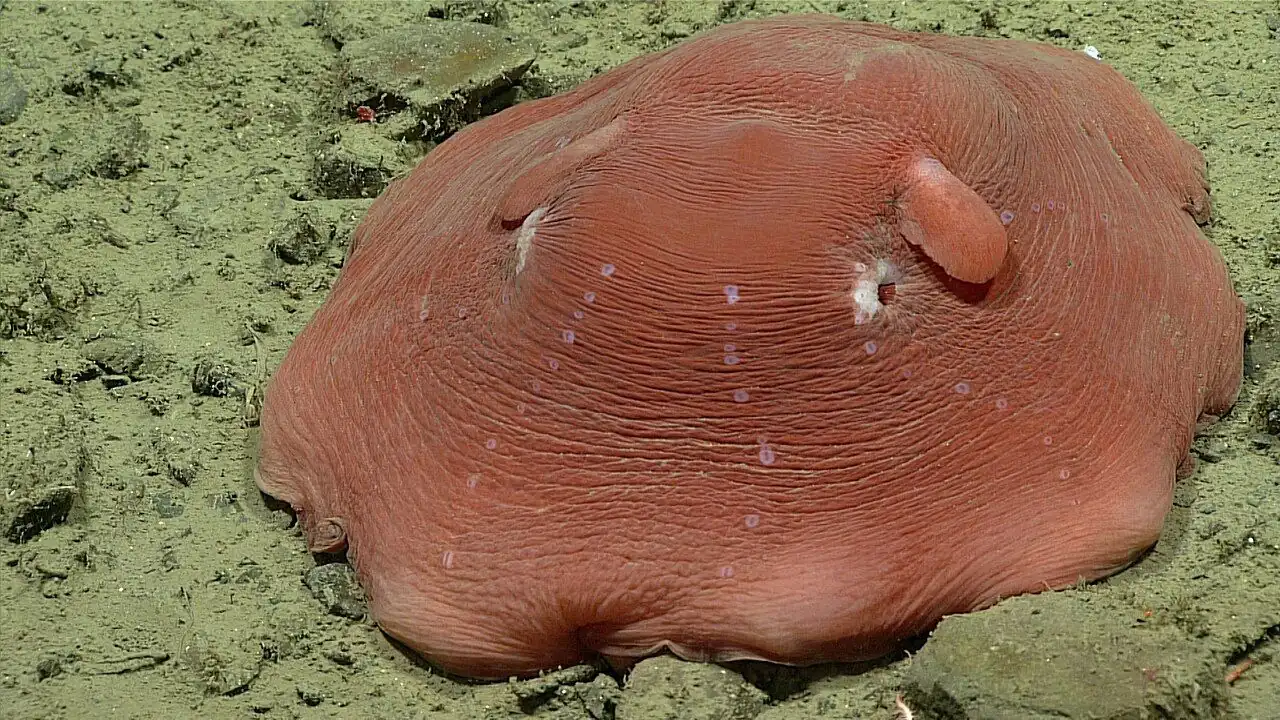
Flapjack Octopus
Family Opisthoteuthidae (Opisthoteuthis, Insigniteuthis and Exsuperoteuthis)
Small deep-sea octopuses that flatten into pancakes on the mud and swim by flapping two stubby fins.
Photo: NOAA Ocean Exploration / Public domain
3 things to know
- When startled, it swims off by flapping its fins and jetting water from its funnel.
- The name Opisthoteuthis adorabilis, floated in 2015 for the Monterey Bay species, was never formally published.
- Females appear to release their eggs one at a time over a long breeding period.
- Scientific name
- Family Opisthoteuthidae (Opisthoteuthis, Insigniteuthis and Exsuperoteuthis)
- Depth
- 130 m – 2,350 m
427 – 7,710 ft - Size
- Up to about 50 cm (20 in); Monterey Bay animals about 8 cm (3 in) across
- Weight
- Not well known
- Lifespan
- Not well known
- Diet
- Small worms, crustaceans and other small invertebrates
- Where
- On and near deep seafloors worldwide
- IUCN status
- Varies by species (Data Deficient where checked)
- Depth zones
- Sunlight · Twilight · Midnight
Resting on the mud, a flapjack octopus spreads into a flat orange disk, like a fluffy pancake in MBARI's description. When a predator startles it, the octopus perks up and swims off by flapping two stubby fins and jetting water through its funnel. When the coast is clear, it spreads its webbed arms and parachutes back to the bottom.
Flapjacks are finned deep-sea octopuses in the suborder Cirrata, the same broad group as the dumbo octopuses, with a very short, dome-like mantle, fins near its tip and large eyes. MBARI lists them worldwide, on and near the seafloor, from 130 to 2,350 meters (430 to 7,710 feet) down. They eat small worms, crustaceans and other invertebrates; one Indonesian specimen examined by Eric Hochberg had tiny crustaceans and bristle-worm bristles in its gut. The largest reach about 50 centimeters (20 inches).
Naming them has proved hard. All flapjacks were once placed in the genus Opisthoteuthis, until Tristan Verhoeff split the family, Opisthoteuthidae, into three genera in 2024, based on the enlarged suckers of males. In 2025 he wrote that the North Pacific species are greatly confused. Monterey Bay's flapjack shows why. In July 2015, MBARI postdoctoral fellow Stephanie Bush and a Monterey Bay Aquarium team used the remotely operated vehicle Ventana to collect five, each about 8 centimeters (3 inches) across, to describe a new species and to display at the aquarium. Bush floated the name Opisthoteuthis adorabilis for it, but the World Register of Marine Species lists that name as a nomen nudum, one never formally published. Verhoeff treats the long-known North Pacific species O. californiana as a synonym of albatrossi, which he places, tentatively, in his new genus Insigniteuthis.
Flapjacks appear to spawn continuously, releasing eggs one at a time over a breeding period that takes up most of their lives, Verhoeff notes from earlier studies. How long they live is not known. Most species are poorly studied: the IUCN lists O. californiana, whose range includes US waters, and O. agassizii as Data Deficient, from 2014 assessments.
Sources
- mbari.org/animal/flapjack-octopus
- mbari.org/news/finding-opisthoteuthis
- cbsnews.com/news/pac-man-ghost-octopus-could-be-named-opisthoteuthis-adorabilis
- Study: doi:10.54102/ajt.c46g9
- marinespecies.org/aphia.php
- marinespecies.org/aphia.php
- sealifebase.se/summary/Opisthoteuthis-californiana.html
- iucnredlist.org/species/163065/968048
- iucnredlist.org/species/163377/1003617



