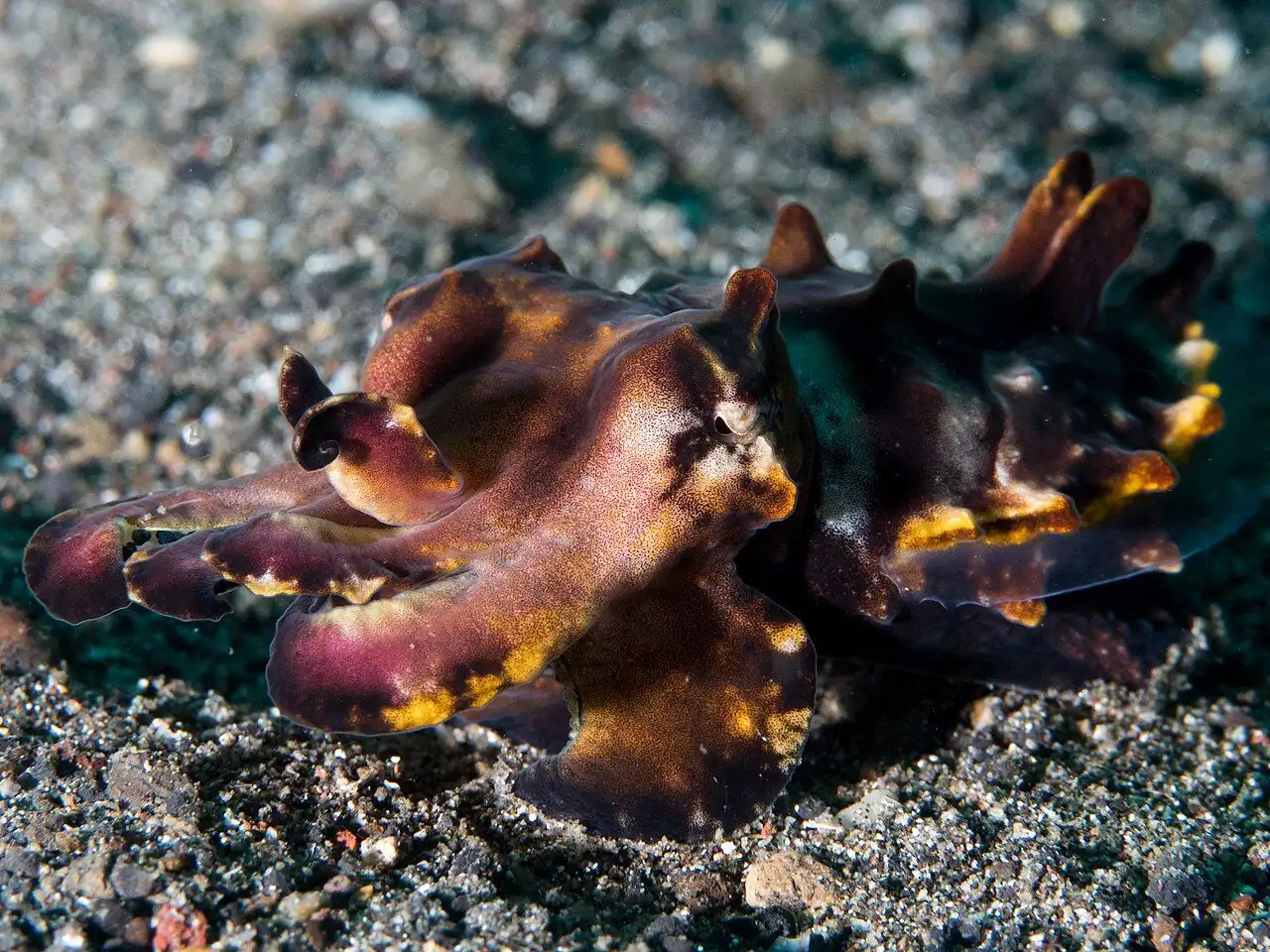
Flamboyant Cuttlefish
Ascarosepion pfefferi (formerly Metasepia pfefferi)
A small Indo-Pacific cuttlefish that walks across the seafloor and flashes bright colors when its camouflage fails.
Photo: Rickard Zerpe / CC BY 2.0
3 things to know
- It walks on two arms and two flaps of its mantle more than it swims.
- Its cuttlebone is small and narrow for its body size.
- A 2023 study moved it from the genus Metasepia to Ascarosepion.
- Scientific name
- Ascarosepion pfefferi (formerly Metasepia pfefferi)
- Depth
- 3 m – 86 m
10 – 282 ft - Size
- Mantle up to about 6 cm (2.4 in) long
- Weight
- Not well known
- Lifespan
- About 18–24 months
- Diet
- Crustaceans and small fishes
- Where
- Northern Australia, southern New Guinea and Indonesia; also reported from the Philippines and Malaysia
- IUCN status
- Data Deficient
- Depth zones
- Sunlight
Barely 6 centimeters (2.4 inches) in mantle length, the flamboyant cuttlefish spends much of its time walking. Bret Grasse, who managed the cephalopods in the Monterey Bay Aquarium's "Tentacles" exhibit, told Science Friday in 2016 that it lumbers along on four appendages: two large arms and parts of its mantle, extended to look like a pair of legs. He suggested a reason. Cuttlefish adjust their buoyancy by filling chambers in their cuttlebone, a chalky internal shell, with gas or liquid, and this species' cuttlebone is small and narrow for its body. Mark Norman of Museum Victoria has described them flapping up into the water, settling down and going back to walking.
It lives on sand and mud from about 3 to 86 meters (10 to 280 feet) deep, across northern Australia from Shark Bay to Mooloolaba, in southern New Guinea and Indonesia, with reports from the Philippines and Malaysia. Unlike most cephalopods, it hunts by day, taking crustaceans and small fishes.
The colors are a backup plan. Roger Hanlon of the Marine Biological Laboratory in Woods Hole told Science Friday that in the wild it is usually so well camouflaged it is almost impossible to find. When camouflage fails, it flashes reds, pinks, yellows, whites and blacks to startle a predator, with dark bands rippling across its body; those moving bands also play a part in courtship.
Whether it is poisonous is less settled than many sources suggest. The Monterey Bay Aquarium's species page calls it highly poisonous and the only cuttlefish known to be toxic. Science Friday reported in 2016 that no published study had yet tested the claim. In preliminary work, Becky Williams of Utah State University Uintah Basin and Christine Bedore of Georgia Southern University found trace amounts of what they suspected was tetrodotoxin, but also in two other cuttlefish species, and predators fed flamboyant cuttlefish showed no ill effects.
A 2023 revision of cuttlefish relationships moved the species from Metasepia to Ascarosepion, and the World Register of Marine Species now lists it under that name. It lives about 18 to 24 months, according to the aquarium. The IUCN lists it as Data Deficient, and bottom trawling that churns up seafloor sediment is among the threats.
Sources
- sciencefriday.com/articles/this-cuttlefish-dazzles
- montereybayaquarium.org/animals/animals-a-to-z/flamboyant-cuttlefish
- australiangeographic.com.au
- sealifebase.se/summary/Metasepia-pfefferi.html
- marinespecies.org/aphia.php
- Study: doi:10.1007/s00227-023-04195-3
- commons.wikimedia.org/wiki/File:Flamboyant_cuttlefish_(Ascarosepion_pfefferi)_(41787075…



