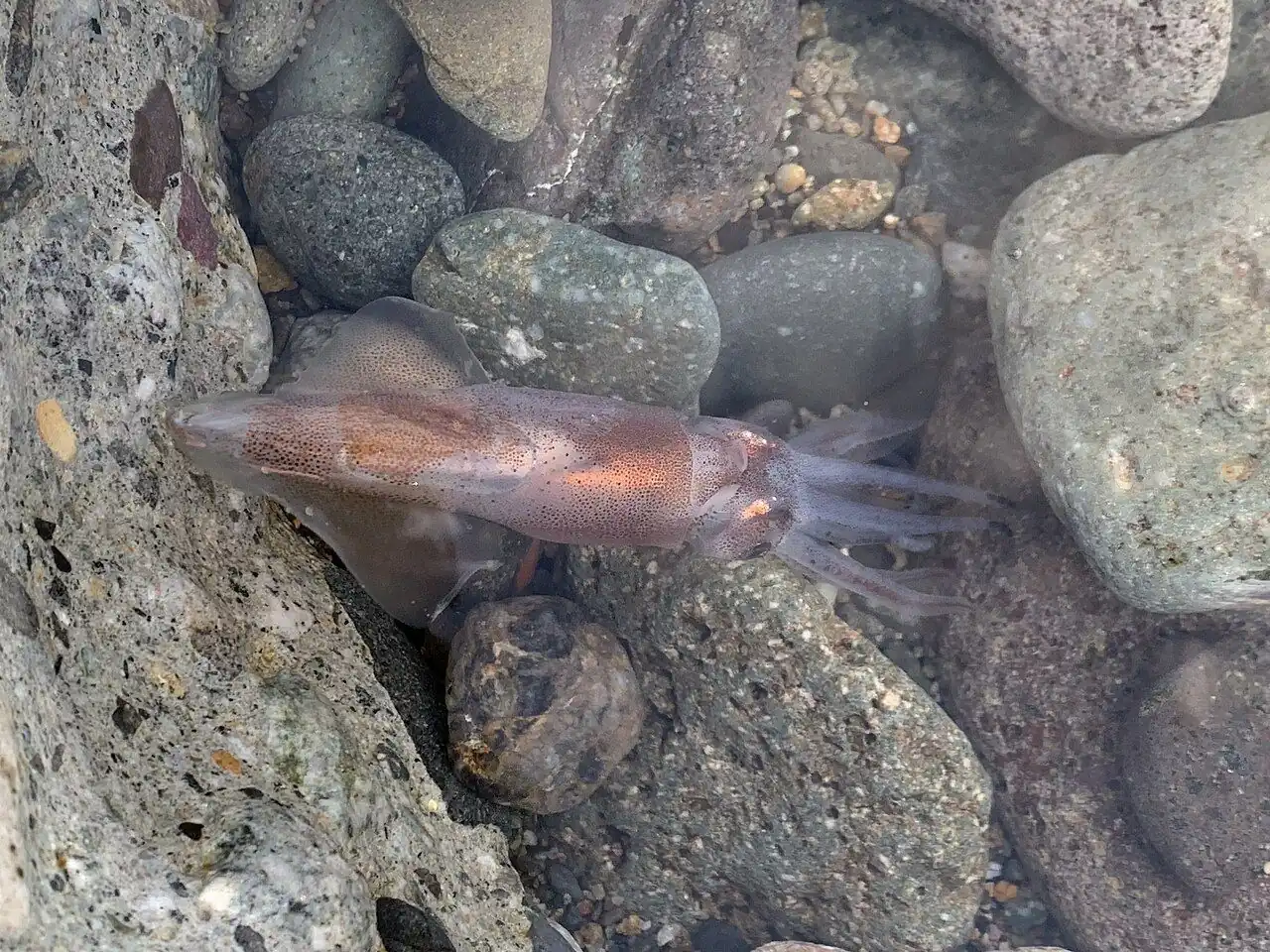
Firefly Squid
Watasenia scintillans
A thumb-sized squid of Japanese waters, studded with light organs and famous for the spring spawning runs of Toyama Bay.
Photo: kamataryo (iNaturalist) / CC0
3 things to know
- Light organs dot its body, with the largest on its tentacle tips and around its eyes.
- In a 2020 study, 18 of 19 females had stored sperm from just one male.
- Adults die after spawning, ending a life of about one year.
- Scientific name
- Watasenia scintillans
- Depth
- 0 m – 600 m
0 – 1,969 ft - Size
- Mantle up to about 7 cm (2.8 in) in females, 6 cm (2.4 in) in males
- Weight
- Not well known
- Lifespan
- About 1 year
- Diet
- Shrimp, crabs, small fish and planktonic crustaceans
- Where
- Northwest Pacific off Japan and Korea
- IUCN status
- Least Concern
- Depth zones
- Sunlight · Twilight
Firefly squid are small, with a mantle about 6 centimeters (2.4 inches) long in males and 7 centimeters (2.8 inches) in females, and their bodies are dotted with light organs called photophores. According to the University of Michigan's Animal Diversity Web, the largest sit on the tips of the tentacles and around the eyes. The squid flash the tentacle lights to attract prey, especially fish, and use their photophores as camouflage, to frighten predators and to attract mates.
They live off Japan and Korea. By day, adults stay near the seafloor deeper than 200 meters (660 feet), and at night they rise to 50 to 100 meters (160 to 330 feet), where they feed on shrimp, crabs, small fish and plankton.
Their spawning season draws crowds to Toyama Bay in Japan. In spring, females come into shallow water to spawn, sometimes in huge schools along the shore, and the bay's firefly squid fishery traditionally opens on March 1. The Animal Diversity Web notes that the spectacle led to the bay being named a Special Natural Monument and to a museum devoted to the species. The adults die after spawning, ending a life of about a year, and the males vanish from the coast first, living about a month less than the females.
That timing shapes how they mate. In a 2020 study in Scientific Reports, Noriyosi Sato and colleagues genotyped the sperm packets that females store in pouches under the collar of the neck. In 18 of 19 females, every stored packet came from a single male, and all the embryos in a clutch were sired from that stored sperm. Males carried only about 30 sperm packages, enough for two or three matings. Most females, spawning long after the males are gone, rely on sperm from one partner for the whole season.
Their eyes are unusual too. The study notes that the retina holds three visual pigments tuned to slightly different wavelengths, which may let the squid tell the green glow of other firefly squid from the blue light filtering down from above. The IUCN lists the species as Least Concern.



