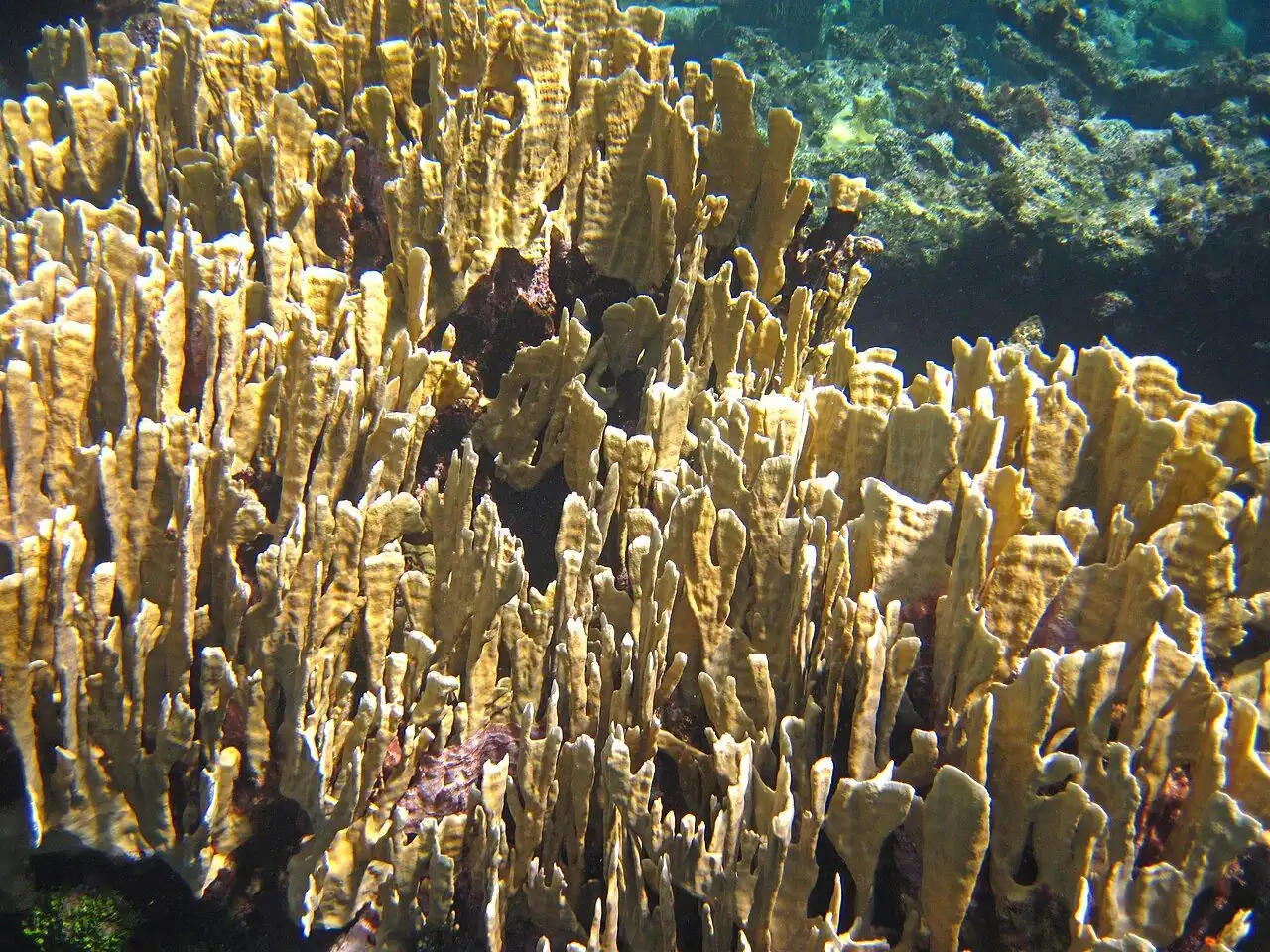
Fire Coral
Millepora spp. (family Milleporidae, class Hydrozoa)
A stinging reef builder that looks like coral but is a hydrozoan, kin to the Portuguese man o' war, and whose Caribbean species are now in steep decline.
Photo: James St. John / CC BY 2.0
3 things to know
- Fire coral is a hydrozoan, more closely related to the Portuguese man o' war than to true reef corals.
- Its colonies bud off tiny swimming medusae, which release the eggs and sperm.
- One species, Millepora boschmai, vanished from Panama after the 1982-83 El Niño.
- Scientific name
- Millepora spp. (family Milleporidae, class Hydrozoa)
- Depth
- 1 m – 40 m
3 – 131 ft - Size
- Varies by species; colonies grow as thin crusts, branching fans or upright blades
- Weight
- Unknown
- Lifespan
- Unknown
- Diet
- Zooplankton caught by stinging polyps, plus food from algae living in their tissues
- Where
- Coral reefs in tropical and subtropical seas worldwide, including the Caribbean and US waters
- IUCN status
- Varies by species (blade fire coral Critically Endangered; branching fire coral Endangered)
- Depth zones
- Sunlight
Brush against fire coral and the sting explains the name. The tan or mustard-yellow growths look like stony coral, but Millepora is a hydrozoan, more closely related to the Portuguese man o' war and other stinging hydroids than to the reef-building corals around it, as the Divers Alert Network explains. Its limestone skeleton is pierced by tiny pores. Short feeding polyps rise from the larger pores, and long, mouthless polyps armed with stinging cells from the smaller ones. Touching them causes a burning feeling that can last for hours, often followed by a rash.
A 2006 review by J. B. Lewis recognized 17 living species. They grow on reefs around the world, at depths of about 1 to 40 meters (3 to 130 feet), as crusts, branching fans or upright blades, and usually cover less than a tenth of a reef's surface. Algae living in their tissues supply part of their food, and the polyps are voracious feeders on zooplankton. Each colony buds off tiny free-swimming medusae, which spend only a short time in the plankton and release eggs and sperm. Broken pieces can also grow into new colonies.
Fire corals bleach in marine heat waves, and they are often among the first to recover after short ones. Millepora boschmai shows how badly a long one can go. In 1991 Wallie de Weerdt and Peter Glynn described it from Panama's Gulf of Chiriquí and reported that it had disappeared after the severe 1982-83 El Niño, which they called the first documented modern extinction of a tropical marine organism from natural causes. Seven more colonies turned up later, but all died in the 1998 El Niño, Zoe Richards of the Western Australian Museum wrote in 2013. Then museum specimens collected in Indonesia turned out to be the same species. The IUCN now lists it as Data Deficient.
The Caribbean species are declining. On the IUCN Red List, blade fire coral (M. complanata) was assessed as Critically Endangered in 2021, and branching fire coral (M. alcicornis), whose range includes US waters, as Endangered in 2024. The threats listed include extreme temperatures, disease, pollution and coastal development. All fire corals are on Appendix II of CITES, which monitors international trade.
Sources
- dan.org/health-medicine/health-resources/diseases-conditions/fire-coral
- biodiversity.org.au/afd/taxa/MILLEPORIDAE
- Study: doi:10.1016/s0065-2881(05)50001-4
- sealifebase.se/summary/Millepora-alcicornis.html
- sealifebase.se/summary/Millepora-complanata.html
- iucnredlist.org/species/133144/254316326
- iucnredlist.org/species/133042/179618755
- iucnredlist.org/species/133300/174746646
- repository.naturalis.nl/pub/318045
- Study: doi:10.1126/science.253.5015.69
- theconversation.com/australian-endangered-species-fire-corals-14273
- speciesplus.net/species



