Finless Porpoise
Neophocaena spp. (two or three species, depending on the authority)
Small Asian porpoises with no dorsal fin that live along shallow coasts and in China's Yangtze River, where one population is slowly recovering.
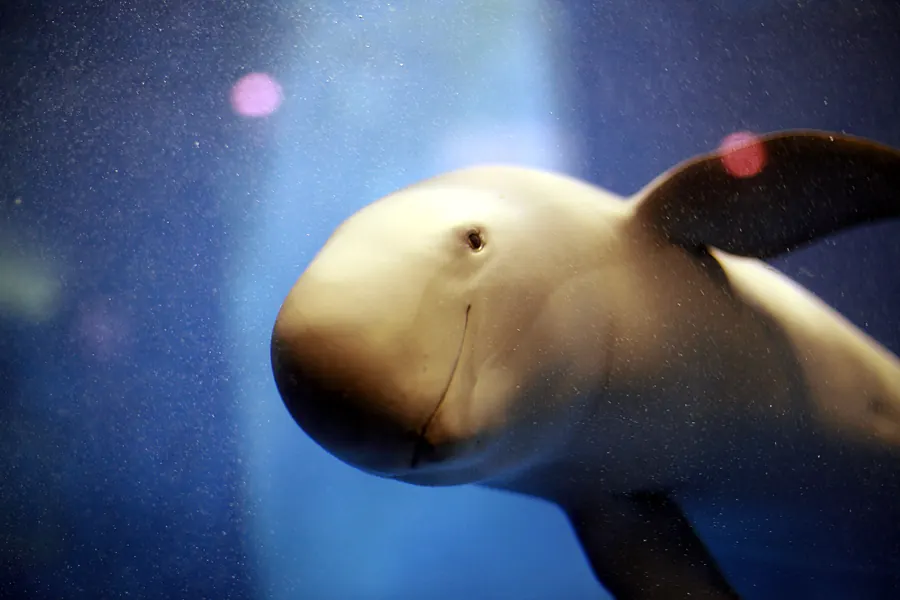
Photo: ori2uru / CC BY 2.0
3 things to know
- In place of a dorsal fin, finless porpoises have a low ridge on the back covered in tiny bumps.
- The oldest finless porpoise recorded in Hong Kong was about 33 years old.
- A survey announced in 2026 counted 1,426 porpoises in the Yangtze River, 177 more than in 2022.
- Scientific name
- Neophocaena spp. (two or three species, depending on the authority)
- Depth
- 0 m – 200 m
0 – 656 ft - Size
- Usually about 1.3–1.7 m (4.3–5.6 ft); the largest on record about 2.27 m (7.4 ft)
- Weight
- About 40–72 kg (90–160 lb)
- Lifespan
- Most reach about 20–25 years; the oldest recorded about 33
- Diet
- Small fish, squid and shrimp
- Where
- Shallow coastal waters of the Indian Ocean and western Pacific, from the Persian Gulf to Japan, and China's Yangtze River and its lakes
- IUCN status
- Varies by species (Indo-Pacific finless porpoise Vulnerable; narrow-ridged finless porpoise Endangered, its Yangtze subspecies Critically Endangered)
- Depth zones
- Sunlight
A finless porpoise has no dorsal fin at all. In its place runs a low ridge of thick skin covered in rows of tiny bumps, and the head is round and beakless with a steep forehead. Adults are plain gray, paler in the sea and nearly black in rivers. The old name "black finless porpoise" comes from a misunderstanding: the skin turns black soon after death.
The name covers more than one species, and the count depends on the authority. The IUCN Red List treats two: the Indo-Pacific finless porpoise (Neophocaena phocaenoides), found from the Persian Gulf to the Taiwan Strait and south to Indonesia, and the narrow-ridged finless porpoise (N. asiaeorientalis) of East Asia. Some taxonomists now split the narrow-ridged group again, into an East Asian species of the Yellow Sea and Japan and the Yangtze finless porpoise, which lives only in China's Yangtze River and its lakes. A 2018 genome study in Nature Communications found the Yangtze animals reproductively isolated, with genetic adaptations to fresh water, and called them an incipient species.
Finless porpoises keep to shallow coasts, bays, estuaries and rivers. In Hong Kong, where the government's Agriculture, Fisheries and Conservation Department studies them, they travel in groups of three or fewer and eat small fish, squid and shrimp, with Loligo squid the most common prey. Calves are about 70 centimeters (28 inches) long at birth and adults grow to about 1.7 meters (5.6 feet); the largest on record reached 2.27 meters (7.4 feet). They mature at 4 to 6 years, and the oldest stranded porpoise found in Hong Kong was about 33.
The 2017 IUCN assessments list both species as decreasing, rating the Indo-Pacific finless porpoise Vulnerable and the narrow-ridged finless porpoise Endangered; a separate 2012 assessment lists the Yangtze subspecies as Critically Endangered. Gillnets and boat strikes kill them, and pollution and dredging also harm them. China banned fishing on the Yangtze for 10 years starting January 1, 2021. On January 30, 2026, the state news agency Xinhua reported a survey count of 1,426 Yangtze finless porpoises, 177 more than in 2022, announced at a press conference that credited the ban.
Sources
- afcd.gov.hk/english/conservation/con_mar/con_mar_fin/con_mar_fin_fin/con_mar_fin_fin_so…
- afcd.gov.hk/english/conservation/con_mar/con_mar_fin/con_mar_fin_fin/con_mar_fin_fin_di…
- animaldiversity.org/accounts/Neophocaena_phocaenoides
- zenodo.org/records/6607561
- en.wikipedia.org/wiki/Finless_porpoise
- en.wikipedia.org/wiki/Indo-Pacific_finless_porpoise
- Study: doi:10.1038/s41467-018-03722-x
- english.news.cn/20260130/96363ed06b9c4d7bad24d6be384ed18d/c.html
- Study: doi:10.2305/IUCN.UK.2017-3.RLTS.T198920A50386795.en
- Study: doi:10.2305/IUCN.UK.2017-3.RLTS.T41754A50381766.en
- Study: doi:10.2305/IUCN.UK.2013-1.RLTS.T43205774A45893487.en



