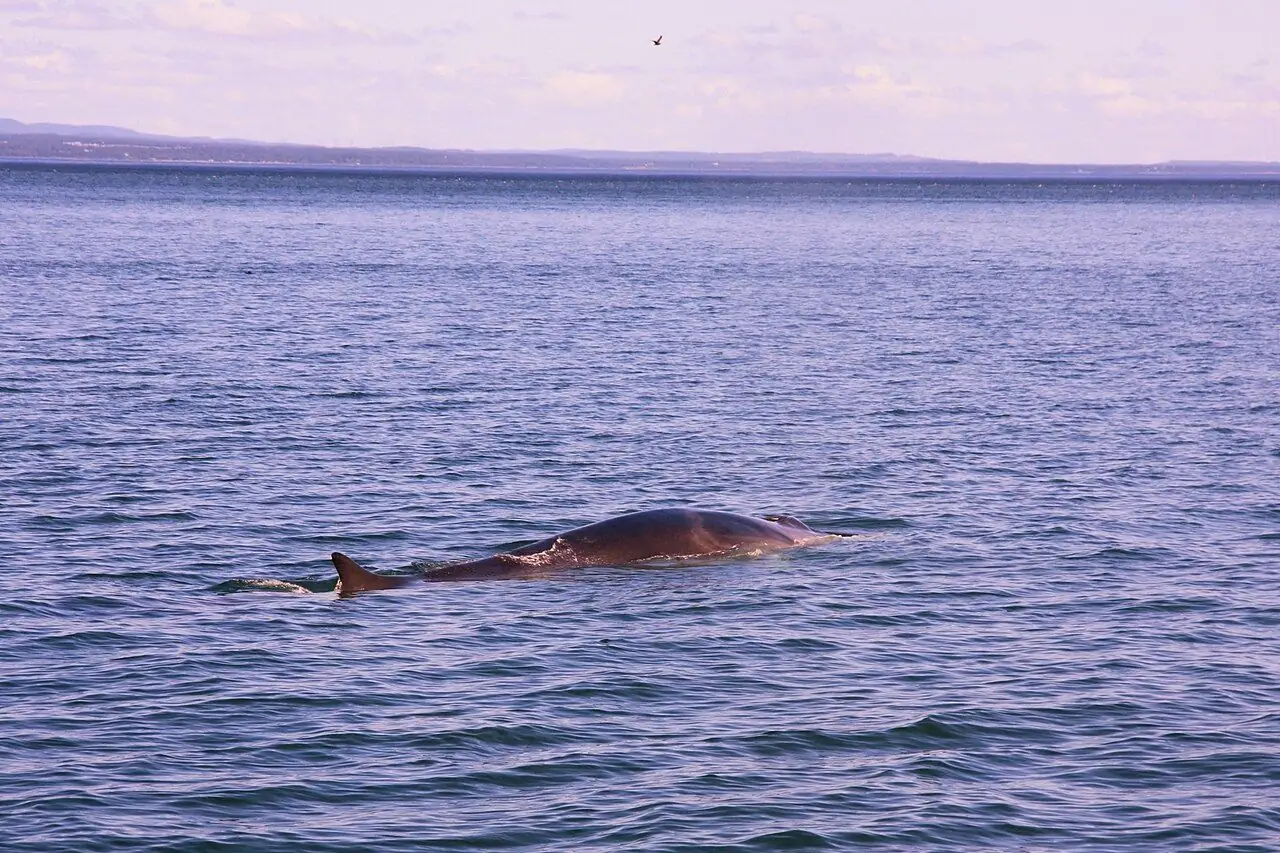
Fin Whale
Balaenoptera physalus
The second-largest animal on Earth, a fast open-ocean whale whose songs are loud enough to probe the rock beneath the seafloor.
Photo: glynniqua / CC BY-SA 2.0
3 things to know
- Only the blue whale is bigger.
- Its lower jaw is dark on the left side and white on the right.
- Whalers killed nearly 725,000 fin whales in the Southern Hemisphere alone.
- Scientific name
- Balaenoptera physalus
- Depth
- 0 m – 470 m
0 – 1,542 ft - Size
- About 23–26 m (75–85 ft) long
- Weight
- About 36–73 metric tons (40–80 US tons)
- Lifespan
- Up to about 90 years
- Diet
- Krill, small schooling fish and squid
- Where
- Deep offshore waters of all major oceans, mostly temperate to polar
- IUCN status
- Vulnerable
- Depth zones
- Sunlight · Twilight
Only the blue whale outweighs the fin whale. Adults reach 23 to 26 meters (75 to 85 feet) and 40 to 80 tons, with a sleek body, a V-shaped head and a tall, hooked fin about two-thirds of the way back. The color is lopsided: the lower jaw is dark on the left side and white on the right, and the tongue is the reverse. Pale V-shaped chevrons behind the head differ from whale to whale, and researchers use them to tell individuals apart.
Fin whales live in deep offshore water in every major ocean, mostly from temperate to polar latitudes. They feed on krill, small schooling fish such as herring, capelin and sand lance, and squid, lunging into a school with the mouth open while 50 to 100 throat pleats balloon out to hold the water. Baleen plates strain the prey, and a single whale can eat up to 2 tons of food a day. In the Mediterranean, Simone Panigada and colleagues fixed depth recorders to fin whales with suction cups and twice logged dives to at least 470 meters (1,540 feet), timed to the late-afternoon rise of the krill they hunt.
Fin whales are fast, and early whalers mostly left them alone. Steam ships and explosive harpoons changed that, and in the mid-1900s the industry killed nearly 725,000 in the Southern Hemisphere alone. Commercial whaling has since ended, and the species is listed as Vulnerable by the IUCN and as endangered under the US Endangered Species Act. Ship strikes are now the main threat, and NOAA ranks fin whales as probably the most vulnerable large whale to collisions after the North Atlantic right whale. Females give birth to a single calf about 5.5 meters (18 feet) long after 11 to 12 months of pregnancy, and the maximum lifespan is about 90 years.
Their songs are among the loudest sounds in the ocean, up to 189 decibels. In 2021 seismologists Václav Kuna of the Czech Academy of Sciences and John Nábělek of Oregon State University reported in Science that one fin whale's songs, picked up by 54 ocean-bottom seismometers in the northeast Pacific, had bounced off layers of rock under the seafloor. The echoes traced sediment 400 to 650 meters thick sitting on 1.8 kilometers of basalt.



