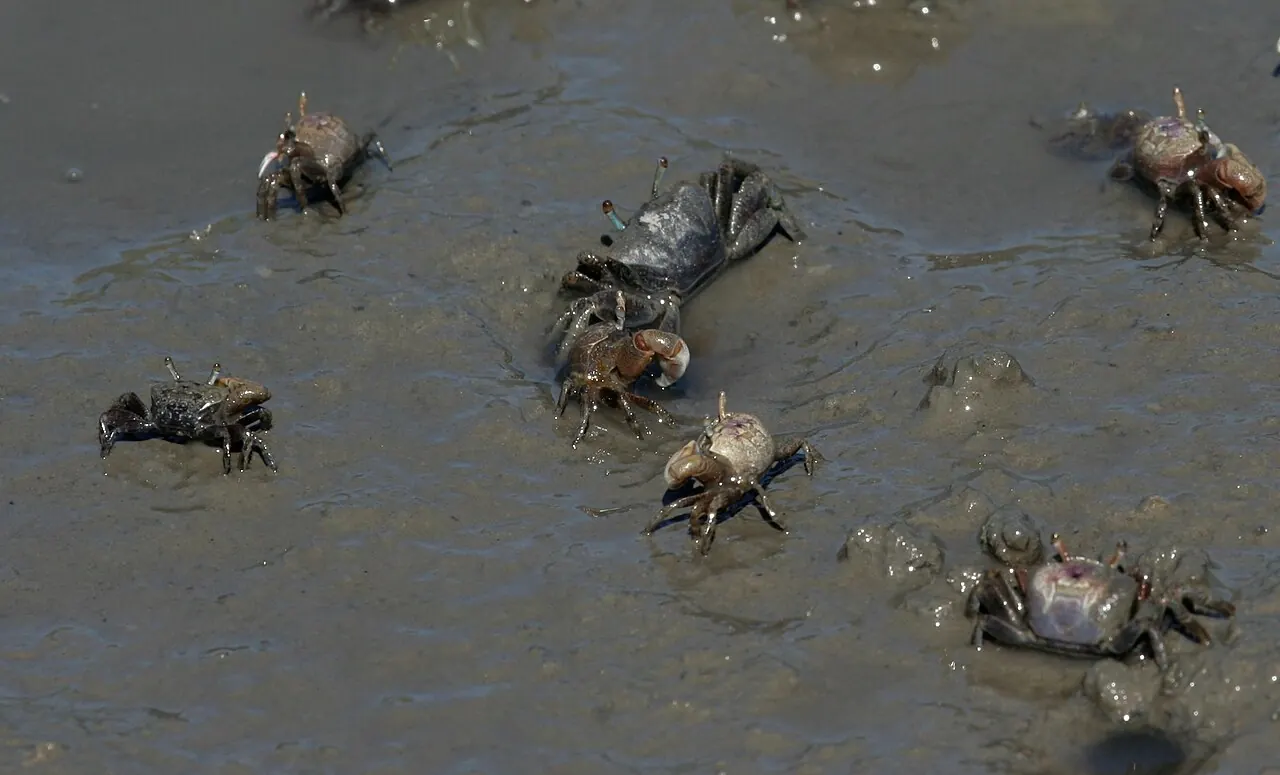
Fiddler Crab
About 109 species in 11 genera, family Ocypodidae
Small shore crabs whose males wave one giant claw to court females; they live on mudflats but start life as larvae drifting at sea.
Photo: Dave Pape / Public domain
3 things to know
- A male's big claw can make up about a third of his body weight or more.
- In most species, half the males are right-handed and half left-handed.
- Fiddler larvae drift at sea for a few weeks to a few months before the young crabs return to shore.
- Scientific name
- About 109 species in 11 genera, family Ocypodidae
- Depth
- At the surface
- Size
- Small; US East Coast species have shells about 2.6 to 3.8 cm (1 to 1.5 in) wide
- Weight
- Unknown
- Lifespan
- About 1 to 1.5 years for the Atlantic marsh fiddler; not well known for most species
- Diet
- Organic matter scraped from sand and mud
- Where
- Muddy and sandy shores, mainly in the tropics; on the US East Coast from the Gulf of Mexico north to New Hampshire
- IUCN status
- Not Evaluated (for the species we checked)
- Depth zones
- Sunlight
Male fiddler crabs are built lopsided. One claw stays small and does the eating, while the other grows into an oversized, often brightly colored claw that the male waves to attract females and uses to wrestle rivals at the burrow. A Stony Brook University marine biology page about New York's West Meadow Beach puts a male sand fiddler's big claw at about a third of its body weight, and the Animal Diversity Web says the marsh fiddler's can approach half. The name comes from feeding: the small claw moving between the ground and the mouth looks like a bow drawn across the fiddle.
Biologist Michael Rosenberg's fiddler crab catalog lists 109 living species in 11 genera, most closely related to ghost crabs. They live on muddy and sandy shores, mainly in the tropics, digging burrows in salt marshes, mangroves and sheltered beaches and coming out at low tide to scrape organic matter from the sand and mud. On the US East Coast, the Atlantic marsh fiddler's shell reaches about 2.6 centimeters (1 inch) across.
Although they spend low tide out of the water, fiddler crabs start out in the sea. A female carries hundreds to thousands of eggs under her abdomen, then goes into the water so they can hatch into swimming larvae. According to Rosenberg, the larvae drift in the plankton for a few weeks to a few months before turning into tiny crabs and returning to land.
Which side the big claw grows on is usually a coin toss, and in most species about half the males are right-handed. Crabs in the genus Gelasimus are the exception, more than 95% right-handed. A male that loses his big claw regrows it on the same side; the popular story that the small claw takes over is a myth, Rosenberg writes.
At least one species is moving north. In 2014, David Johnson, then at the Marine Biological Laboratory, reported marsh fiddlers on the northern Massachusetts coast, nearly 80 kilometers (50 miles) beyond the range limit long assumed at Cape Cod, and later found them as far as Hampton, New Hampshire. He suggested that water 1.3°C (2.3°F) warmer than the previous decade's average in 2012 and 2013 let them spread. The marsh fiddler lives about 1 to 1.5 years, and the species we checked have not been assessed by the IUCN.
Sources
- fiddlercrab.info
- fiddlercrab.info/uca_lifecycle.html
- fiddlercrab.info/handedness/index.html
- you.stonybrook.edu/marinebio
- animaldiversity.org/accounts/Uca_pugnax
- animaldiversity.org/accounts/Uca_pugilator
- sealifebase.se/summary/Uca-pugilator.html
- Study: doi:10.1163/1937240x-00002268
- sciencedaily.com/releases/2014/11/141124092434.htm
- api.gbif.org/v1/species/9444500/iucnRedListCategory



