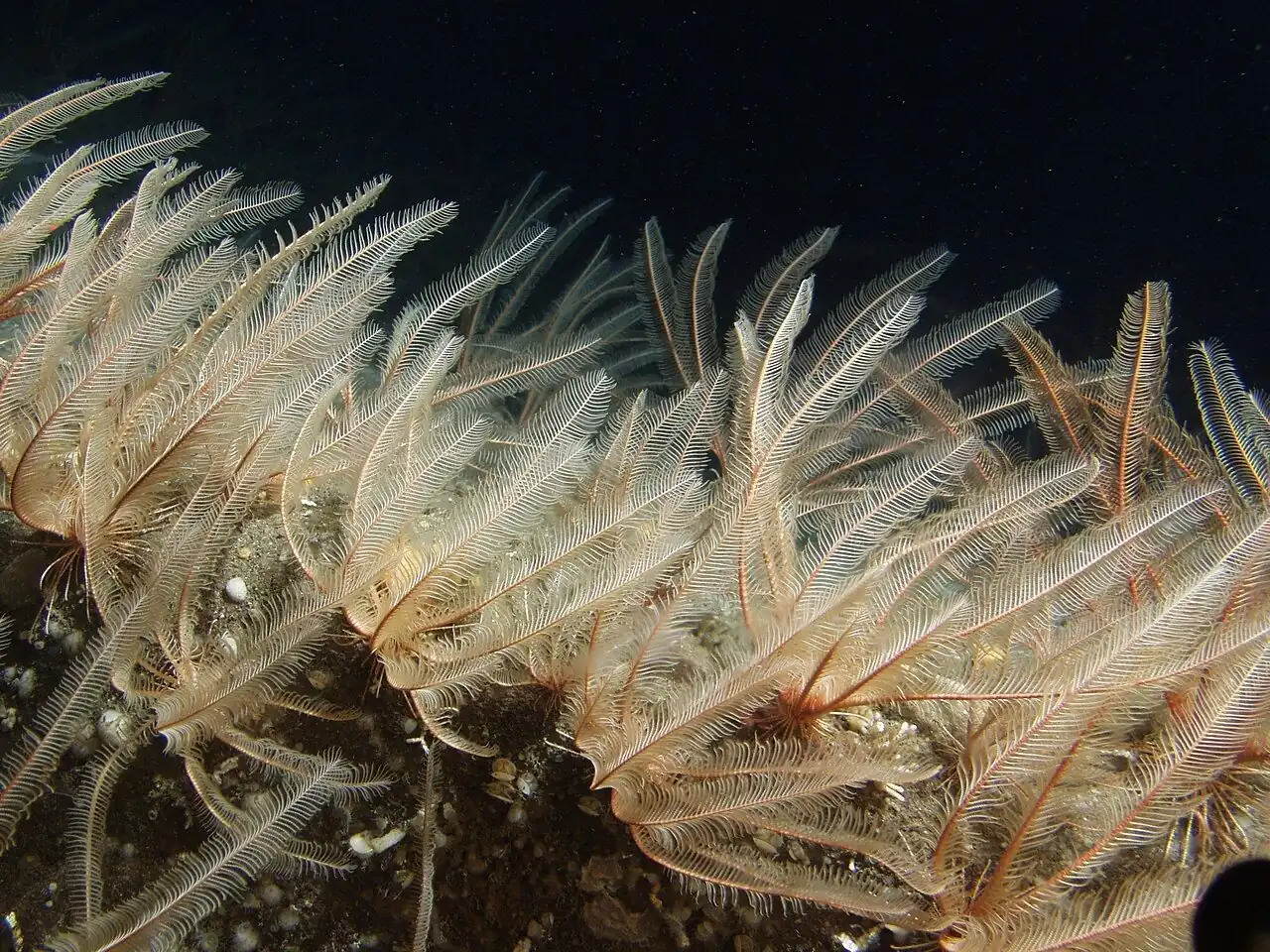
Feather Star
Stalk-shedding crinoids, most of the order Comatulida (more than 500 species)
Crinoids that drop their stalk while young, then cling, crawl and sometimes swim on feathery arms that comb food from the current.
Photo: Jill Baltan, NOAA/Cordell Bank National Marine Sanctuary / Public domain
3 things to know
- Feather stars start life on a stalk and shed it while still small juveniles.
- Some can swim short distances by beating their arms.
- Florometra serratissima can regrow a 200 mm (8 in) arm in about 9 months.
- Scientific name
- Stalk-shedding crinoids, most of the order Comatulida (more than 500 species)
- Depth
- 0 m – 50 m
0 – 164 ft - Size
- Varies by species; arms of Florometra serratissima reach about 20 cm (8 in)
- Weight
- Not well known
- Lifespan
- Not well known
- Diet
- Food particles carried by the current, caught on sticky tube feet along the arms
- Where
- From the cold North Pacific to tropical reefs; a single reef in the Indo-West Pacific may hold dozens of species
- IUCN status
- Not Evaluated (for the species we checked)
- Depth zones
- Sunlight
Feather stars are crinoids, relatives of sea stars and sea urchins built on the same five-part plan, with a skeleton of small chalky plates. A small cup-shaped body holds the gut. From it rise five arms that usually branch into many more, each lined with side branches called pinnules, like the barbs of a feather. Unlike other living echinoderms, crinoids hold both mouth and anus on the upper surface, facing away from the bottom. Feather stars start life attached to a stalk but shed it while still small juveniles, keeping only the topmost segment, which bears hooked cirri for gripping a perch.
They eat whatever the current brings. A feather star spreads its arms in a fan or bowl across the flow and catches particles on fine, sticky tube feet that, unlike a sea star's, have no suckers. Charles Messing of Nova Southeastern University in Florida, who studies crinoids, notes that single reefs in the tropical Indo-West Pacific may support dozens of species. Several reef species listed on SeaLifeBase live from the surface to about 50 meters (165 feet), some hiding by day and climbing onto exposed perches at night, but feather stars also reach the deep sea.
Free of a stalk, a feather star can let go and move. It crawls with its arms, and some species swim short distances by beating them up and down, with the pinnules lying flat against the arm on the upstroke and spread wide on the power stroke. With more than 500 species, feather stars are by far the most diverse living crinoids, and Messing and Tomasz Baumiller note that their mobility has been linked to escaping predators.
Arm loss is part of the life of a feather star, and so is regrowth. Fish nibble arms off many tropical species. Off the US Pacific coast lives Florometra serratissima, recorded from 11 to 1,252 meters (36 to 4,108 feet) deep; NOAA photographed crowds of them at 74 meters (243 feet) on Cordell Bank off California. Off Vancouver Island, a 1983 study by Mladenov found that 80% of them had at least one regrowing arm, damage he blamed on a crab and the sunflower sea star, and they can regrow a 200-millimeter (8-inch) arm in about 9 months. None of the species we checked has been assessed by the IUCN.
Sources
- libguides.nova.edu/crinoids
- libguides.nova.edu/crinoids/stalk
- libguides.nova.edu/crinoids/mechanisms
- libguides.nova.edu/crinoids/postures
- libguides.nova.edu/crinoids/predation
- palaeo-electronica.org/2007_1/crinoid/intro.htm
- palaeo-electronica.org/2007_1/crinoid/discus.htm
- sealifebase.se/summary/Florometra-serratissima.html
- sealifebase.se/summary/Anneissia-bennetti.html
- sealifebase.se/summary/Lamprometra-palmata.html
- sealifebase.se/summary/Davidaster-rubiginosus.html
- commons.wikimedia.org/wiki/File:Sanc1619_-_Flickr_-_NOAA_Photo_Library.jpg
- api.gbif.org/v1/species/2274589/iucnRedListCategory



