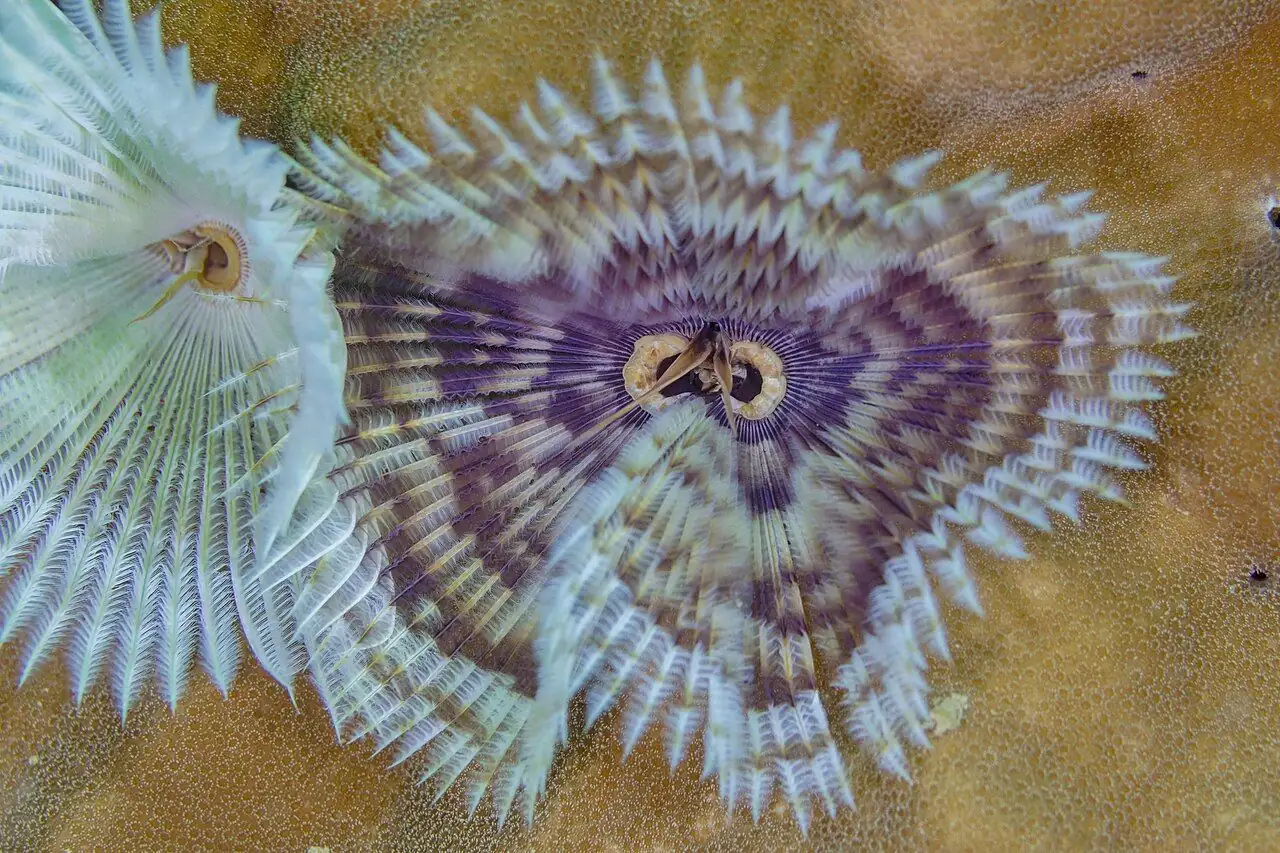
Feather Duster Worm
Family Sabellidae (fan worms; several genera, including Sabellastarte)
Tube-dwelling fan worms with feathery crowns that filter food from the water and, in many species, carry eyes on their tentacles.
Photo: Diego Delso / CC BY-SA 4.0
3 things to know
- Many fan worms have eyes on their feathery tentacles, some with hundreds of facets.
- A feather duster can regrow its whole crown if it loses it.
- Hawaii's large feather duster probably arrived as fouling on ship hulls.
- Scientific name
- Family Sabellidae (fan worms; several genera, including Sabellastarte)
- Depth
- 0 m – 23 m
0 – 75 ft - Size
- Varies by species; common reef species range from about 2 cm (1 in) to 15 cm (6 in)
- Weight
- Not well known
- Lifespan
- Not well known
- Diet
- Plankton and organic particles filtered from the water
- Where
- Common reef species include Sabellastarte magnifica in Florida and the Caribbean, and S. spectabilis from the Red Sea across the Indo-Pacific to Hawaii
- IUCN status
- Not Evaluated (Sabellastarte magnifica and S. spectabilis)
- Depth zones
- Sunlight
Feather duster worms, or fan worms, make up the family Sabellidae: segmented worms that live in tubes and push a crown of feathery tentacles, called radioles, out into the water. The crown is their gill and their net. Tiny hairs on the radioles drive a current through it, and food particles caught in mucus are sorted and carried along grooves to the mouth, while larger particles are set aside for building the tube. When danger comes, the worm pulls its crown back into the tube.
On reefs in Florida, the Bahamas and the Caribbean, the magnificent feather duster (Sabellastarte magnifica) measures 8 to 15 centimeters (3 to 6 inches) and lives 3 to 18 meters (10 to 60 feet) down, while the split-crown feather duster (Anamobaea orstedii) is only 2 to 5 centimeters (1 to 2 inches) and lives 5 to 23 meters (15 to 75 feet) deep.
Many fan worms keep eyes on their feathers. In a 2016 review, Michael Bok of Lund University in Sweden and colleagues described radiolar eyes ranging from scattered single light-sensing spots to compound eyes with up to hundreds of facets. The worm's main eyes, on its head, sit inside the tube most of the time and are little more than tiny pigment cups. The eyes on the radioles appear to work as what the authors called visual burglar alarms, spotting a looming predator so the worm can snap back into its tube.
In Hawaii, the large feather duster is Sabellastarte spectabilis, native to the Red Sea and Indo-Pacific. Its body reaches 80 millimeters (3 inches) or more, and it lives in tough, mud-covered tubes. The Bishop Museum treats it as an introduced species, probably carried on ships' hulls: there are no specimens in its collections from before 1946, and it is missing from earlier Hawaiian surveys, including studies of fouling in Pearl Harbor. Today it is abundant on Oahu's south shore reefs, in Pearl Harbor and in Kaneohe Bay, especially in dredged areas with silty water.
Hawaii's feather dusters have separate sexes, and sabellid worms can also reproduce by breaking into pieces, and they can regrow lost body parts, including the entire crown. The IUCN has not evaluated either Sabellastarte magnifica or S. spectabilis.
Sources
- data.bishopmuseum.org/HBS/invertguide/species/sabellastarte_spectabilis.htm
- reefguide.org/keys/magnificentfeatherduster.html
- reefguide.org/keys/featherduster.html
- Study: doi:10.1093/icb/icw089
- sealifebase.se/summary/Sabellastarte-magnifica.html
- sealifebase.se/summary/Sabellastarte-spectabilis.html
- commons.wikimedia.org/wiki/File:Gusano_plumero_tropical_(Sabellastarte_spectabilis),_An…



