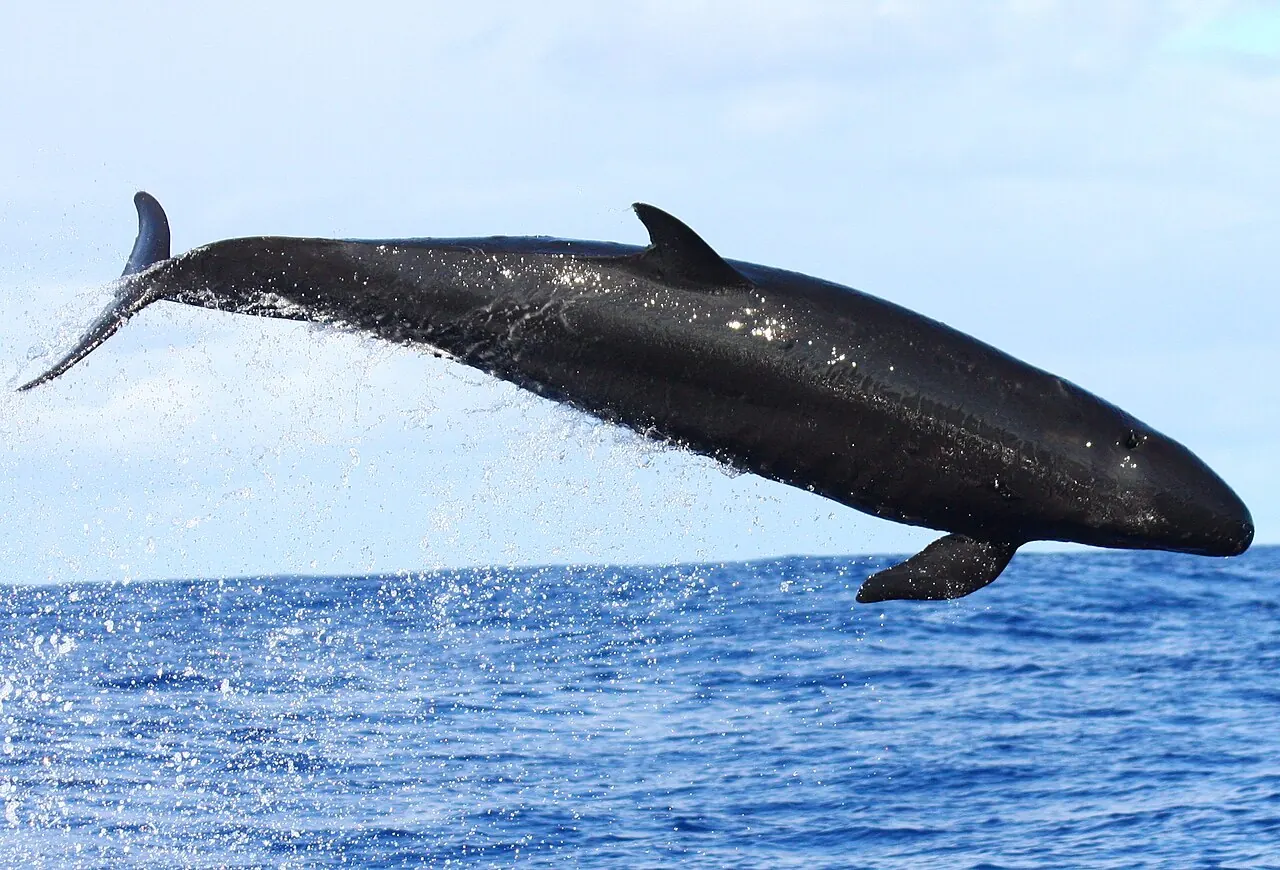
False Killer Whale
Pseudorca crassidens
A slender, dark, fish-hunting member of the dolphin family whose small population around the main Hawaiian Islands is endangered.
Photo: Jim Cotton, NOAA/NMFS/PIFSC (NOAA Photo Library) / CC BY 2.0
3 things to know
- In Hawaii, false killer whales are known to toss fish high into the air before eating them.
- Females go through menopause, between about 44 and 55 years old.
- The endangered population around Hawaii's main islands numbers about 140, by NOAA's 2026 estimate.
- Scientific name
- Pseudorca crassidens
- Depth
- 0 m – 500 m
0 – 1,640 ft - Size
- Females up to about 4.9 m (16 ft); males nearly 6.1 m (20 ft)
- Weight
- Up to about 1,400 kg (3,000 lb)
- Lifespan
- Up to at least 63 years for females and 58 for males
- Diet
- Large fish such as tunas, billfish, wahoo and mahi-mahi, and squid
- Where
- Tropical, subtropical and warm temperate waters of all oceans
- IUCN status
- Near Threatened
- Depth zones
- Sunlight · Twilight
Despite the name, the false killer whale is a large, slender member of the dolphin family. It is dark gray enough to look black, except for a paler area on the underside between the flippers. The head is small and conical with no beak, the dorsal fin sits in the middle of the back and curves backward, and each flipper has a hump along its outer edge that gives it an S-shaped outline. NOAA Fisheries says adult females reach about 4.9 meters (16 feet) and males nearly 6.1 meters (20 feet), and large animals weigh up to about 1,400 kilograms (3,000 pounds).
It lives in tropical, subtropical and warm temperate waters in every ocean, usually offshore where the water is more than 1,000 meters (3,300 feet) deep, and the IUCN says it is not common anywhere. False killer whales hunt large fish and squid, diving for up to 18 minutes and chasing prey at high speed 300 to 500 meters (980 to 1,640 feet) down. In Hawaii they take mahi-mahi, tunas, billfish and wahoo, and they are known to throw fish high into the air before eating them. When one catches something, others in its cluster tend to converge, and the prey may be shared.
Groups are made of small subgroups spread over tens of kilometers and held together by strong social bonds. Females mature at 8 to 11, give birth after a pregnancy of 11 to 16 months and go through menopause, between about 44 and 55. Whole groups sometimes strand; the largest known mass stranding, cited by the IUCN, put 835 ashore in Argentina in 1946.
Hawaii has three populations that overlap off Kauai and Niihau but do not socialize or breed with each other. The main Hawaiian Islands insular population is rarely seen more than 70 kilometers (45 miles) from shore, and NOAA listed it as endangered under the Endangered Species Act in 2012. NOAA's species page, updated in September 2026, puts it at about 140 animals and declining by about 3.5 percent a year; a 2018 study led by Amanda Bradford had estimated that 167 used the surveyed area in 2015. Frequent fin and mouth injuries point to fishing lines, since these whales take bait and catch from longlines. Worldwide, the IUCN's 2018 assessment lists the species as Near Threatened.



