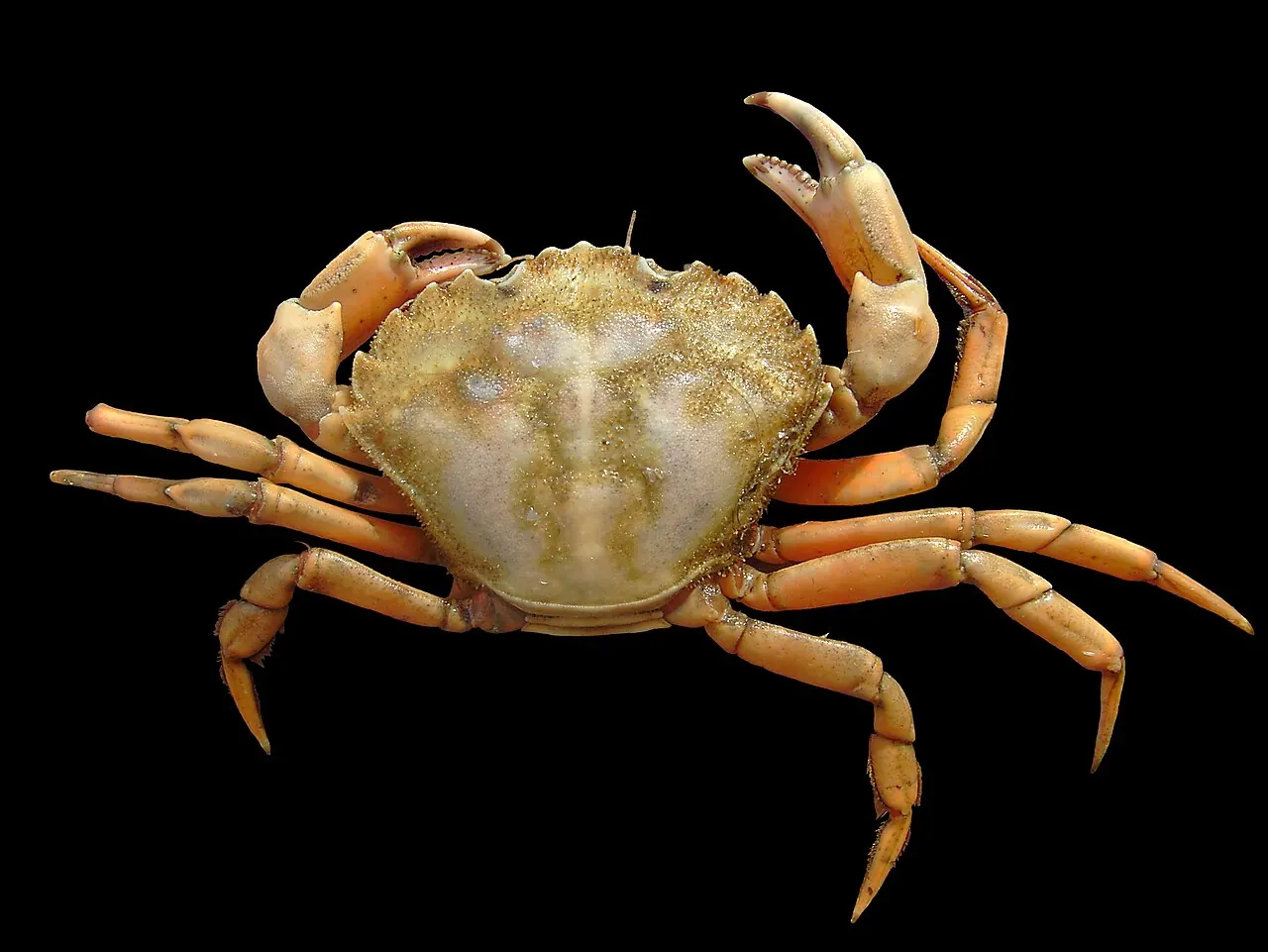
European Green Crab
Carcinus maenas
A small European shore crab that has invaded both US coasts, eating clams and young oysters and prompting an emergency in Washington state.
Photo: Hans Hillewaert / CC BY-SA 4.0
3 things to know
- Five spines on each side of the shell are the surest way to identify it.
- Washington wildlife officials say one green crab can eat 40 half-inch clams a day.
- It reached San Francisco Bay in 1989 and southeast Alaska by 2022.
- Scientific name
- Carcinus maenas
- Depth
- 0 m – 6 m
0 – 20 ft - Size
- Adults 6 to 10 cm (2.4 to 4 in) across the shell
- Weight
- Unknown
- Lifespan
- Up to about 7 years
- Diet
- Clams, young oysters, small crabs and other shore animals
- Where
- Native from Norway to Mauritania; invasive on both US coasts, in Canada, South Africa and Australia
- IUCN status
- Not Evaluated
- Depth zones
- Sunlight
Count the spines. A European green crab has five sharp teeth along each side of the front of its shell and three rounded lobes between its eyes, and the Washington Department of Fish and Wildlife calls that count the best way to identify one, because its color ranges from dark mottled green to reddish. The shell is broader than it is long and seldom more than 4 inches (10 centimeters) across. It is a shore crab of shallow water, typically less than 25 feet (8 meters) deep, in estuaries, mudflats, marshes and eelgrass beds.
Its native range runs along the Atlantic coasts of Europe and North Africa, from Norway to Mauritania. It reached the Cape Cod region by ship in the mid-1800s, spread north in the early 1900s and is believed to have contributed to steep declines in the soft-shell clam fishery as far as Nova Scotia. In 1989 it turned up in San Francisco Bay. Strong El Niño currents helped carry it into Oregon, Washington and British Columbia in the late 1990s, and it was detected in southeast Alaska in 2022. According to the US Geological Survey, populations are now established on five continents, and the crab tolerates salinities from 4 to 52 parts per thousand and temperatures from 0 to 30°C (32 to 86°F).
It eats a wide range of prey. Washington officials say one green crab can eat 40 half-inch clams a day and will dig 6 inches (15 centimeters) down to reach them. It cannot crack a mature oyster but takes young ones, along with other crabs its own size, and its digging damages eelgrass and marsh. Larger females can breed two or three times a year, and the oldest recorded age is 7 years.
Washington now treats it as an emergency. After numbers rose sharply in 2021 in the Lummi Nation's Sea Pond and on the outer coast, Governor Jay Inslee issued an emergency proclamation on January 19, 2022. Each field season, more than 25 state staff and 1,000 traps go into the effort alongside tribes and other partners, under a management plan that runs to June 2031. The crab has not been evaluated for the IUCN Red List.



