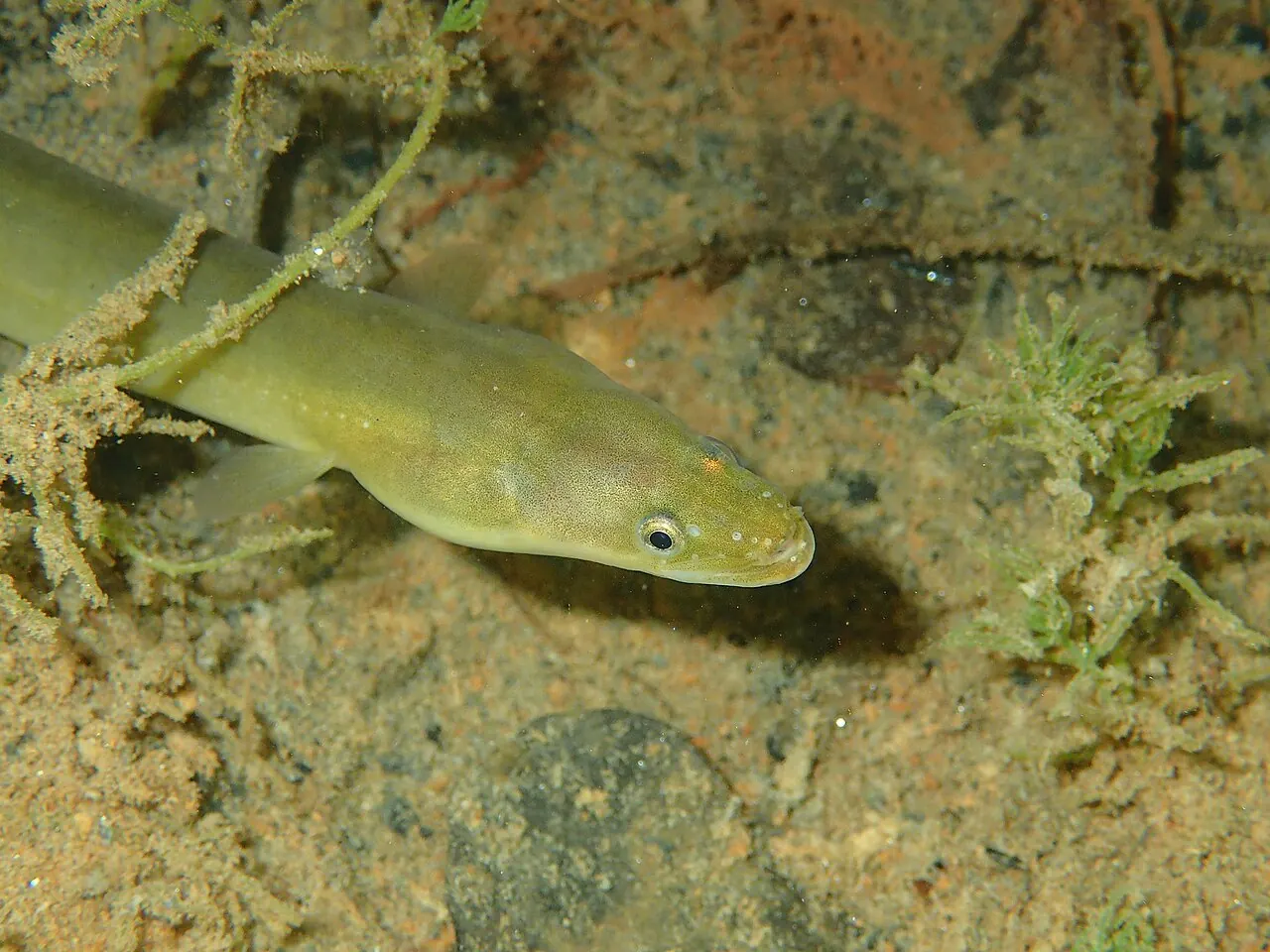
European Eel
Anguilla anguilla
A river eel that swims thousands of kilometers to breed in the Sargasso Sea, where tagged adults were first tracked in 2022. It is Critically Endangered.
Photo: jujurenoult / CC BY 4.0
3 things to know
- No European eel eggs or spawning adults have ever been caught in the Sargasso Sea; the evidence comes from larvae and tags.
- In 2022, satellite tags placed on eels in the Azores showed adults reaching the Sargasso Sea for the first time.
- Recruitment of young eels has fallen by about 95 percent since the 1980s.
- Scientific name
- Anguilla anguilla
- Depth
- 0 m – 1,000 m
0 – 3,281 ft - Size
- Females up to 133 cm (52 in); males up to about 50 cm (20 in)
- Weight
- Up to 6.6 kg (14.6 lb)
- Lifespan
- Usually 15–20 years; males feed and grow for 6–12 years and females for 9–20 before migrating to spawn once and die
- Diet
- Almost any aquatic animal it can catch, in fresh water or the sea, plus worms
- Where
- Rivers, lakes and coasts of Europe and North Africa, including the Baltic, Mediterranean and Black seas; spawns in the Sargasso Sea in the western Atlantic
- IUCN status
- Critically Endangered
- Depth zones
- Sunlight · Twilight
A European eel spends most of its life in a river, lake or estuary and ends it, as far as anyone can tell, in the middle of the Atlantic. Young eels arrive on European coasts as see-through glass eels about 6 to 8 centimeters (2.4 to 3.1 inches) long and move into fresh water. There they live for years as yellow eels, hiding under stones and in mud and eating almost any animal they can catch. Males grow for 6 to 12 years and reach about 50 centimeters (20 inches); females grow for 9 to 20 years and can reach about 1.3 meters (4.4 feet). Then they turn silver, with larger eyes, and head for the sea.
For a century the evidence for where they go came from larvae. In the early 1900s Johannes Schmidt surveyed eel larvae across the Atlantic, found the smallest ones in the Sargasso Sea and concluded that eels spawn there. But no eggs or spawning adults have ever been sampled there. Tagging filled in the route. A 2016 study led by David Righton of Britain's Cefas laboratory reconstructed the routes of more than 80 eels from Europe toward the Azores, and found that every eel dived daily, between about 200 meters (660 feet) by night and 1,000 meters (3,300 feet) by day.
The last leg came in 2022. Rosalind Wright of England's Environment Agency and colleagues fitted satellite tags to 26 female silver eels from rivers in the Azores in 2018 and 2019. The tags stayed on for 40 to 366 days. Five popped up inside the Sargasso Sea, and one inside the presumed breeding area, the first direct evidence of adult European eels reaching it. The eels averaged only about 7 kilometers (4 miles) a day, too slow to arrive before the next spawning season ended, which suggests they arrive in time for the following one. The trip from Europe covers 5,000 to 10,000 kilometers. American eels have been tracked heading for the Sargasso Sea too.
The IUCN lists the European eel as Critically Endangered (assessed 2018), and the number of young eels reaching Europe has fallen about 95 percent since the 1980s. Trade in the species is regulated under CITES Appendix II.



