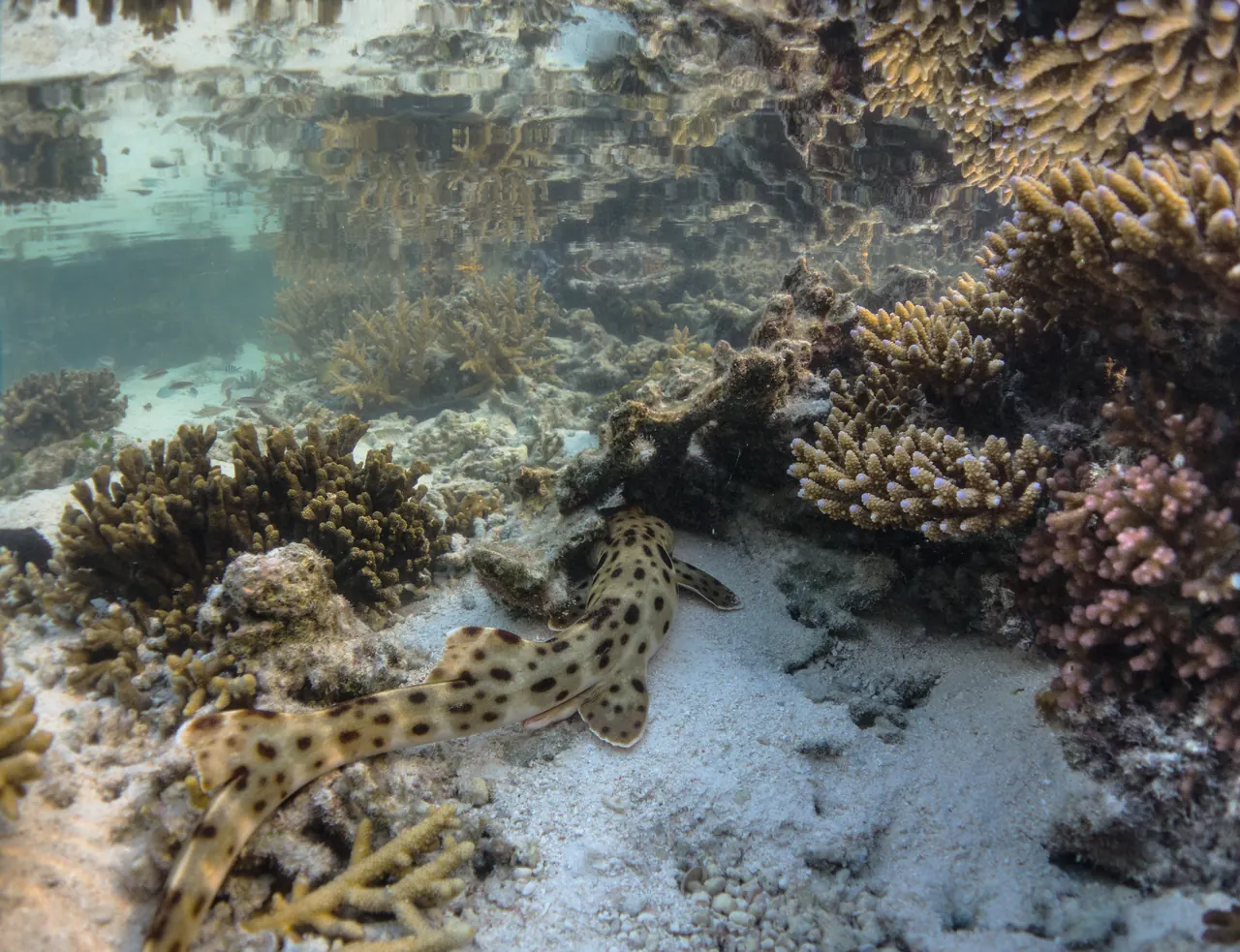
Epaulette Shark
Hemiscyllium ocellatum
A small spotted reef shark of Australia and New Guinea that walks on its fins and copes with almost no oxygen on reef flats cut off by the tide.
Photo: Alexander Fordyce / CC BY-SA 4.0
3 things to know
- It is named for the large, white-ringed black spot near each pectoral fin, which looks like a military epaulette.
- In a 2002 experiment, epaulette sharks in water with almost no oxygen stayed upright for about 46 minutes and recovered as soon as oxygen returned.
- Females lay egg cases about 10 cm (4 in) long, and the young hatch after roughly four months.
- Scientific name
- Hemiscyllium ocellatum
- Depth
- 0 m – 50 m
0 – 164 ft - Size
- Usually 70–90 cm (28–35 in) long; up to about 107 cm (3.5 ft)
- Weight
- Not well known
- Lifespan
- Not well known
- Diet
- Worms, crabs, shrimp, amphipods and small fishes
- Where
- Shallow reefs and tide pools of southern New Guinea and northern Australia, including the Great Barrier Reef
- IUCN status
- Least Concern
- Depth zones
- Sunlight
Paddle-shaped fins and a pair of big eye-like spots make the epaulette shark easy to pick out on a reef flat. It is a slender little shark, usually under 1 meter (3.3 feet) and recorded to 107 centimeters (3.5 feet), beige to brown with scattered dark spots. Near each pectoral fin sits a large black spot ringed in white, the "epaulette" of its name, and more than half its length is tail.
It lives on shallow coral reefs and in tide pools from southern New Guinea to northern Australia, down to about 50 meters (164 feet) but often in water barely deep enough to cover it. It is most active at dusk and at night, when it finds worms, crabs, shrimp and small fish by smell and by sensing their electric fields. Instead of swimming, it often walks, bending its body and pushing off with its paired fins, and a 2022 study by Marianne Porter, Jodie Rummer and colleagues notes that it can walk both in and out of water.
Those reef flats are a hard place to breathe. As the tide goes out they become isolated from the sea, and the water in them can run short of oxygen. In a 2002 experiment, Gillian Renshaw of Griffith University and colleagues put epaulette sharks in water with almost no oxygen at all. The sharks lost the ability to stay upright after about 46 minutes, then became alert again the moment oxygen returned. The team linked that early shutdown to adenosine, a natural brain depressant that seems to help the shark keep its brain's energy supply from running down.
Females lay paired egg cases about 10 centimeters (4 inches) long, and the young hatch after about 130 days. Carolyn Wheeler, then at the New England Aquarium in Boston, Rummer and colleagues reared 27 embryos at 27, 29 and 31 °C (81 to 88 °F) and reported in 2021 that sharks raised at 31 °C hatched lighter and with poorer metabolic performance. In a 2025 Biology Open study of five females at James Cook University in Townsville, the same team found no significant change in energy use while the sharks were making eggs.
Outside a small aquarium trade, fisheries take little interest in this shark, and the IUCN lists it as Least Concern, in an assessment from 2015.
Sources
- fishbase.se/summary/Hemiscyllium-ocellatum.html
- australian.museum/learn/animals/fishes/epaulette-shark-hemiscyllium-ocellatum
- iucnredlist.org/species/41818/68625284
- en.wikipedia.org/wiki/Epaulette_shark
- Study: doi:10.1016/S1096-4959(01)00484-5
- Study: doi:10.1093/icb/icac127
- Study: doi:10.1038/s41598-020-79953-0
- Study: doi:10.1242/bio.062076
- sciencedaily.com/releases/2026/01/260121034119.htm



