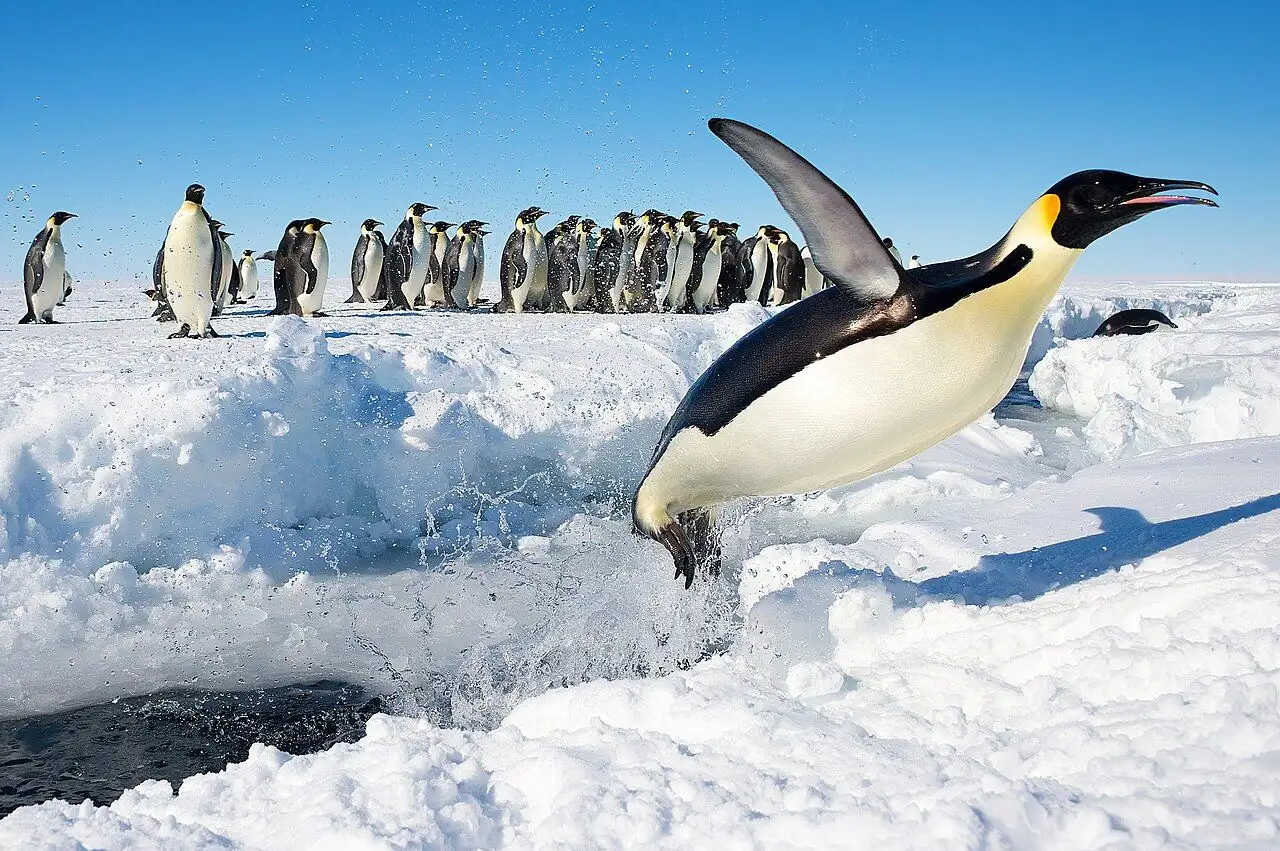
Emperor Penguin
Aptenodytes forsteri
The largest penguin, which breeds through the Antarctic winter on sea ice and dives deeper than 500 m on a single breath.
Photo: Christopher Michel / CC BY 2.0
3 things to know
- It is the only animal that breeds during the Antarctic winter, and only males incubate the egg.
- Most foraging happens 150–250 m (490–820 ft) down, but the deepest recorded dive reached 564 m (1,850 ft).
- In April 2026 the IUCN moved it from Near Threatened to Endangered because of sea-ice loss.
- Scientific name
- Aptenodytes forsteri
- Depth
- 0 m – 250 m
0 – 820 ft - Size
- About 1.1–1.2 m (3.6–3.9 ft) long
- Weight
- Up to about 40 kg (88 lb)
- Lifespan
- Some live more than 40 years, but most do not in the wild
- Diet
- Fish, especially Antarctic silverfish, plus krill and squid
- Where
- Around the coast of Antarctica
- IUCN status
- Endangered
- Depth zones
- Sunlight · Twilight
Up to 40 kilograms (88 pounds) at the start of the breeding season and about 1.1 to 1.2 meters (3.6 to 3.9 feet) long, the emperor is the largest of the 18 penguin species. The head and back are black, sharply set off from a white belly, a pale-yellow breast and bright-yellow ear patches.
They live around Antarctica, breeding in colonies scattered around the continent. Most colonies sit on fast ice, sea ice locked in place between islands or grounded icebergs, and they range from a few hundred to more than 20,000 pairs. Emperors are the only animals that breed during the Antarctic winter. Only the males incubate the egg, and huddling together lets them survive the long fast that comes with it. Some emperors live more than 40 years, though most do not last that long in the wild.
At sea they hunt fish, with Antarctic silverfish among the most common prey, along with krill and squid. According to the Australian Antarctic Division, they mostly forage 150 to 250 meters (490 to 820 feet) down, and dives average 3 to 6 minutes. The deepest dive on record, logged by a tagged bird in July 2006, reached 564 meters (about 1,850 feet). Longer dives push them hard. A team including Katsufumi Sato and Gerald Kooyman recorded a bird that stayed under for 27.6 minutes, then needed 6 minutes before it stood up and 8.4 hours before it dived again. Paul Ponganis and colleagues found that by the end of long dives, blood oxygen can be almost used up, a level that would be catastrophic for many birds and mammals. Their hemoglobin holds oxygen more tightly than that of most birds.
The species depends on stable sea ice, and the ice is breaking up early. In April 2026 the IUCN moved the emperor penguin from Near Threatened to Endangered. Satellite images show a loss of about 10 percent of the population between 2009 and 2018, more than 20,000 adults, and models project the population will halve by the 2080s.
Sources
- antarctica.gov.au/about-antarctica/animals/penguins/emperor-penguin
- iucn.org/press-release/202604/emperor-penguin-and-antarctic-fur-seal-now-endangered-due…
- en.wikipedia.org/wiki/Emperor_penguin
- Study: doi:10.1007/s00300-006-0168-8
- guinnessworldrecords.com/world-records/deepest-dive-by-a-bird
- Study: doi:10.1242/jeb.055723
- Study: doi:10.1242/jeb.011221



