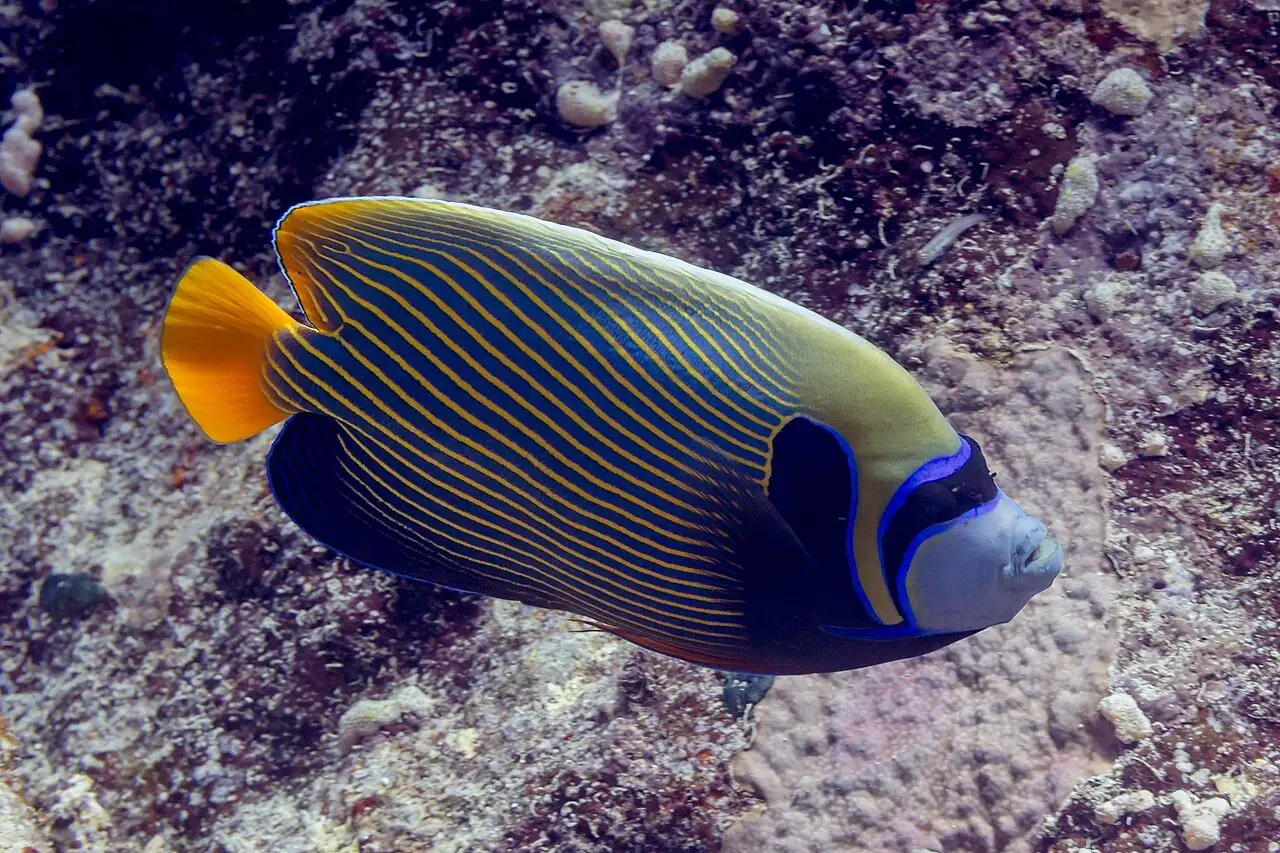
Emperor Angelfish
Pomacanthus imperator
An Indo-Pacific angelfish whose young wear rings and adults wear stripes; released aquarium fish have turned up on Florida reefs.
Photo: Diego Delso / CC BY-SA 4.0
3 things to know
- Juveniles are dark blue-black with a white ring, nothing like the striped adults.
- Young and adults sometimes clean much larger fish, including sunfish.
- A 2004 study found it was the non-native fish most often seen on southeast Florida reefs.
- Scientific name
- Pomacanthus imperator
- Depth
- 1 m – 100 m
3 – 328 ft - Size
- Up to about 40 cm (16 in) long (standard length)
- Weight
- Not well known
- Lifespan
- At least 14 years (oldest reported age)
- Diet
- Sponges, tunicates and other encrusting animals
- Where
- Indo-Pacific from the Red Sea and East Africa to the Line and Tuamotu islands, north to southern Japan, south to the Great Barrier Reef and New Caledonia
- IUCN status
- Least Concern
- Depth zones
- Sunlight
Diagonal stripes of yellow and purplish blue run the length of an adult emperor angelfish, and a curved black bar masks each eye. The young look like a different fish. Juveniles are dark blue-black with a white ring toward the rear of the body and a white edge on the dorsal fin, a pattern that gives way to stripes as they grow. Adults reach about 40 centimeters (16 inches) in standard length, which leaves out the tail.
It lives on coral reefs across the Indo-Pacific, from the Red Sea and East Africa to the Line and Tuamotu islands, north to southern Japan and south to the Great Barrier Reef and New Caledonia, from 1 to 100 meters (3 to 330 feet) deep. Each life stage has its own address. Juveniles hide under ledges or in holes on outer lagoon patch reefs and channel edges, often near cleaner shrimps. Subadults move to holes and surge channels on the reef front. Large adults claim ledges and caves among rich coral on lagoon, channel and seaward reefs.
Adults feed on sponges, tunicates and other encrusting animals, and they form pairs. Both young and adult fish sometimes act as cleaners for much larger fish, such as sunfish. They mature at about 25 centimeters (10 inches), and the oldest one on record in FishBase was 14 years old.
It is frequently exported through the aquarium trade, and some of those fish end up in the wrong ocean. FishBase notes that reports from Hawaii are probably aquarium releases. In 2004 Brice Semmens of the University of Washington and colleagues, working with sightings sent in by volunteer divers through the Reef Environmental Education Foundation, reported 16 non-native fish species off southeast Florida, apparently set free from home aquariums. The sightings came from 32 locations in Broward and Palm Beach counties and the upper Florida Keys, and emperor angelfish were the most commonly sighted of all. The researchers noted that the species is imported in relatively large numbers.
The IUCN lists the emperor angelfish as Least Concern, from a 2009 assessment.
Sources
- fishbase.se/summary/Pomacanthus-imperator.html
- australian.museum/learn/animals/fishes/emperor-angelfish-pomacanthus-imperator
- washington.edu/news/2004/04/07/freeing-nemo-aquarium-owners-releasing-non-native-fish-c…
- Study: doi:10.3354/meps266239
- commons.wikimedia.org/wiki/File:Pez_%C3%A1ngel_emperador_(Pomacanthus_imperator),_mar_R…



