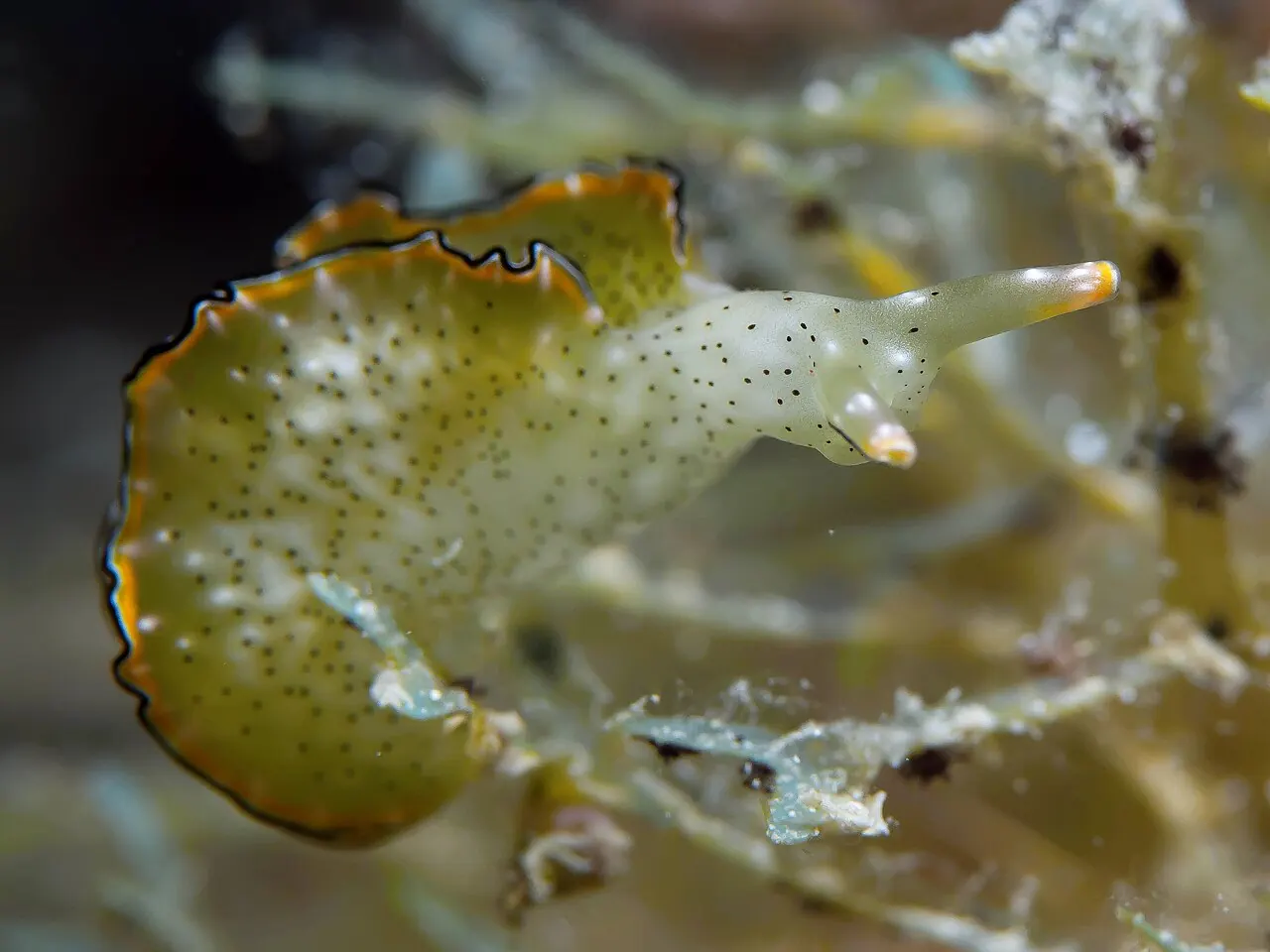
Tri-banded Taco Slug
Elysia marginata
A small green sea slug of Indo-Pacific shallows that keeps stolen chloroplasts from algae and can regrow a body from its severed head.
Photo: Rickard Zerpe / CC BY-SA 2.0
3 things to know
- It keeps chloroplasts from the algae it eats inside its own cells, a habit called kleptoplasty.
- Lab slugs dropped almost their whole body at the neck, and young heads regrew a body in about three weeks.
- Its wing-like side flaps are edged with bands of orange, white and black.
- Scientific name
- Elysia marginata
- Depth
- 0 m – 12 m
0 – 39 ft - Size
- Up to about 6–7.6 cm (2.4–3 in) long; many are much smaller
- Weight
- Unknown
- Lifespan
- Unknown
- Diet
- Green algae, such as Bryopsis
- Where
- Indo-Pacific, from East Africa to Japan, Australia, Guam and Hawaii
- IUCN status
- Not Evaluated
- Depth zones
- Sunlight
Wing-like flaps along the sides of the tri-banded taco slug, Elysia marginata, are bordered with a triple band of orange, white and black, and its olive-green body is dotted with black and white spots. It is one of the commonest "leaf slugs" on intertidal green algae across the Indo-West Pacific, from East Africa to Japan, Australia, Guam and Hawaii. The largest reach about 6 to 7.6 centimeters (2.4 to 3 inches) long.
In Hawaii, observers describe two forms. A larger, sedentary form lives in beds of the green alga Bryopsis, usually less than 1 meter (3 feet) deep in sheltered back-reef spots, and has been seen feeding on it in the lab. A smaller, migratory form, seldom longer than 25 millimeters (1 inch), roams rocky bottoms down to about 12 meters (39 feet). One 15-millimeter slug laid a tightly coiled white egg mass that hatched in about six days in the lab.
Like some of its relatives, the slug keeps chloroplasts from the algae it eats and holds them in its own cells, a habit called kleptoplasty. That has earned these slugs the label solar-powered. A 2014 study of two related species by Gregor Christa and colleagues found the stolen chloroplasts do fix carbon in the light, but slugs kept in darkness survived months of starvation about as well, so the chloroplasts may work more like a slowly digested food store.
The species made news in 2021, when Sayaka Mitoh and Yoichi Yusa of Nara Women's University in Japan reported that slugs identified as Elysia cf. marginata, along with a second species, could cast off almost the whole body, heart included. The head kept moving. Younger heads began eating algae within hours, started regrowing a heart within a week and had a complete new body in about three weeks. Older slugs' heads did not feed and died in about 10 days, and the shed bodies never grew new heads, though they moved and reacted to touch for days or even months. The authors suggest the stolen chloroplasts may help a head survive until it can eat, and that shedding the body might help a slug get rid of internal parasites. The species has not been assessed for the IUCN Red List.



