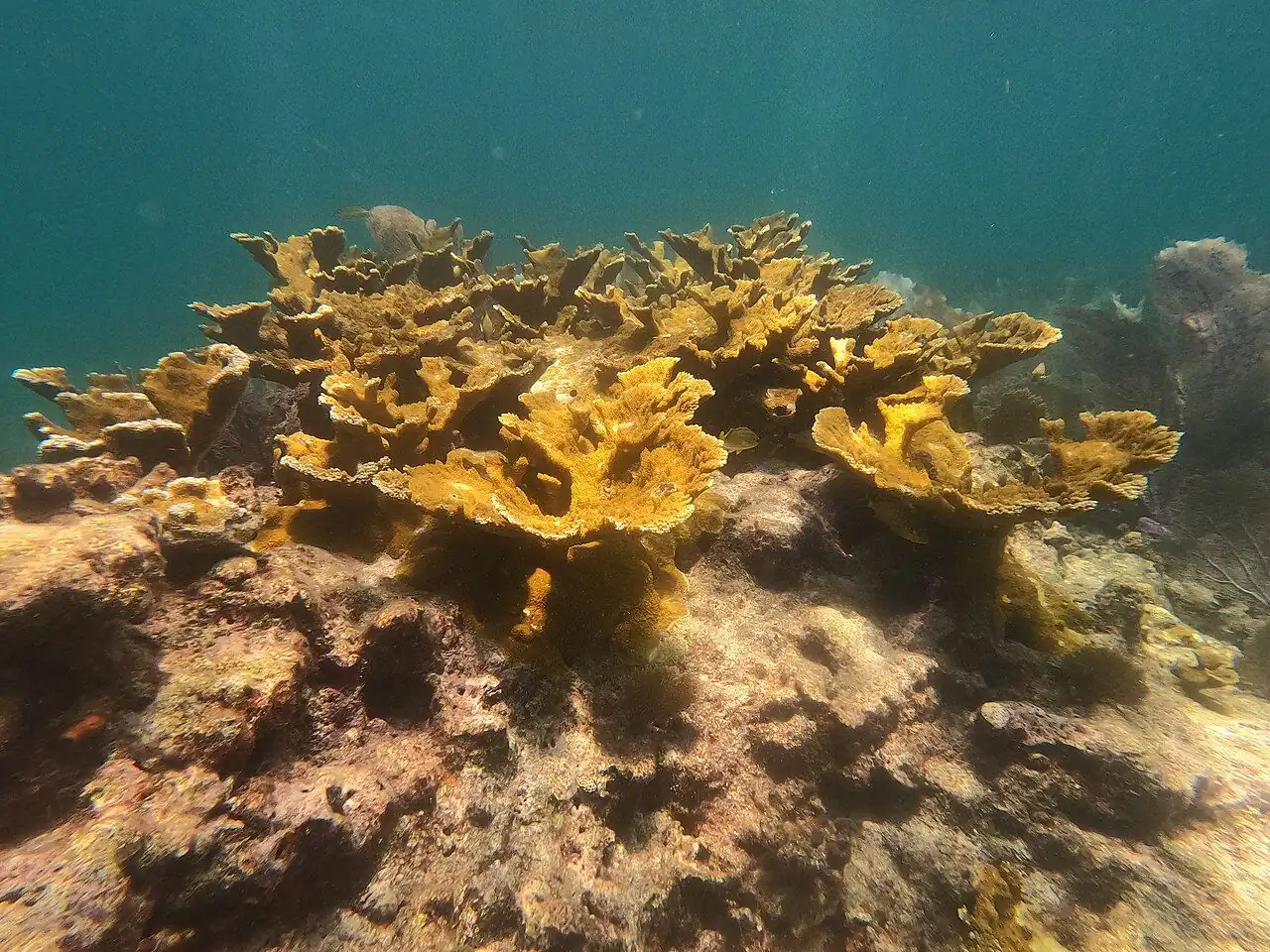
Elkhorn Coral
Acropora palmata
A fast-growing Caribbean reef builder with antler-like branches, down 97% since the 1980s and nearly wiped out in the Florida Keys in 2023.
Photo: Jstuby / CC0
3 things to know
- A healthy colony can add up to 5 inches (13 cm) of branch length a year.
- Broken branches can reattach and grow into new colonies.
- In the 2023 Florida heat wave, 97.8 to 100% of colonies in the Keys and Dry Tortugas died.
- Scientific name
- Acropora palmata
- Depth
- 0 m – 5 m
0 – 16 ft - Size
- Colonies at least 1.8 m (6 ft) tall and 3.7 m (12 ft) across
- Weight
- Unknown
- Lifespan
- Unknown
- Diet
- Food made by algae living in its tissues, plus plankton caught by its polyps
- Where
- Bahamas, Florida and the Caribbean; north to Broward County, Florida
- IUCN status
- Critically Endangered
- Depth zones
- Sunlight
Elkhorn coral grows flattened, frond-like branches that spread upward from a central trunk, like a set of antlers. Acropora palmata colonies are golden tan or pale brown with white tips, colored by algae living in their tissue. Branches can be up to 15 inches (38 centimeters) wide, and a single colony can grow at least 6 feet (1.8 meters) tall and 12 feet (3.7 meters) across. Neighboring colonies lock together into dense stands called thickets, which shelter fish and break the force of storm waves before they reach shore.
It grows in clear, shallow water, typically 1 to 15 feet (0.3 to 4.6 meters) deep, in reef zones with heavy wave action, across the Bahamas, Florida and the Caribbean. Its northern limit is Broward County, Florida, where only a few colonies are known. It feeds on what the algae make and on plankton its polyps catch. Major storms can snap off branches, which can reattach and start new colonies. When healthy, it is one of the fastest-growing corals, adding up to 5 inches (13 centimeters) of branch length a year. Each colony makes both eggs and sperm, and it spawns once a year after the full moon in late summer.
Together with staghorn coral and the star corals, it built Caribbean reefs over the last 5,000 years, and it was once so common that a whole reef zone is named for it. Starting in the early 1980s, white band disease killed about 97% of it, and NOAA puts the population at less than 3% of its former size. It was listed as threatened under the Endangered Species Act in 2006.
The marine heat wave of 2023 hit what was left. A study led by Derek Manzello of NOAA Coral Reef Watch and Ross Cunning of Chicago's Shedd Aquarium, published in Science in 2025, found that 97.8 to 100% of elkhorn and staghorn colonies in the Florida Keys and Dry Tortugas died, against 37.9% off cooler southeast Florida. The authors called it the functional extinction of both corals on Florida's reef. NOAA Fisheries' species page, covering the 2023 and 2024 heat waves, puts the toll at 89 to 100% of known wild and restored elkhorn colonies in the Florida Keys. Restoration teams now grow fragments in nurseries, plant them back on reefs and freeze coral sperm for the future. The IUCN assessed it as Critically Endangered in 2021.



