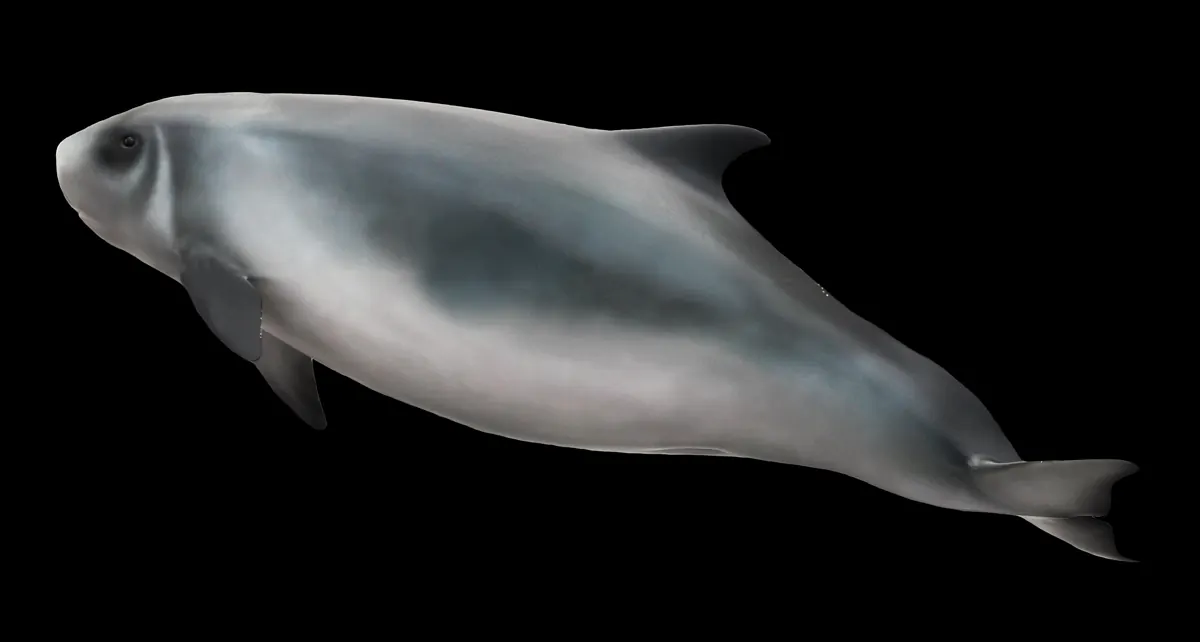
Dwarf Sperm Whale
Kogia sima
The smallest whale named for the sperm whale, a shy deep-water hunter that drifts at the surface and can squirt a cloud of ink.
Photo: Citron / CC BY-SA 3.0
3 things to know
- Calves are about 1 m (3.3 ft) long and weigh about 14 kg (30 lb) at birth.
- It can mature at just 2.5 years old.
- Around the main Hawaiian Islands it is the sixth most commonly seen toothed whale.
- Scientific name
- Kogia sima
- Depth
- 0 m – 300 m
0 – 984 ft - Size
- Up to about 2.7 m (9 ft) long
- Weight
- About 135–270 kg (300–600 lb)
- Lifespan
- Up to about 22 years
- Diet
- Squid and octopus, crabs and shrimp, and fish
- Where
- Tropical and warm temperate seas worldwide
- IUCN status
- Least Concern
- Depth zones
- Sunlight · Twilight
At up to about 2.7 meters (9 feet) and 135 to 270 kilograms (300 to 600 pounds), the dwarf sperm whale is the smaller of the two Kogia species. It has a marking behind the eye that NOAA calls a false gill, after its resemblance to a fish's gill slit. Like the pygmy sperm whale, its close relative, it can release more than 11 liters (3 gallons) of dark, reddish-brown ink to cover its escape from predators.
At sea the two small sperm whales are very hard to tell apart. In Hawaii, Robin Baird of Cascadia Research Collective separated them by the dorsal fin: on a dwarf sperm whale it sits about midway along the back and is relatively tall, more than 5 percent of body length, while a pygmy sperm whale's fin is shorter.
The species lives in temperate and tropical seas around the world, including the western North Atlantic and the northern Gulf in US waters. It is usually seen alone or in groups of 10 or fewer, and it almost never approaches boats. It hunts by echolocation, and NOAA says it dives at least 300 meters (1,000 feet) for squid, octopus, crabs, shrimp and fish.
During boat surveys around the main Hawaiian Islands from 2000 to 2003, Baird's team found Kogia 18 times, and 13 of the 14 groups identified to species were dwarf sperm whales. The sightings came mostly over deep water, averaging 1,425 meters (4,675 feet) to the bottom, and in calm seas. Most groups behaved the same way: the whales lay still at the surface for up to a few minutes, then slowly sank or rolled out of sight and were not seen again. Photos showed distinctive marks on some dorsal fins, so individuals can be recognized. Baird ranked the species the sixth most common toothed whale around the main islands.
Dwarf sperm whales mature at 2.5 to 5 years. In the Southern Hemisphere, calves are born between December and March, about 1 meter (3.3 feet) long and 14 kilograms (30 pounds). NOAA gives a lifespan of up to 22 years. Threats include entanglement in fishing gear, ship strikes, noise and debris in the deep layers where they feed, which may be mistaken for prey, and some stranded whales have been found with plastic blocking their stomachs. The IUCN lists the species as Least Concern.



