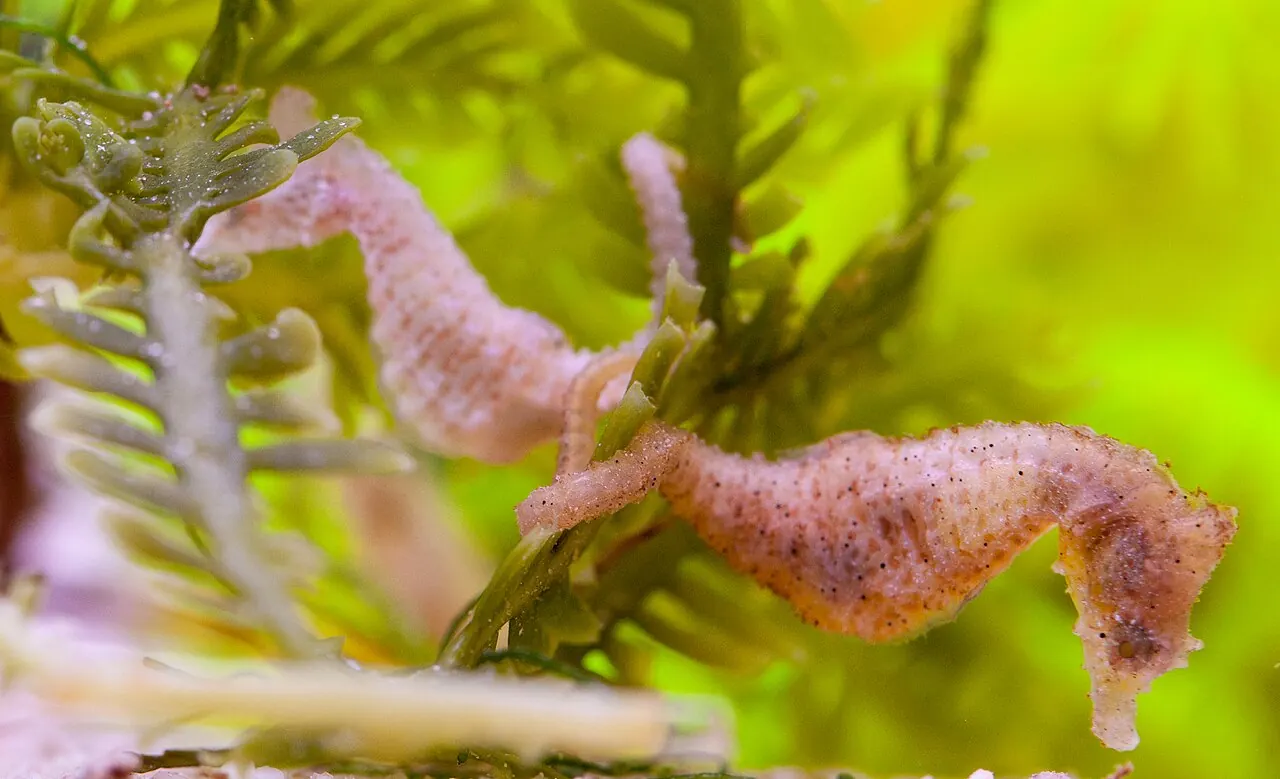
Dwarf Seahorse
Hippocampus zosterae
One of the smallest seahorses in the world, an inch-long seagrass fish from Florida and the Gulf whose males carry the young and give birth.
Photo: Will Thomas / CC BY 2.0
3 things to know
- NOAA ranks it the third-smallest seahorse species in the world.
- The male carries the young in a pouch for 10 to 12 days, then gives birth.
- A pair can produce up to two broods a month.
- Scientific name
- Hippocampus zosterae
- Depth
- 0 m – 2 m
0 – 7 ft - Size
- Usually about 2–3 cm (1 in) long; some males up to about 5 cm (2 in)
- Weight
- Not well known
- Lifespan
- About 1 year; rarely more than 2 years in the wild, up to 3 in aquariums
- Diet
- Copepods, amphipods and other tiny crustaceans
- Where
- Seagrass beds of the Gulf of Mexico, Florida, Bermuda, the Bahamas and the Caribbean
- IUCN status
- Least Concern
- Depth zones
- Sunlight
An adult dwarf seahorse is about the size of a fingertip. NOAA Fisheries lists it at 1 inch (about 2.5 centimeters) long and ranks it the third-smallest seahorse species in the world, though a few males have been measured at more than 5 centimeters (2 inches). Colors run from yellow and green to black, often with white markings or dark spots that help it disappear into seagrass.
It lives almost entirely in seagrass, in warm, shallow, sheltered water in the Gulf of Mexico, along Florida's Atlantic coast, in Bermuda, the Bahamas and the Caribbean. In the United States it has been recorded from Texas to Florida, and its Florida populations include Tampa Bay, Charlotte Harbor and Florida Bay. Its tail grips the grass blades, its eyes move independently of each other, and it swims by fine adjustments of its fins rather than speed. It barely travels; in one study dwarf seahorses moved about 3 meters (10 feet) a day on average.
It hunts by ambush, picking off copepods and amphipods, crustaceans only a few millimeters long, as they drift along the edges of the seagrass. While it feeds it makes a clicking sound with two bones in its skull.
Seahorses and their relatives the pipefishes are the only fishes in which the male gets pregnant. In the dwarf seahorse a three-day courtship ends with the female placing her eggs in the male's brood pouch, where they are fertilized and kept supplied with oxygen and a stable balance of salts. Pregnancy lasts 10 to 12 days, and the female visits the male each day. Broods average 3 to 16 young, though 55 have been counted in one pouch. Under good conditions a male can mate again 4 to 20 hours after giving birth. The fish mature in about three months and usually live about a year, rarely more than two in the wild, though some have reached three in aquariums.
The IUCN lists the dwarf seahorse as Least Concern, and in 2020 NOAA decided it did not warrant listing under the Endangered Species Act. Loss of seagrass, oil spills and energy exploration, and harvesting are the main threats, and international trade is regulated under CITES Appendix II.



