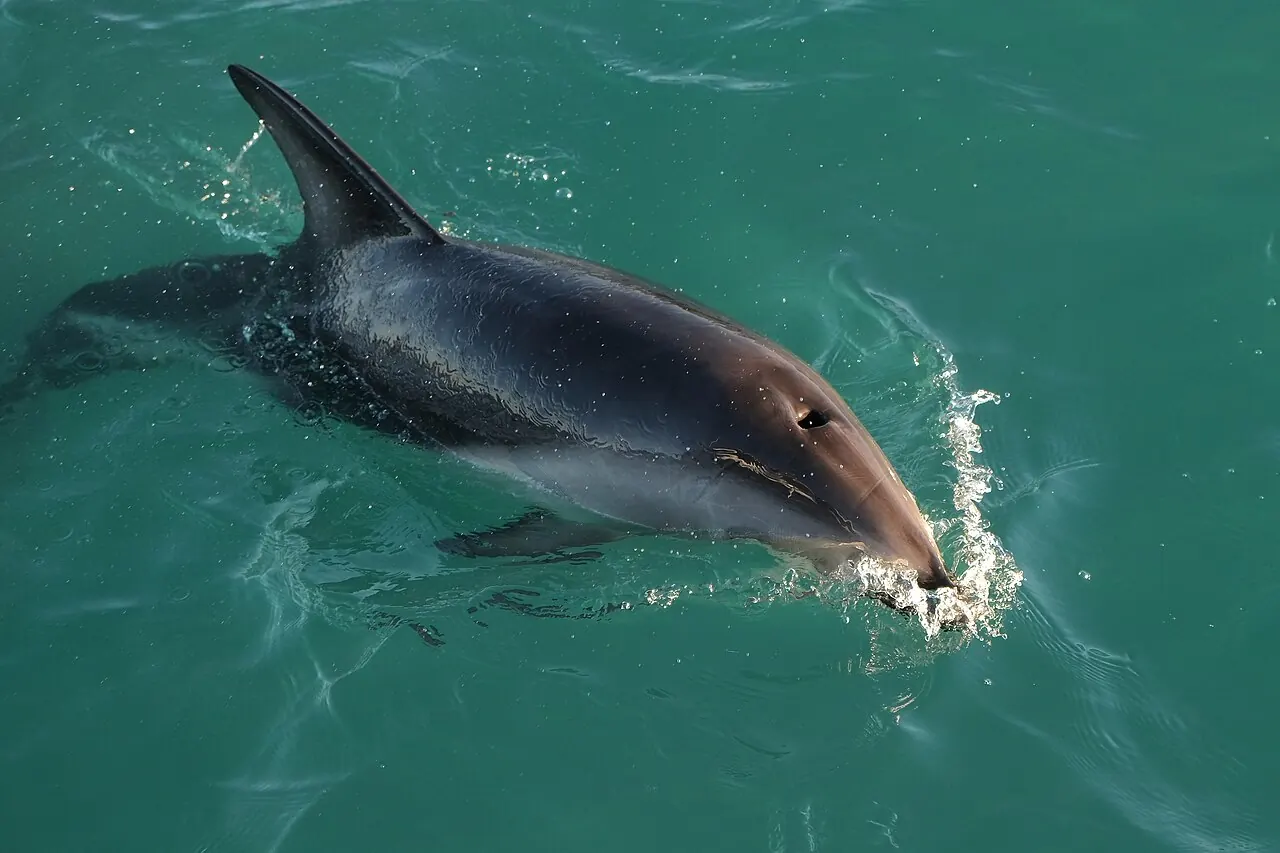
Dusky Dolphin
Aethalodelphis obscurus
An acrobatic Southern Hemisphere dolphin that, off Kaikoura in New Zealand, follows the deep scattering layer up toward the surface to hunt at night.
Photo: Pseudopanax at English Wikipedia / Public domain
3 things to know
- Off Kaikoura, groups of several hundred to more than 1,000 dusky dolphins are present all year.
- At night, Kaikoura's dusky dolphins appear to follow their prey as it rises from about 125 m to 30 m below the surface.
- In 2025 it and the Pacific white-sided dolphin were moved into a new genus of their own, Aethalodelphis.
- Scientific name
- Aethalodelphis obscurus
- Depth
- 0 m – 125 m
0 – 410 ft - Size
- Up to about 1.9 m (6.3 ft) for females and 2.1 m (6.9 ft) for males
- Weight
- Up to about 140 kg (310 lb)
- Lifespan
- 30 years or more
- Diet
- Anchovies, hake, squid and other small fish
- Where
- Temperate coastal waters of the Southern Hemisphere, mainly off South America, southwestern Africa and New Zealand
- IUCN status
- Least Concern
- Depth zones
- Sunlight
Dusky dolphins are small dolphins with almost no beak and a blunt, unhooked dorsal fin. They are bluish-black on the back and tail and white underneath. New Zealand's Department of Conservation gives a maximum length of 1.93 meters (6.3 feet) for females and 2.11 meters (6.9 feet) for males. They live in temperate waters of the Southern Hemisphere, with the main populations off South America, southwestern Africa and New Zealand. Because they stay fairly close to shore, these populations are separated from each other.
Off Kaikoura on the South Island, groups of several hundred to more than 1,000 are present all year, and some move north to Admiralty Bay in the Marlborough Sounds to feed in winter. The dolphins eat anchovies, hake, several kinds of squid and other small fish. When they feed near the surface they do it in large groups, with acrobatic leaps that are believed to help them coordinate.
Kaikoura's dolphins mostly hunt at night, and Kelly Benoit-Bird, Bernd Würsig and Cynthia McFadden showed how in a 2004 study. Using active acoustics, a kind of echosounding, they tracked both the dolphins and their prey in the deep scattering layer, a layer of small animals that rises toward the surface after dark. At 8 p.m. the layer had climbed to within 125 meters (410 feet) of the surface and the dolphins were inside it. By 1 a.m. it had risen to 30 meters (100 feet), and the dolphins had risen too, apparently following their prey, in coordinated subgroups of one to five. In shallow Admiralty Bay the pattern was different: dolphins showed up where prey was dense and were rarely present when it was not.
In 2025, Anders Galatius and colleagues used more than 3,000 nuclear genes to show that the dusky dolphin and the Pacific white-sided dolphin of the North Pacific form their own branch, and placed both in a new genus, Aethalodelphis. Older sources call it Lagenorhynchus obscurus.
Dusky dolphins mature at about 7 to 8 years and are thought to live 30 years or more. Killer whales and some sharks prey on them, and they move into shallower water and bunch together to avoid killer whales. The IUCN lists the species as Least Concern. Unknown numbers are caught in set nets in New Zealand each year, and at Kaikoura the Department of Conservation focuses on limiting the effects of tourism.
Sources
- doc.govt.nz/nature/native-animals/marine-mammals/dolphins/dusky-dolphin
- Study: doi:10.1111/j.1748-7692.2004.tb01152.x
- iucnredlist.org/species/11146/175604493
- marinemammalscience.org/science-and-publications/list-marine-mammal-species-subspecies
- Study: doi:10.1016/j.ympev.2025.108299
- sealifebase.se/summary/Lagenorhynchus-obscurus.html



