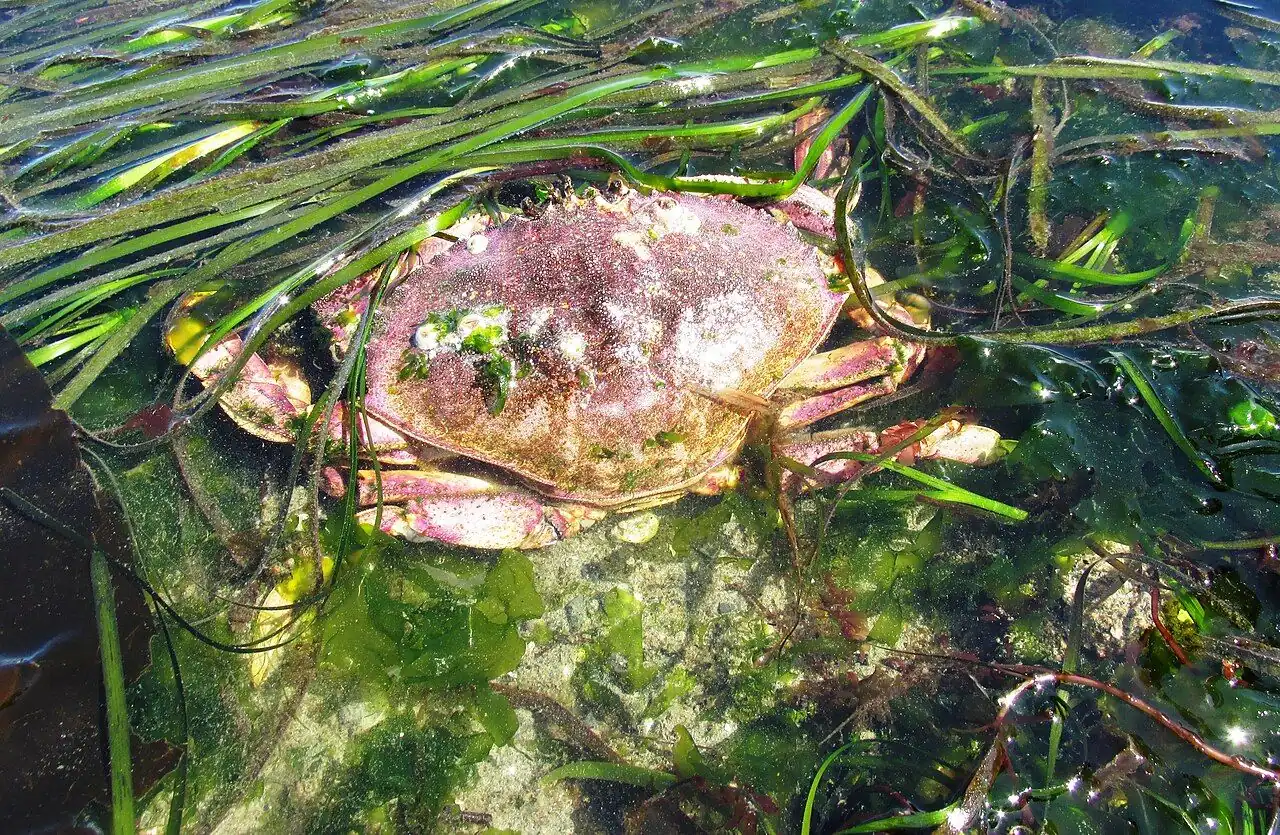
Dungeness Crab
Metacarcinus magister
The West Coast's prized eating crab, named for a sandy bay in Washington, whose larvae already show shell damage from acidifying seawater.
Photo: brewbooks / CC BY-SA 2.0
3 things to know
- It is named after the shallow, sandy bay inside Dungeness Spit in Washington.
- Females can store sperm for up to two years before fertilizing their eggs.
- A large female can carry up to about 2.5 million eggs.
- Scientific name
- Metacarcinus magister
- Depth
- 0 m – 30 m
0 – 98 ft - Size
- Shell about 16.5 cm (6.5 in) wide at legal size; large males exceed 25 cm (10 in)
- Weight
- About 0.9–1.4 kg (2–3 lb) at legal size
- Lifespan
- Estimated maximum 8–13 years
- Diet
- Clams, worms, shrimp, fish and small crabs; also scavenges
- Where
- Aleutian Islands, Alaska, to Magdalena Bay, Mexico
- IUCN status
- Not Evaluated
- Depth zones
- Sunlight
One spot on the map gave the Dungeness crab its name: the shallow, sandy bay inside Dungeness Spit, on the Washington shore of the Strait of Juan de Fuca. The species itself ranges from the Aleutian Islands of Alaska to Magdalena Bay in Mexico. It has a broad, oval, smooth-topped shell, and its legs are short for its body compared with those of king and Tanner crabs.
It lives on sandy and muddy bottoms and puts up with the changing salinity of estuaries. It is most abundant in water shallower than 30 meters (about 100 feet) but has been found as deep as 200 meters (660 feet). It hunts animals that live partly or completely buried in the sand, eating clams, worms, shrimp, fish and smaller crabs, and it scavenges dead fish and invertebrates. Sea otters, octopuses and Pacific halibut eat hard-shelled adults, and a crab that has just molted has many more enemies.
Males mate only with females that have just molted. A female can store the sperm for up to two years, and a large one carries up to about 2.5 million eggs on the hairs under her abdomen. The Alaska Department of Fish and Game says that in Alaska brooding females bury themselves and stop eating for six months or more, and produce eggs only every other year. Males reach Alaska's legal size of 16.5 centimeters (6.5 inches) across the shell at four to five years, weighing 0.9 to 1.4 kilograms (2 to 3 pounds), and the biggest exceed 25 centimeters (10 inches). The estimated maximum lifespan is 8 to 13 years.
The department lists ocean acidification among the species' main threats. In a 2020 study, Nina Bednaršek and colleagues examined crab larvae taken from the wild off the US West Coast, where acidification is intensifying faster than in the global ocean, using electron microscopes and X-ray methods. They found dissolution across the shell and legs, including around the mechanoreceptors, sense organs that help crabs feel their surroundings. The damage was most extensive in coastal waters with the steepest chemical gradients and the longest exposure, and larvae with more dissolution were narrower. The team estimated an 8.3 percent increase in outer shell dissolution over the previous two decades.
It has not been assessed for the IUCN Red List.



