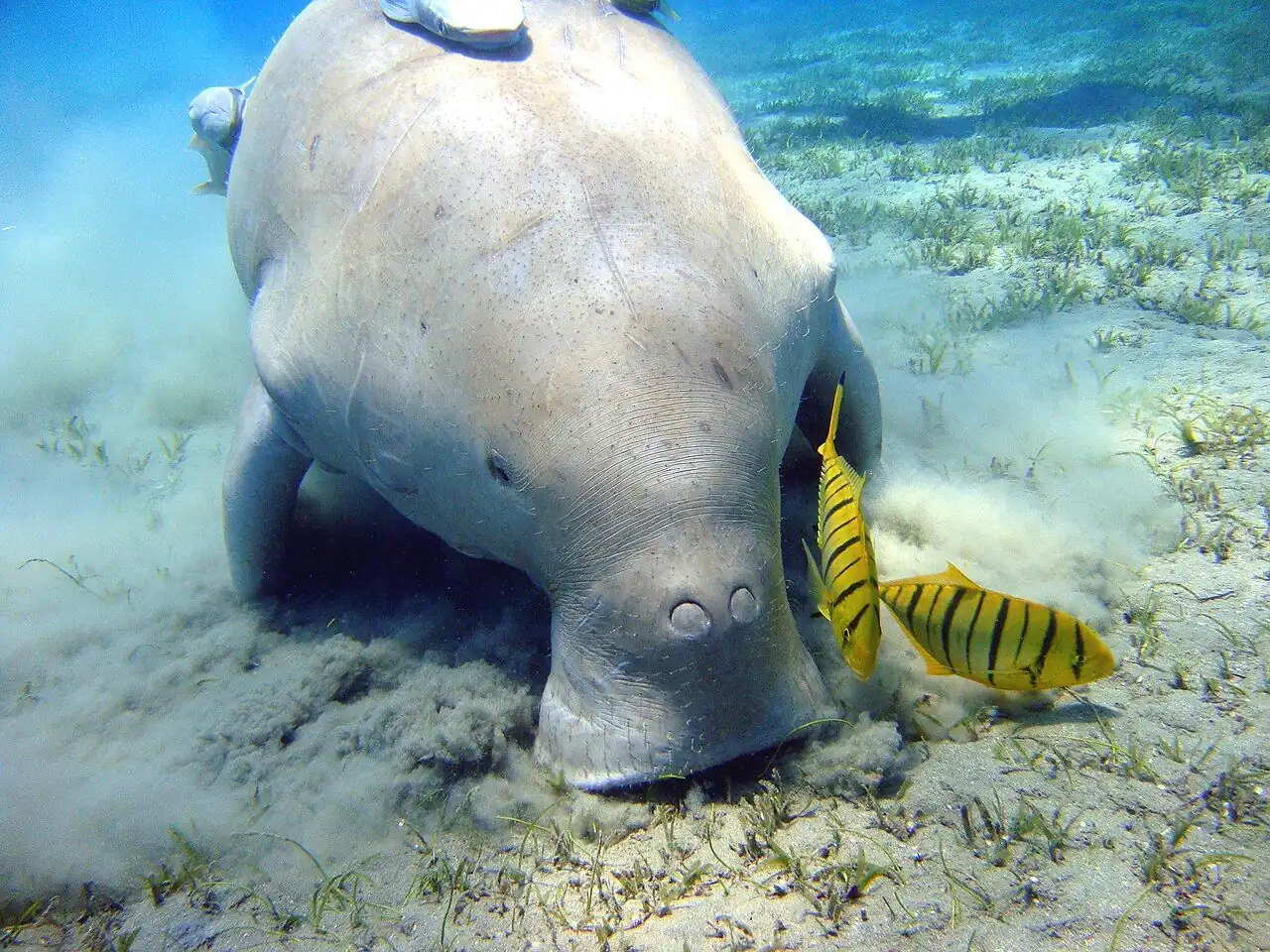
Dugong
Dugong dugon
The seagrass-grazing sea cow of the Indo-Pacific, the only living member of Steller's sea cow's family, now functionally extinct in China.
Photo: Julien Willem / CC BY-SA 3.0
3 things to know
- It has a fluked tail like a whale's, unlike the paddle-shaped tail of a manatee.
- A female may wait 2.5 to 7 years between calves.
- A 2022 study concluded dugongs are functionally extinct in China.
- Scientific name
- Dugong dugon
- Depth
- 0 m – 10 m
0 – 33 ft - Size
- About 2.4–4 m (8–13 ft) long
- Weight
- About 230–400 kg (510–880 lb)
- Lifespan
- 70 years or more, estimated from tusk growth layers
- Diet
- Seagrass
- Where
- Warm coastal waters of the western Indo-Pacific, including northern Australia
- IUCN status
- Vulnerable
- Depth zones
- Sunlight
Dugongs are grazers. A broad, flat muzzle angled down toward the seabed lets them crop seagrass leaves and roots, and a feeding herd leaves plumes of stirred-up sand that show where it has been. They eat seagrass and nothing else.
A dugong is a large, gray-brown, rounded animal with paddle-like flippers, no dorsal fin and small eyes and ears. Its tail is fluked like a whale's, unlike a manatee's paddle-shaped tail. Adults are about 2.4 to 4 meters (8 to 13 feet) long and 230 to 400 kilograms (510 to 880 pounds). Tusks, which are incisor teeth, show through the skin mainly in mature males and old females. The dugong is the only living member of its family. The only other known species, Steller's sea cow, was hunted to extinction in 1767, 36 years after it was discovered.
Dugongs live in warm coastal waters of the western Indo-Pacific. In Australia they occur in an arc from Moreton Bay in Queensland across the north to Shark Bay in Western Australia. They prefer wide, shallow bays, mangrove channels and the sheltered sides of inshore islands, usually at depths around 10 meters (33 feet), though they sometimes dive to 39 meters (128 feet) to feed.
They breed slowly. A calf is born after 12 to 14 months of pregnancy and suckles for about 18 months, and a female may not calve again for 2.5 to 7 years. Counting growth layers in their tusks suggests dugongs can live 70 years or more. That pace leaves them open to sharp declines when nets, boats and hunting kill adults.
Mingli Lin of the Chinese Academy of Sciences, Samuel Turvey of the Zoological Society of London and colleagues interviewed 788 people who work on the sea across four Chinese provinces. Only 5 percent had ever seen a dugong, and on average their last sighting was 23 years earlier. With no verified field sighting since 2000, the team concluded in 2022 that dugongs are functionally extinct in China, the first such loss reported for a large vertebrate in Chinese seas.
The IUCN lists the dugong as Vulnerable. It is protected in all Australian states and under the CITES trade treaty, and it is on the US endangered species list.



