Decorator Crab
Many species in the spider crab superfamily Majoidea
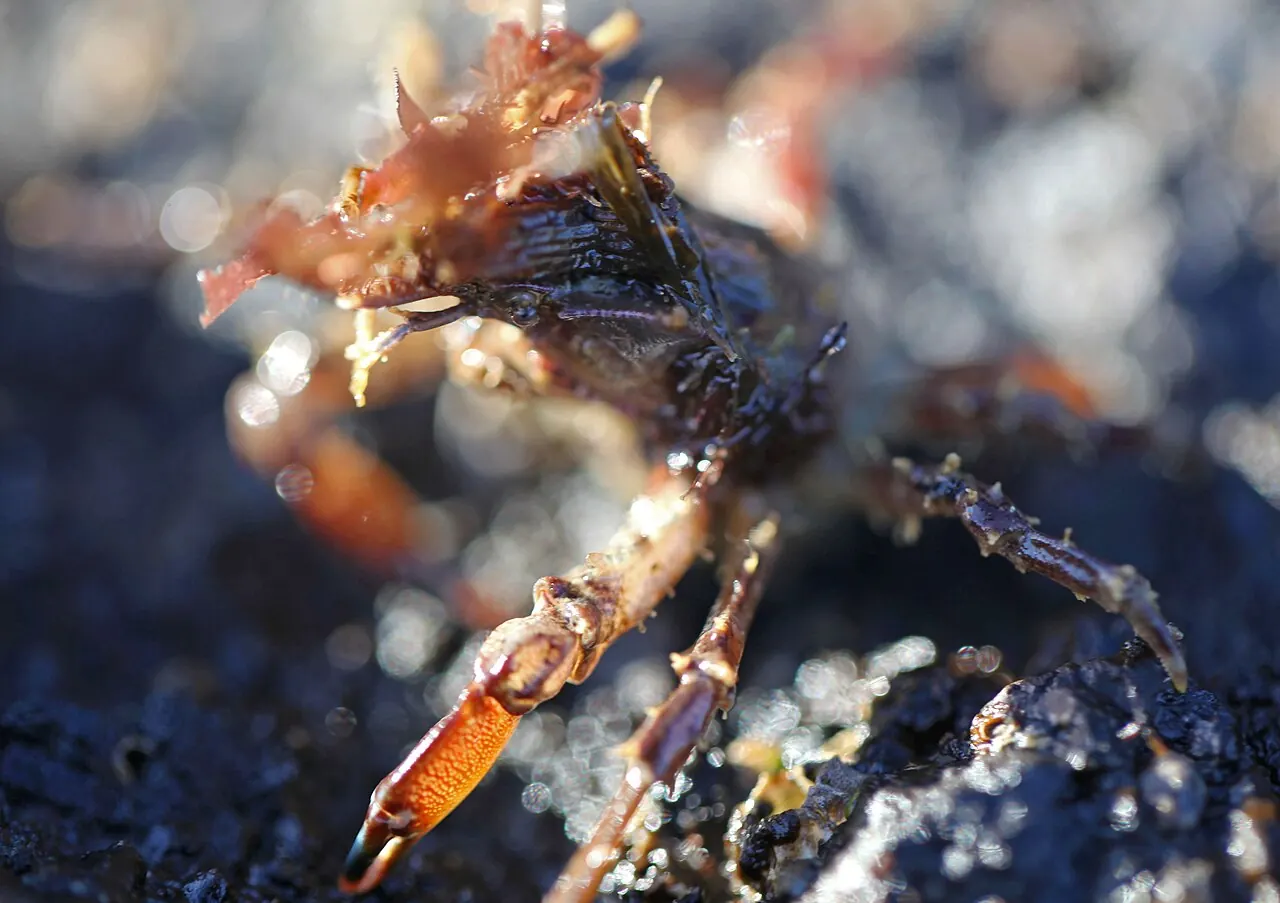
Spider crabs that stick seaweed, sponges and other living things to their shells as camouflage, and sometimes borrow their chemical defenses.
Photo: Peter Pearsall/U.S. Fish and Wildlife Service / Public domain
3 things to know
- Hooked, Velcro-like bristles on the shell hold the crab's decorations in place.
- When it molts, a decorator crab moves its decorations from the old shell to the new one.
- In North Carolina, one species dresses almost only in a seaweed that fish avoid.
- Scientific name
- Many species in the spider crab superfamily Majoidea
- Depth
- 0 m – 400 m
0 – 1,312 ft - Size
- Varies by species; the California decorator crab Loxorhynchus crispatus is up to about 9 to 13 cm (3.5 to 5 in) across
- Weight
- Unknown
- Lifespan
- Not well known
- Diet
- Varies; Loxorhynchus crispatus eats algae, sponges, small crustaceans and bryozoans
- Where
- Oceans from the Bering Sea and New England to the tropics; the species we checked live on both coasts of North America and in the Indo-West Pacific
- IUCN status
- Not Evaluated (for the species we checked)
- Depth zones
- Sunlight · Twilight
Decorating is a habit, and a whole set of crabs share it. Many spider crabs in the superfamily Majoidea pick up bits of seaweed, sponge and other small living things and fasten them to their backs, where hooked, Velcro-like bristles called setae hold them in place. The disguise can be good enough that a crab passes for a moving rock. On the California coast, the Monterey Bay Aquarium's decorator crab, Loxorhynchus crispatus, grows to about 12.7 centimeters (5 inches) and eats algae, sponges, small crustaceans and bryozoans. When it molts, it takes the anemones, sponges and other decorations off its old shell and puts them on the new one.
Not every spider crab decorates, and size seems to matter. In a 2009 study in The American Naturalist, Kristin Hultgren and John Stachowicz compared majoid species and found that the amount of hooked setae on a crab strongly predicted how much decoration it wore in the field. In half the species they examined, the hooks thinned out as crabs grew, and across species, bigger crabs had fewer of them. Several kelp crabs that decorate little change color to blend in instead. The aquarium notes the same pattern in its crab: large ones decorate less, though plants and animals still settle on their shells.
Some crabs choose their costume with care. In North Carolina, Stachowicz and Mark Hay found that the decorator crab Libinia dubia covers itself almost entirely with the seaweed Dictyota menstrualis, which is chemically noxious, and so borrows its defenses against omnivorous predators. In winter and spring, when the seaweed disappears, the crabs switch to a sun sponge that local fish also refuse to eat. Farther north, in Rhode Island, Connecticut and New Jersey, where the seaweed does not grow, Libinia simply matched its surroundings. The 2000 study noted that the shift coincides with lower predation pressure in the north.
Decorator crabs live from the shore into deeper water. The graceful decorator crab, Oregonia gracilis, ranges from the Bering Sea south to US waters and down to 400 meters (1,312 feet), and Libinia dubia is recorded to 46 meters (150 feet). Lifespans are not well known, and the species we checked have not been assessed by the IUCN.
Sources
- montereybayaquarium.org/animals/animals-a-to-z/decorator-crab
- Study: doi:10.1086/597797
- Study: doi:10.1086/303366
- sealifebase.se/summary/Oregonia-gracilis.html
- sealifebase.se/summary/Loxorhynchus-crispatus.html
- sealifebase.se/summary/Libinia-dubia.html
- sealifebase.se/summary/Camposcia-retusa.html
- en.wikipedia.org/wiki/Decorator_crab



