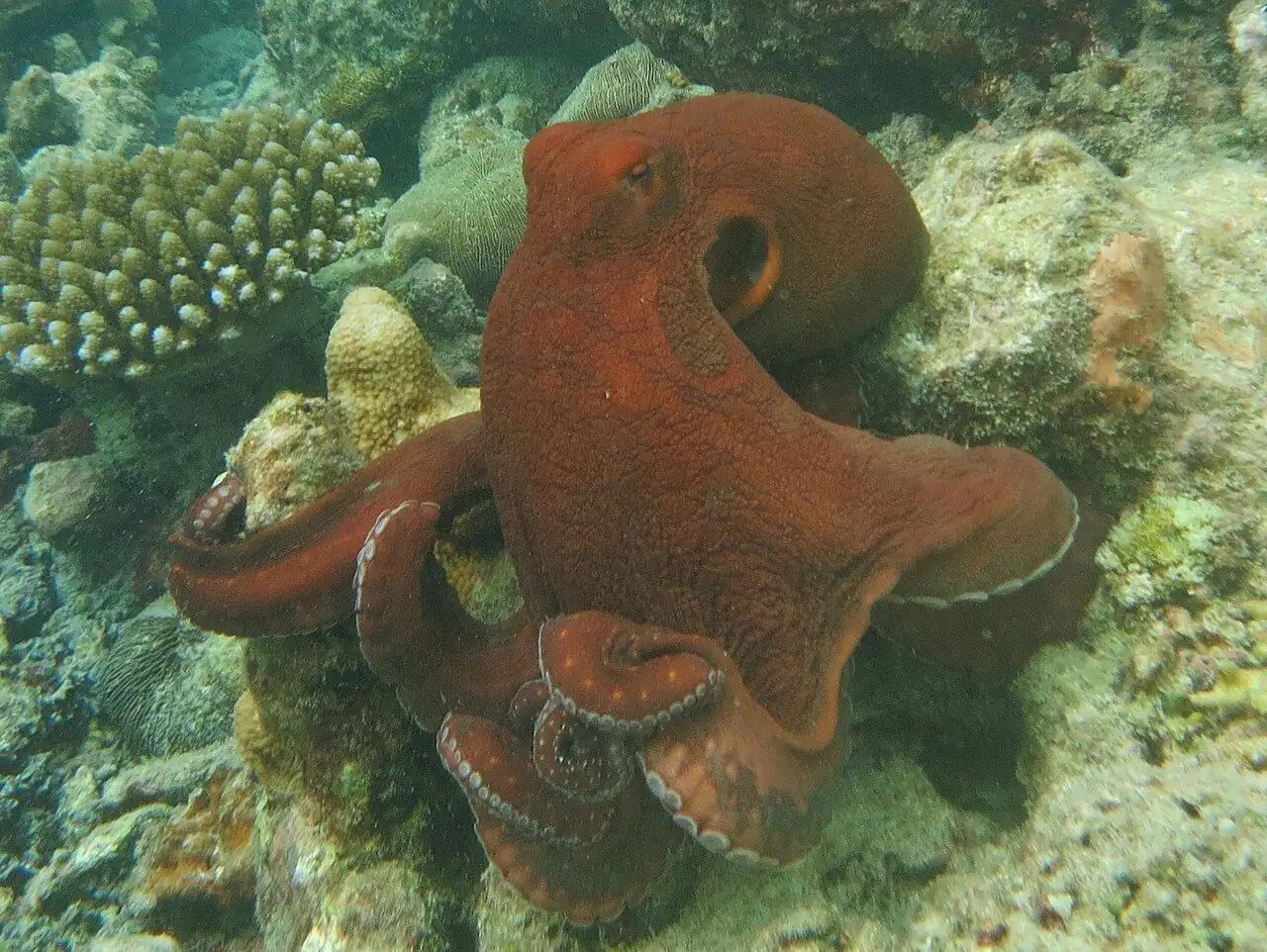
Day Octopus
Octopus cyanea
A reef octopus of the Indian and Pacific Oceans that hunts by day, often with fish partners it sometimes punches.
Photo: Ahmed Abdul Rahman / CC BY-SA 4.0
3 things to know
- Unlike most octopuses, it hunts in daylight.
- It often hunts alongside goatfish and groupers, and sometimes punches them.
- A female guards her eggs without eating and dies about 10 days after the last one hatches.
- Scientific name
- Octopus cyanea
- Depth
- 0 m – 150 m
0 – 492 ft - Size
- Arm span typically about 80 cm (31 in); mantle up to about 22 cm (8.7 in)
- Weight
- Usually about 1.2 kg (2.6 lb); up to about 6 kg (13 lb)
- Lifespan
- Usually 12–15 months
- Diet
- Mainly crabs, snails and clams
- Where
- Indian and Pacific Oceans, from East Africa and the Red Sea to Hawaii
- IUCN status
- Least Concern
- Depth zones
- Sunlight
Hunting in daylight is uncommon among octopuses, but Octopus cyanea does it, which is how it got its common name. It lives on coral reefs and the sand, rubble and seagrass around them across the Indian and Pacific Oceans, from East Africa and the Red Sea to the Hawaiian Islands, from the shallows to about 150 meters (490 feet). It is also called the big blue octopus. The name cyanea means dark blue, for the dark blue rings on its skin, though like other octopuses it can change color to blend into its surroundings.
A typical adult weighs about 1.2 kilograms (2.6 pounds) and measures about 80 centimeters (31 inches) from arm tip to arm tip. The heaviest reach about 6 kilograms (13 pounds). It feeds mostly on crabs, snails and clams. Sometimes it pounces on a crab; at other times it spreads the web of skin between its arms over a coral head, rock or clump of algae and feels underneath with its arm tips for anything hiding there. It stays in one den for up to about 35 days, then moves on.
Life is short. Day octopuses mature at about 10 to 12 months and usually live 12 to 15 months. A female lays hundreds of thousands of tiny eggs, guards them day and night without eating, and dies about 10 days after the last one hatches. Males also stop eating, lose weight and die, at around 13 to 15 months. The IUCN lists the species as Least Concern.
On reefs in the Red Sea and on the Great Barrier Reef, day octopuses often hunt with fish. Goatfish probe the sand while groupers wait above for anything that bolts. In a short paper in the journal Ecology, Eduardo Sampaio and colleagues described octopuses lashing out with one arm at their fish partners, a move they called punching. Their 3D tracking of these hunting groups, published in 2024, found that goatfish mostly decide where the group goes, while the octopus decides whether and when it moves, and that the octopus punches partners that exploit the group.



