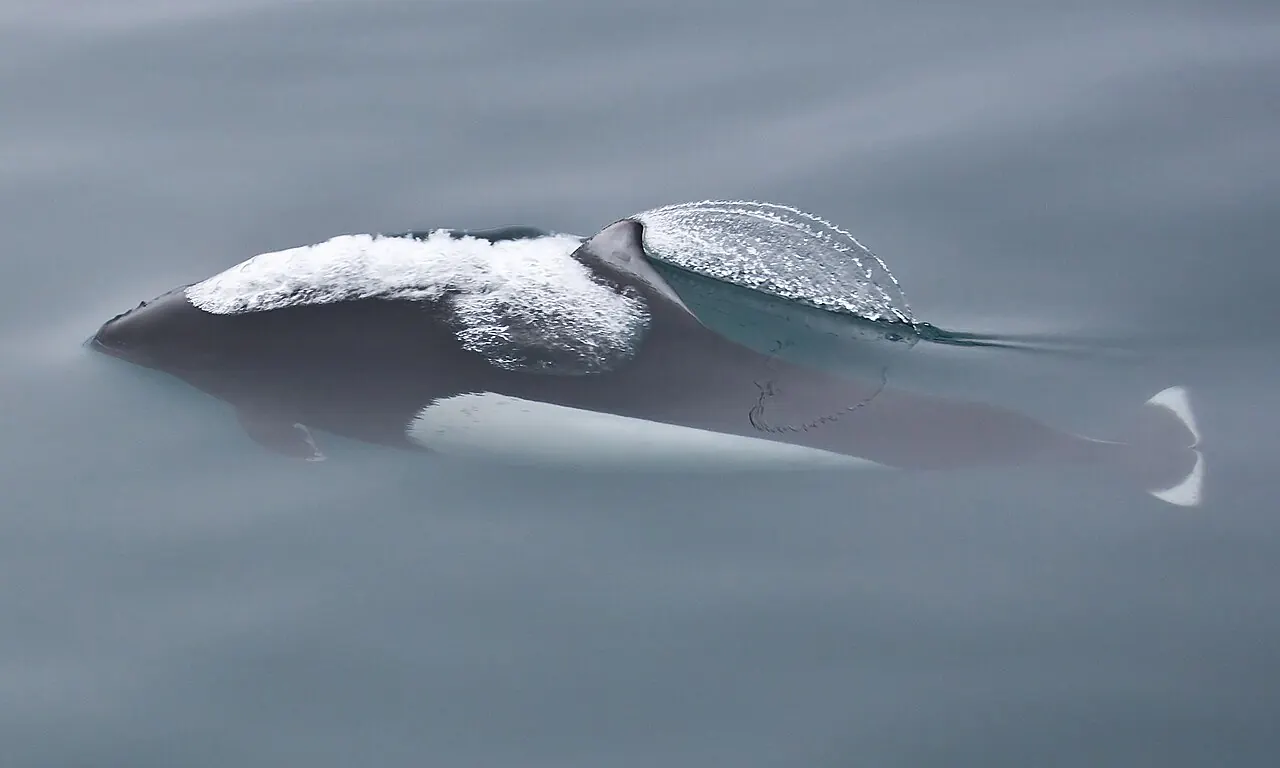
Dall's Porpoise
Phocoenoides dalli
A chunky black-and-white North Pacific porpoise, often mistaken for a baby orca, that throws up a rooster tail of spray at speed.
Photo: Susan E Adams / CC BY-SA 2.0
3 things to know
- It can swim at about 55 km/h (34 mph) over short distances.
- Its teeth are about the size of a grain of rice.
- Hybrids between Dall's and harbor porpoises are fairly common in the northeast Pacific.
- Scientific name
- Phocoenoides dalli
- Depth
- 0 m – 236 m
0 – 774 ft - Size
- About 2.1–2.4 m (7–8 ft) long
- Weight
- Up to about 200 kg (440 lb)
- Lifespan
- Usually 15–20 years; up to about 22
- Diet
- Small schooling fish, lanternfish and other midwater fish, and squid
- Where
- North Pacific, from about 30° to 62° N, from Baja California to the Bering Sea and Japan
- IUCN status
- Least Concern
- Depth zones
- Sunlight · Twilight
With its black body and bright white flank patches, a Dall's porpoise is often mistaken for a baby killer whale, but it has no eye patch or saddle and its dorsal fin is triangular. The fin and the tail carry white markings too. The head is small, with little or no beak, the body is thick, and the tail stock rises into a pronounced hump. NOAA Fisheries gives adults a length of 2.1 to 2.4 meters (7 to 8 feet) and a weight of up to 200 kilograms (440 pounds). Its teeth are tiny, about the size of a grain of rice, with 38 to 56 in each jaw.
NOAA calls it the fastest swimmer among small whales and dolphins, reaching about 55 kilometers per hour (34 miles per hour) over short distances. It throws up a "rooster tail" of spray that is a mark of the species, and it is drawn to fast-moving boats, riding beside their bows. Groups average 2 to 12 animals, but loose gatherings of hundreds or even thousands have been seen.
Dall's porpoises live across the North Pacific between about 30° and 62° north, from Baja California to the Bering Sea and from central Japan to the Sea of Okhotsk, and are found off the US West Coast from California to the Bering Sea. They prefer water deeper than 180 meters (600 feet) and between 2 and 17°C (36 and 63°F). Three porpoises tagged off British Columbia and Washington in 1997 made longer, probably foraging dives with median depths of 22 to 33 meters (72 to 108 feet); the deepest reached 236 meters (774 feet), the limit of the recorder. NOAA says they can dive to 500 meters (1,640 feet). They usually feed at night, when lanternfish, squid and other prey rise toward the surface. Hybrids with harbor porpoises are fairly common in the northeast Pacific.
The IUCN's assessment, published in 2018, lists the species as Least Concern, with more than a million animals. NOAA's estimates include about 100,000 off the US West Coast and 83,000 off Alaska. Japan has hunted them with hand harpoons since the 1910s, under quotas the IUCN says rest on optimistic assumptions, and with bycatch in Japanese and Russian waters the removals total on the order of 20,000 a year, which likely affects local stocks. In US waters the species is protected under the Marine Mammal Protection Act.



