Midnight Zone · 1,000–4,000 m
The Whale That Dove Nearly 10,000 Feet and Held Its Breath 3 Hours
Tags off California and North Carolina caught Cuvier's beaked whales setting mammal records for depth and dive time.
Ziphius cavirostris
A scarred, deep-diving beaked whale that hunts squid more than a kilometer down and has set mammal records for dive depth and length.
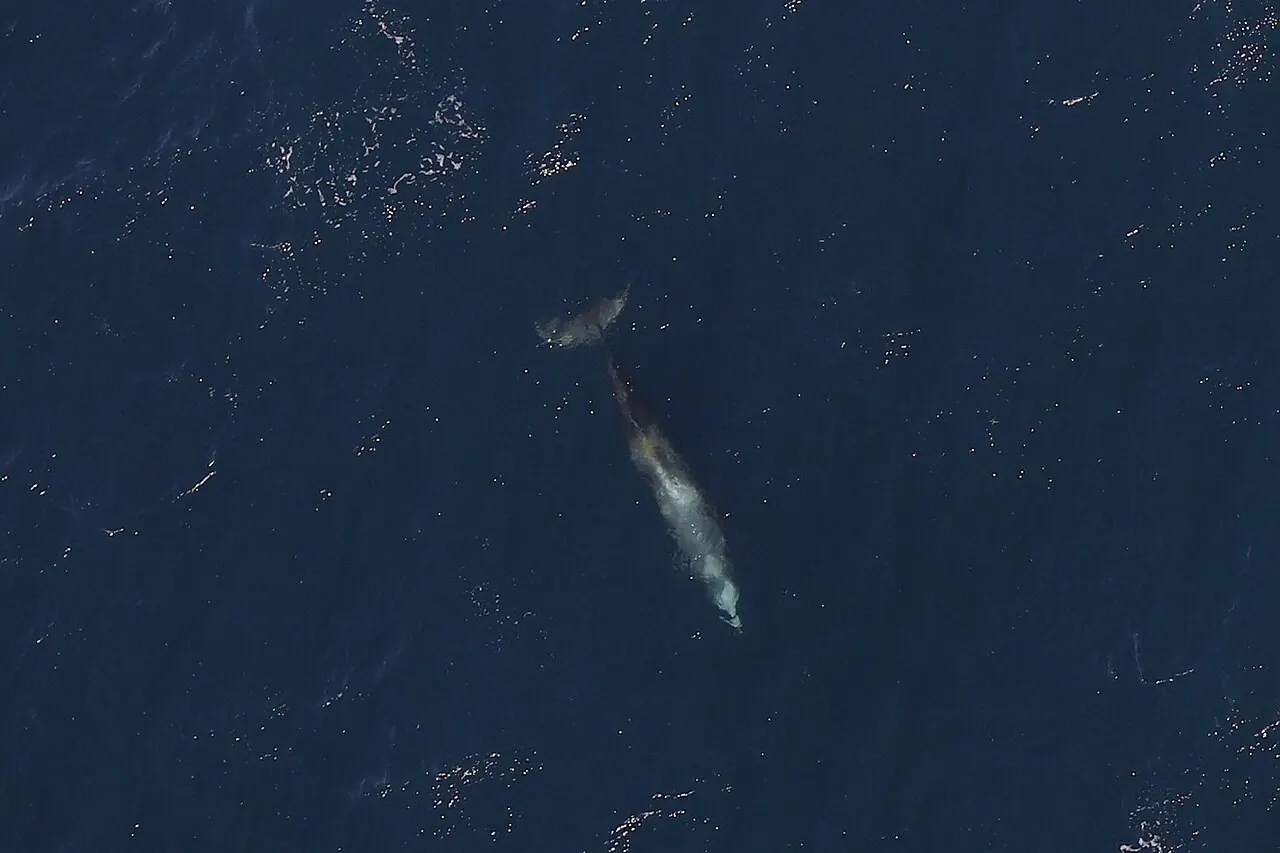
Photo: Laura (Laney) White, USGS Western Ecological Research Center / Public domain
Also called the goose-beaked whale, Cuvier's beaked whale has a sloping head with no obvious melon, an indistinct beak and a body that ranges from dark gray to reddish-brown. The skin is often covered with linear scratches and oval scars. Males have two small cone-shaped teeth at the tip of the lower jaw, often used in fights. Adults are about 4.6 to 7 meters (15 to 23 feet) long and weigh about 1,800 to 3,100 kilograms (4,000 to 6,800 pounds), according to NOAA Fisheries.
It lives in temperate, subtropical and tropical seas and prefers deep water, usually more than 1,000 meters (3,300 feet), along the continental slope. It feeds mostly on squid and octopus, and sometimes fish and crustaceans.
Its dives are extreme. Satellite tags on eight whales off Southern California, reported by Gregory Schorr and colleagues in 2014, recorded deep dives averaging 1,401 meters (about 4,600 feet) and 67 minutes. One reached 2,992 meters (9,816 feet), and one lasted 137.5 minutes, both new records for a mammal. The longest dive known for the species lasted 222 minutes. In 3,680 dives from 23 tags, Nicola Quick's team found no link between the longest dives and the rest that followed. They suggested a low metabolic rate, large oxygen stores and a strong capacity to buffer the acid that builds up in working muscles.
Breeding and calving seem to happen year round, often in spring. After a pregnancy of about a year, a female has a single calf every two to three years. NOAA estimates a lifespan of up to 60 years.
The IUCN lists the species as Least Concern, and it is protected under the US Marine Mammal Protection Act. Noise is a growing concern. Strandings in the Bahamas, the Caribbean, the Canary Islands and the Mediterranean have been associated with active naval sonar, and Schorr's tagged whales were inside a Navy sonar training range on 38 percent of the days their locations came through. Entanglement in fishing gear is another threat.



