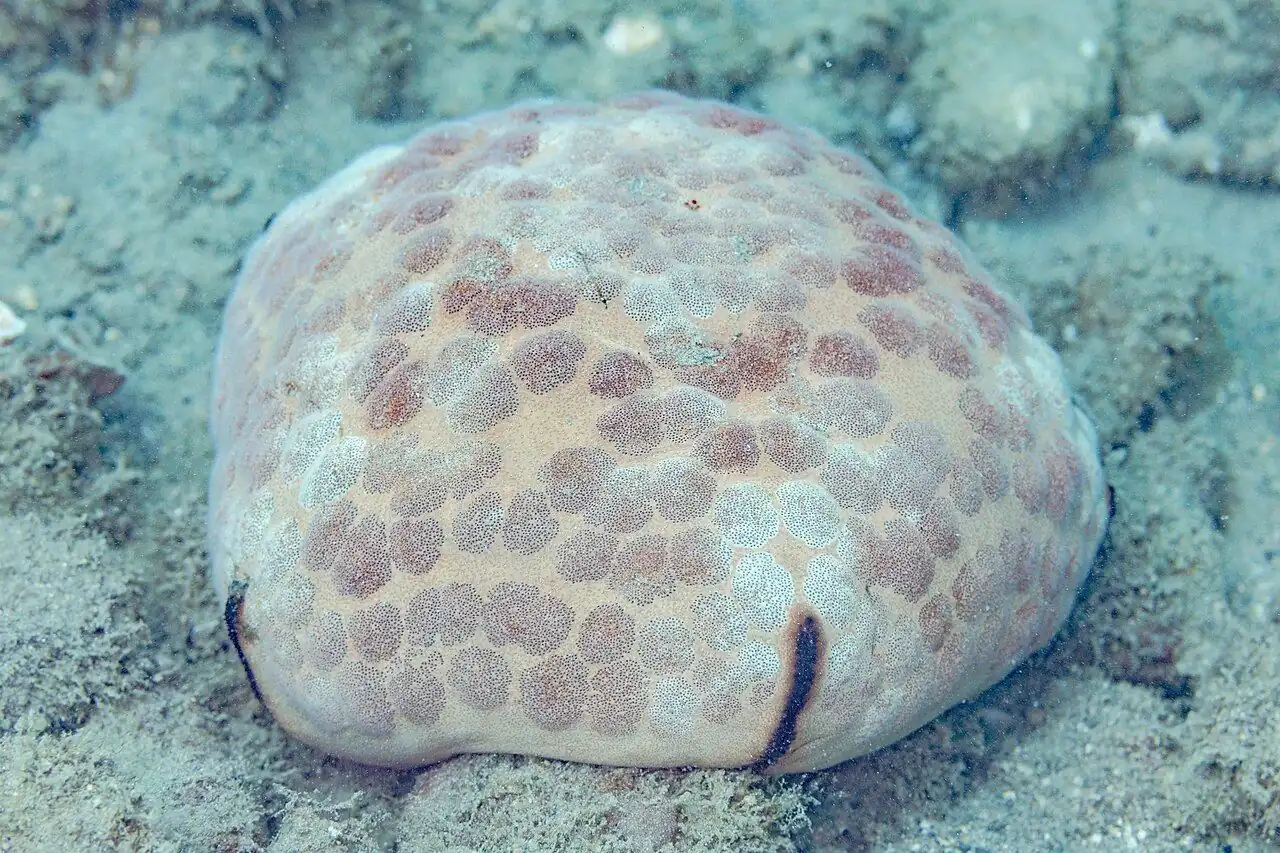
Cushion Star
Culcita novaeguineae
A puffy, five-sided sea star with arms so short they barely show. It starts life star-shaped and grows into a cushion that eats coral.
Photo: Diego Delso / CC BY-SA 4.0
3 things to know
- Young cushion stars less than 10 mm (0.4 in) from center to arm tip are star-shaped.
- In lab tests in Hawaii it chose Pocillopora corals over three other kinds of coral.
- A pearlfish, Carapus mourlani, lives mainly in sea stars, and in Micronesia it prefers cushion stars.
- Scientific name
- Culcita novaeguineae
- Depth
- 1 m – 20 m
3 – 66 ft - Size
- Usually 30–40 cm (12–16 in) across
- Weight
- Unknown
- Lifespan
- Unknown; reaches adult size in about 2 years
- Diet
- Coral polyps and other small animals fixed to the reef; also sea urchins and the microbial film on the bottom
- Where
- Coral reefs of the tropical Indo-Pacific, east to Hawaii
- IUCN status
- Not Evaluated
- Depth zones
- Sunlight
An adult Culcita novaeguineae looks less like a starfish than a stuffed cushion: a thick, domed pentagon, almost round in outline, with arms so short they barely show. Most are 30 to 40 centimeters (12 to 16 inches) across. The thick skin may be cream, green or brown, broken up by patches of red, brown or green.
Young ones look more like ordinary sea stars. In 1991 Yasuo Kano of Japan's Uozu Aquarium and two Toyama University biologists reported that juveniles less than 10 millimeters (0.4 inch) from center to arm tip are typically star-shaped. They suggested that uneven growth of the arms and the edges between them turns those inward-curving edges straight, while a loosely built skeleton helps give the adult its cushion shape. The Western Australian Museum says it takes about 2 years to reach adult size. Its weight and lifespan are not known.
The cushion star lives across the tropical Indo-Pacific, as far east as Hawaii, on living reefs at the reef edge and slope. SeaLifeBase puts it mostly 1 to 20 meters (3 to 66 feet) down, with records as deep as 90 meters (295 feet). It feeds on coral polyps and other small animals fixed to the reef, and the Western Australian Museum adds sea urchins and the film of microbes on the bottom. In a study of the Hawaiian population published in 1986, Glynn and Krupp found in lab tests that it preferred two Pocillopora corals to Porites, Montipora and Fungia. It ate about 28 square centimeters (4.3 square inches) of Pocillopora damicornis a day. Small colonies, guarded by fewer and smaller crabs and shrimp, were eaten more often than big ones. The authors put the coral it kills at about one-fifth of the toll from the crown-of-thorns starfish.
Other animals live on it and in it. A small shrimp, Periclimenes soror, lives on its underside. The pearlfish Carapus mourlani lives mainly in sea stars, and in Micronesia it prefers this one. On Moorea, in French Polynesia, Eric Parmentier and Pierre Vandewalle found seven C. mourlani in 15 percent of the 45 cushion stars they collected.
The cushion star has not been assessed for the IUCN Red List.
Sources
- sealifebase.se/summary/Culcita-novaeguineae.html
- museum.wa.gov.au/online-collections/names/Culcita-novaeguineae
- vliz.be/imisdocs/publications/ocrd/122554.pdf
- Study: doi:10.1016/0022-0981(86)90014-6
- kirjandus.geoloogia.info/en/reference/52316
- fishbase.se/summary/Carapus-mourlani.html
- orbi.uliege.be/bitstream/2268/12846/1/19etho-eco.pdf
- api.gbif.org/v1/species/5187244/iucnRedListCategory



