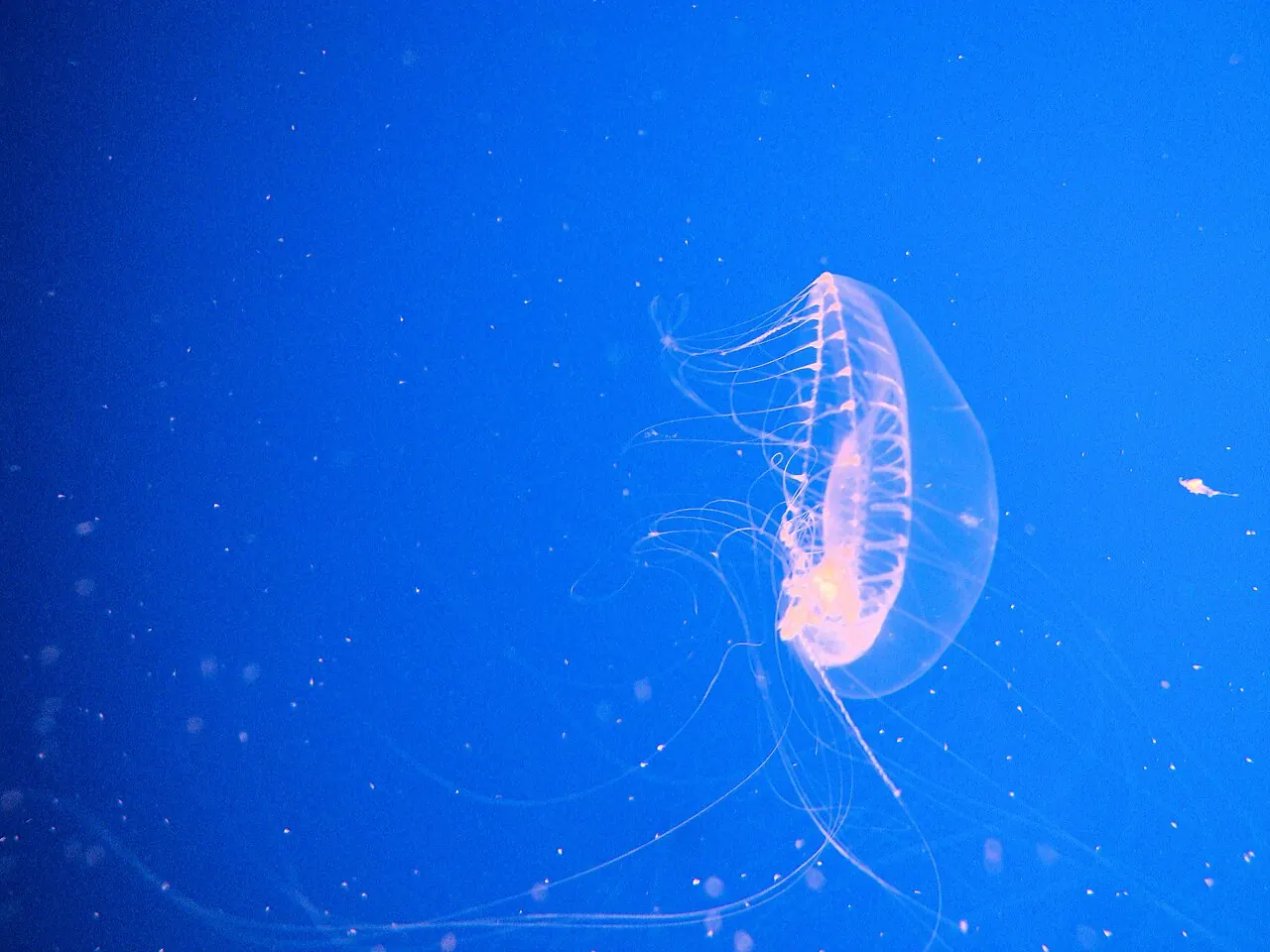
Crystal Jelly
Aequorea victoria
A clear Pacific jelly whose glowing rim gave science aequorin and green fluorescent protein, honored with the 2008 Nobel Prize in Chemistry.
Photo: Jim G from Silicon Valley, CA, USA / CC BY 2.0
3 things to know
- Its green fluorescent protein turns the blue light of another protein, aequorin, into green.
- In the summer of 1961, researchers took extract from about 10,000 of these jellies to study their glow.
- Around Friday Harbor, Washington, it tends to stay in the top 25 m (82 ft) of water.
- Scientific name
- Aequorea victoria
- Depth
- 0 m – 25 m
0 – 82 ft - Size
- Bell about 7 to 12 cm (3 to 4.7 in) across in species descriptions; the Monterey Bay Aquarium gives up to 25 cm (10 in)
- Weight
- Not well known
- Lifespan
- Not well known; more than two years in an aquarium
- Diet
- Other jellies, comb jellies, copepods and larval fish
- Where
- Northeast Pacific, from Southern California to British Columbia and the Gulf of Alaska
- IUCN status
- Not Evaluated
- Depth zones
- Sunlight
During the summer of 1961, Osamu Shimomura and Frank Johnson gathered crystal jellies at Friday Harbor, Washington, cut off the rims of their bells and squeezed them through a filter. When Shimomura poured some of the extract into a sink, it flashed. Calcium in the seawater had set off the reaction, and the flash was blue, not green like the rim of a living jelly. They took extract from about 10,000 jellies back to Princeton and purified a few milligrams of the blue light-maker, which they named aequorin.
Their 1962 paper also mentioned a protein that glowed green under ultraviolet light, the first description of what became green fluorescent protein, or GFP. In the jelly, GFP turns aequorin's blue light into green. It needs no added chemicals to glow, and in 1994 Martin Chalfie's team used it as a living tag, making six touch-sensing nerve cells shine green in the worm C. elegans. Shimomura, Chalfie and Roger Tsien shared the 2008 Nobel Prize in Chemistry for the discovery and development of GFP.
The animal is a clear hydromedusa. Its bell is saucer-shaped, with dozens of radial canals, sometimes more than 100, and up to 150 tentacles. Size estimates vary: a Canadian fisheries guide gives a bell up to 12 centimeters (4.7 inches) wide, SeaLifeBase 7 centimeters, and the Monterey Bay Aquarium up to 25 centimeters (10 inches). The Monterey Bay Aquarium says it glows green-blue from more than 100 tiny light organs along the bell's edge when disturbed. It lives in the northeast Pacific, from Southern California to British Columbia and the Gulf of Alaska. Around Friday Harbor it tends to stay in the top 25 meters (82 feet), with no sign of a day-night pattern, Claudia Mills and Richard Vogt reported in 1984. It eats other jellies, comb jellies and copepods, and larval fish such as Pacific herring. Its life cycle includes a tiny attached polyp stage, rarely found in the wild.
In 2018 and 2019 it made up as much as 90% of the large jellies netted in most surveys of the northern Gulf of Alaska. In Puget Sound, densities were high from the early 1960s to the mid-1990s, when researchers were collecting thousands for aequorin and GFP. Since then the jellies there have become fewer and smaller, a change that may reflect environmental change as well as heavy collecting. The IUCN has not evaluated the species.
Sources
- nobelprize.org/prizes/chemistry/2008/popular-information
- nobelprize.org/prizes/chemistry/2008/press-release
- Study: doi:10.1002/jcp.1030590302
- Study: doi:10.1126/science.8303295
- montereybayaquarium.org/animals/animals-a-to-z/crystal-jelly
- waves-vagues.dfo-mpo.gc.ca/Library/922.pdf
- Study: doi:10.2307/1541443
- archive.org/download/biostor-9853/biostor-9853.pdf
- scholarsbank.uoregon.edu/xmlui/bitstream/handle/1794/12624/A_victoria_2015_final.pdf
- inverts.wallawalla.edu/Cnidaria/Class-Hydrozoa/Hydromedusae/Aequorea_victoria.html
- Study: doi:10.1093/plankt/fbad032
- par.nsf.gov/servlets/purl/10468060
- sealifebase.se/summary/Aequorea-victoria.html
- api.gbif.org/v1/species/2267514/iucnRedListCategory



