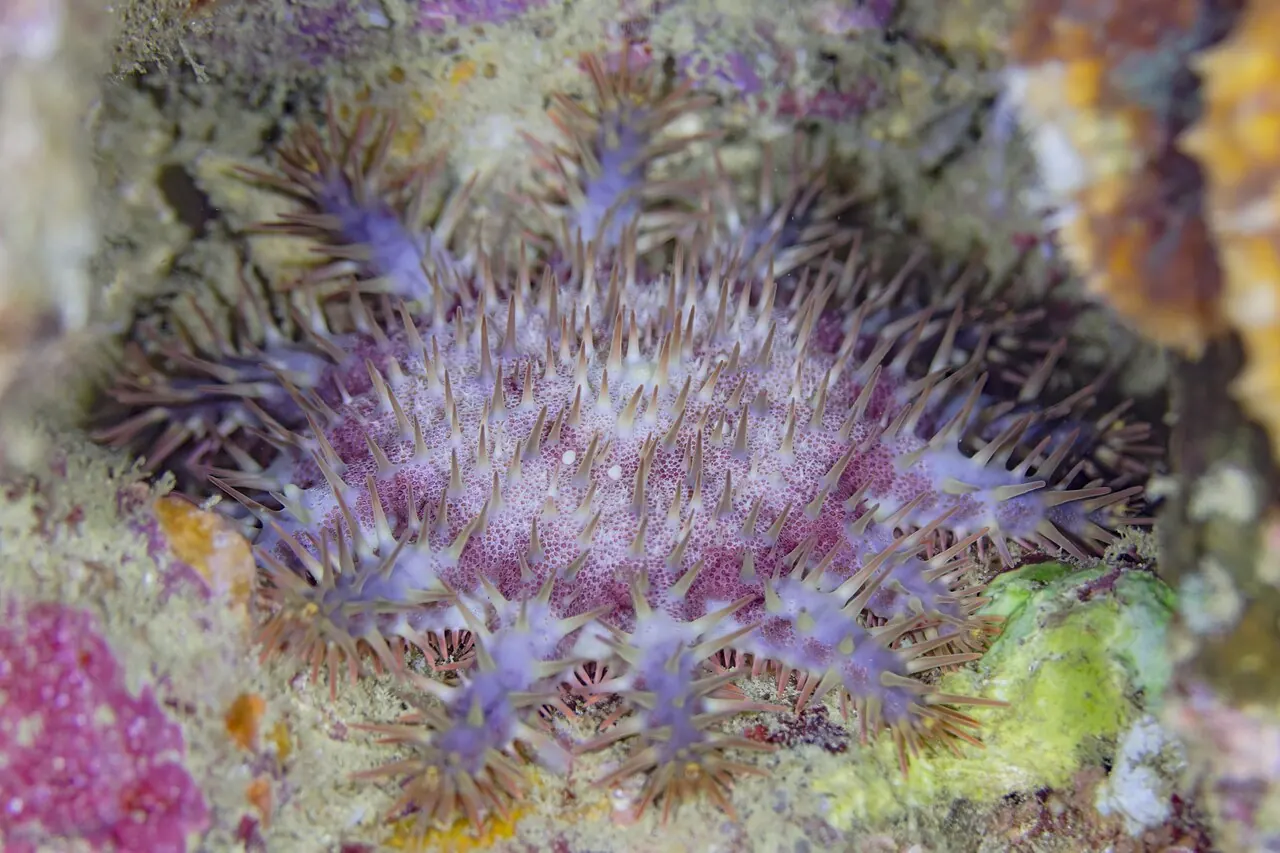
Crown-of-Thorns Starfish
Acanthaster planci (species complex)
A large, venomous-spined Indo-Pacific starfish that eats living coral and, in outbreaks, can strip whole reefs.
Photo: Diego Delso / CC BY-SA 4.0
3 things to know
- It eats coral by pushing its stomach out over the colony and digesting the living tissue.
- A study of the Great Barrier Reef from 1985 to 2012 blamed it for 42% of the coral cover lost.
- In 2016 it became the first starfish shown to have true image-forming vision.
- Scientific name
- Acanthaster planci (species complex)
- Depth
- 0 m – 65 m
0 – 213 ft - Size
- Usually 25–35 cm (10–14 in) across; up to about 80 cm (31 in)
- Weight
- Unknown
- Lifespan
- Not well known
- Diet
- Mainly hard corals; also soft corals, encrusting animals and algae
- Where
- Coral reefs of the Indo-Pacific, including the Great Barrier Reef
- IUCN status
- Not Evaluated
- Depth zones
- Sunlight
The crown-of-thorns starfish eats living coral. Its many arms and upper surface bristle with sharp spines carrying toxins that are venomous to people and to marine animals, and it is one of the largest sea stars in the world: usually 25 to 35 centimeters (10 to 14 inches) across, with a recorded maximum of about 80 centimeters (31 inches). To feed, it climbs onto a coral, pushes its stomach out of its body over the colony and digests the tissue, leaving bare white skeleton behind. The Great Barrier Reef Foundation says one can eat its way through about 10 square meters (110 square feet) of coral a year.
It lives on coral reefs across the Indo-Pacific, from the surface down to about 65 meters (213 feet), and is mostly active at night. In normal numbers it is part of a healthy reef, tending to eat fast-growing corals and giving slower species a chance. The foundation defines an outbreak as 15 or more starfish in a hectare (2.5 acres), and at that density they can strip a reef of 90% of its living coral tissue.
Glenn De'ath, Katharina Fabricius and colleagues put a number on the damage in 2012. Using 2,258 surveys of 214 reefs from 1985 to 2012, they found that coral cover on the Great Barrier Reef fell from 28.0% to 13.8%. Cyclones accounted for 48% of the estimated loss, crown-of-thorns starfish 42% and bleaching 10%. On the reef, trained divers cull outbreaks by injecting the starfish with bile salts or vinegar, which kill them without harming the reef around them.
In 2016, Ronald Petie, Anders Garm and Michael Hall showed shapes to crown-of-thorns starfish in aquarium tests. The starfish moved toward dark targets in a way that required true spatial vision, the first direct proof of image-forming sight in any starfish.
DNA barcoding has found at least four species within what was long called Acanthaster planci. In 2017, Gerhard Haszprunar, Catherine Vogler and Gert Wörheide proposed keeping that name for the northern Indian Ocean form and calling the Pacific one, including Great Barrier Reef and Philippine starfish, A. solaris. The World Register of Marine Species still treats A. solaris as a synonym of A. planci but accepts separate species from the southern Indian Ocean and the Red Sea. How long they live in the wild is not well known, and the IUCN has not assessed them.
Sources
- sealifebase.se/summary/Acanthaster-planci.html
- barrierreef.org/the-reef/threats/crown-of-thorns-starfish
- Study: doi:10.1073/pnas.1208909109
- Study: doi:10.1186/s12983-016-0174-9
- en.wikipedia.org/wiki/Crown-of-thorns_starfish
- marinespecies.org/aphia.php
- marinespecies.org/aphia.php
- Study: doi:10.3390/d9020022
- api.gbif.org/v1/species/2271208/iucnRedListCategory



