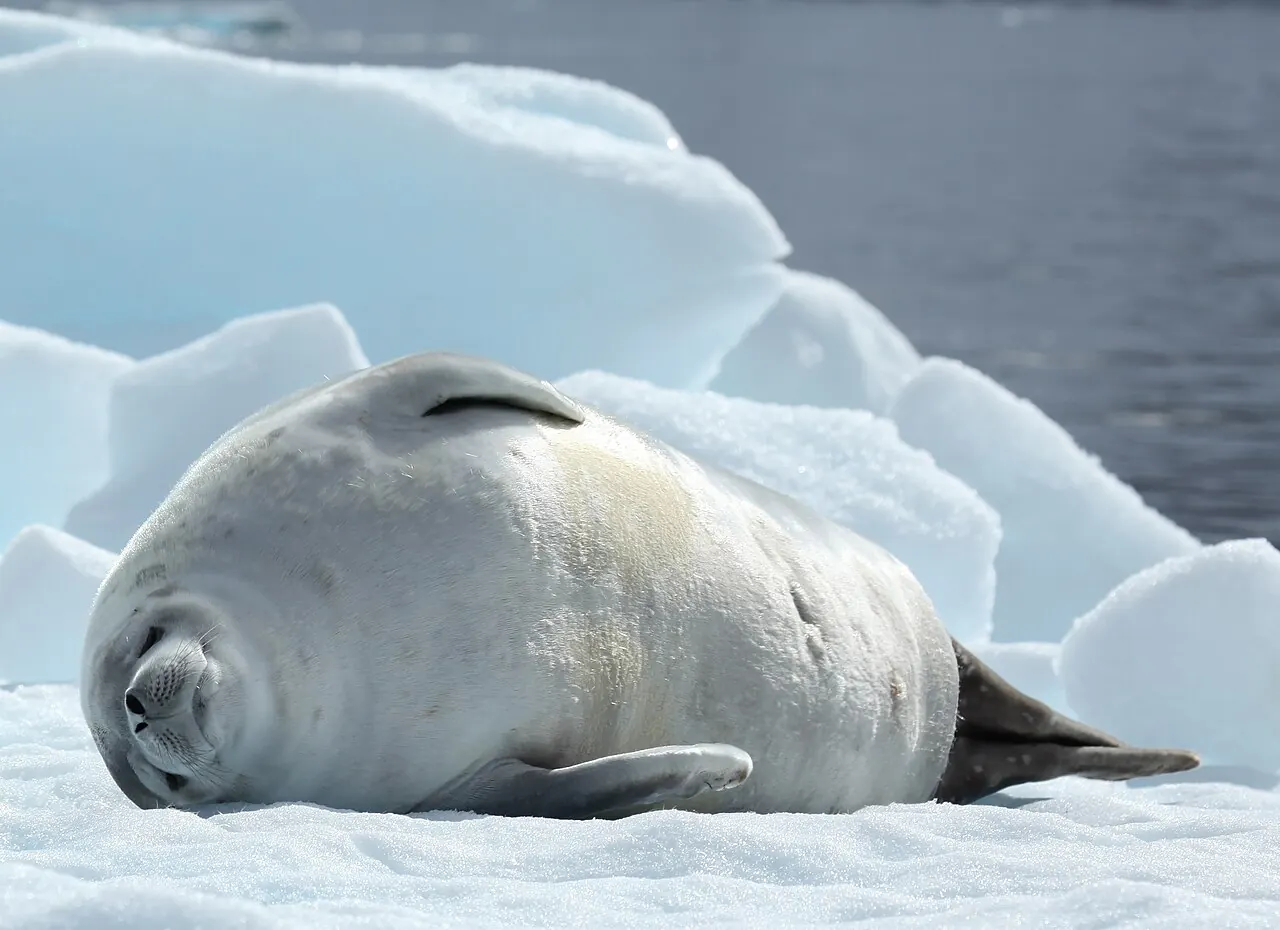
Crabeater Seal
Lobodon carcinophaga
The most abundant seal in the Southern Ocean, which never eats crabs: its lobed teeth sieve krill from the water like a strainer.
Photo: Liam Quinn from Canada / CC BY-SA 2.0
3 things to know
- Despite its name, it eats krill, not crabs.
- Its teeth have been called the most complex of any carnivore.
- Most adults carry long scars from leopard seal attacks they survived when young.
- Scientific name
- Lobodon carcinophaga
- Depth
- 0 m – 713 m
0 – 2,339 ft - Size
- About 2–2.5 m (6.6–8.2 ft) long
- Weight
- About 200–300 kg (440–660 lb), up to about 400 kg (880 lb)
- Lifespan
- Not well known; females have given birth at up to about 25 years old
- Diet
- Antarctic krill
- Where
- Pack ice around Antarctica; strays reach South America, South Africa, Australia and New Zealand
- IUCN status
- Least Concern
- Depth zones
- Sunlight · Twilight
Crabeater seals do not eat crabs. They live on Antarctic krill, and the Australian Antarctic Division traces the name to the German word Krebs, which covers other crustaceans as well as crabs. Their teeth do the work. Each tooth carries several lobes separated by deep gaps, and the upper and lower teeth fit together so closely that, with the mouth shut, the gaps are the only openings left. The seal takes in a mouthful of seawater and strains it out, keeping the krill. Writing in 1981, the biologist Gerald Kooyman called these teeth "the most complex of any carnivore."
The body is slender, with a long snout, and males and females are about the same size: about 2 to 2.5 meters (6.6 to 8.2 feet) and 200 to 300 kilograms (440 to 660 pounds), with large animals reaching 400 kilograms (880 pounds). After the summer molt the fur is dark brown above and blond below, and it fades through the year until the seal is almost entirely blond.
Crabeaters spend their whole lives in the pack ice around Antarctica, resting, breeding and molting on floes and feeding in the water below, and they move south in spring and north in autumn as the ice shrinks and spreads. The Australian Antarctic Division calls them the most abundant seal in the Southern Ocean. A pregnant female gives birth on a floe in spring, and a male soon joins her and guards mother and pup, though he is probably not the father. He waits until the pup is weaned at about three weeks, and the pair appears to mate on the ice rather than in the water.
In summer they usually feed within about 20 meters (65 feet) of the surface. Winter is different. Jennifer Burns, Daniel Costa and colleagues tagged 34 adults in Marguerite Bay on the Antarctic Peninsula in 2001 and 2002, and found winter dives averaged 92 meters (300 feet), ranged from 6 to 713 meters (20 to 2,340 feet) and lasted up to 23.6 minutes, with the seals hauling out at night instead of by day.
Leopard seals are their main predator, especially of pups, and most adult crabeaters carry long scars from attacks they survived when young. The IUCN lists the species as Least Concern.
Sources
- web.archive.org/web/20220709112248/https://www.antarctica.gov.au/about-antarctica/anima…
- animaldiversity.org/accounts/Lobodon_carcinophaga
- Study: doi:10.1016/j.dsr2.2004.07.021
- research-portal.st-andrews.ac.uk/en/publications/winter-habitat-use-and-foraging-behavi…
- Study: doi:10.2305/IUCN.UK.2025-2.RLTS.T12246A294810299.en
- en.wikipedia.org/wiki/Crabeater_seal



