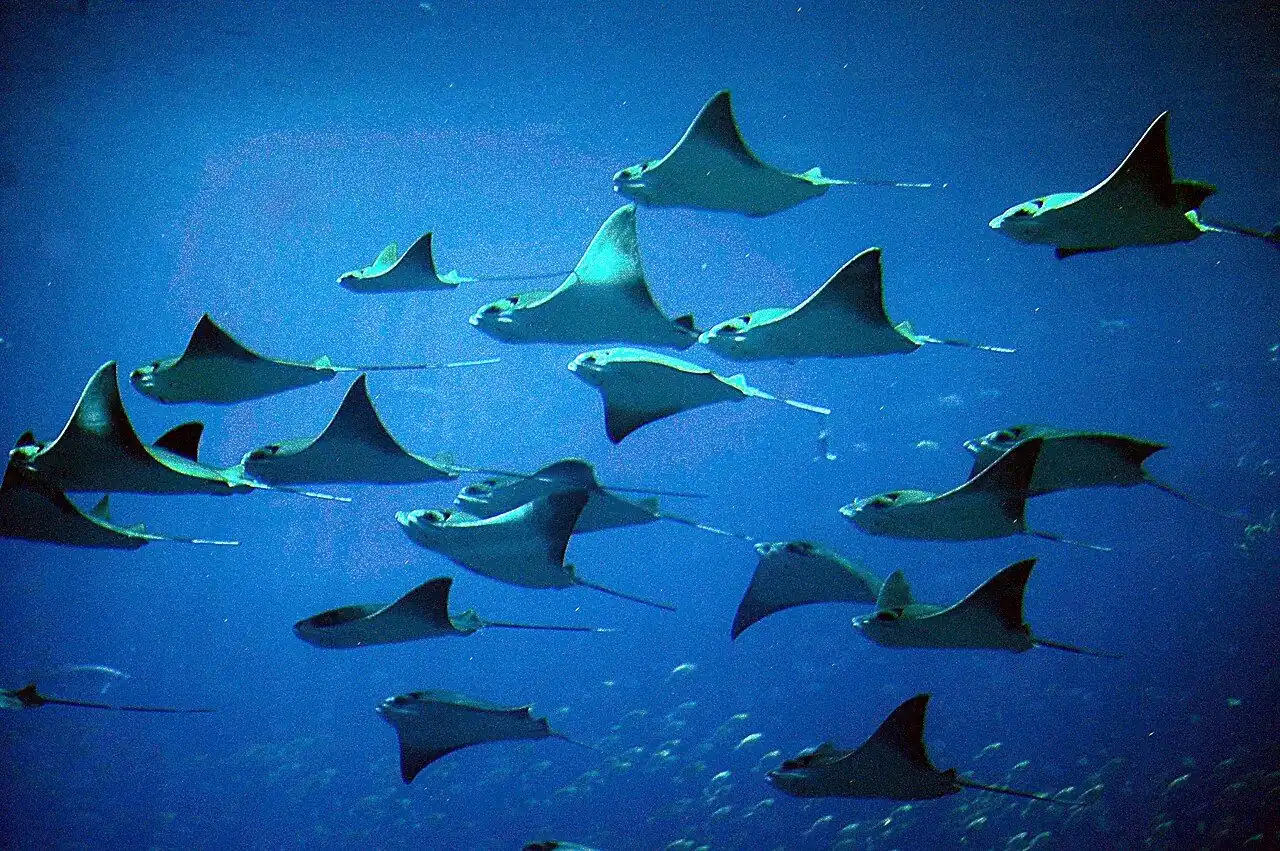
Cownose Ray
Rhinoptera bonasus
A brown, long-winged ray with a two-lobed snout that migrates along the US Atlantic and Gulf coasts in large schools.
Photo: Mike Johnston from San Francisco, USA / CC BY 2.0
3 things to know
- A female usually has just one pup a year, after a pregnancy of 11 to 12 months.
- In the Gulf of Mexico, schools of up to 10,000 rays leave Florida's west coast for Mexico's Yucatán each fall.
- Maryland has barred cownose ray fishing contests since 2017.
- Scientific name
- Rhinoptera bonasus
- Depth
- 0 m – 22 m
0 – 72 ft - Size
- Disc up to about 1.1 m (3.6 ft) wide in Chesapeake Bay; FishBase gives a maximum of 1.2 m (3.9 ft)
- Weight
- Not well documented
- Lifespan
- At least 21 years (oldest aged female)
- Diet
- Mainly thin-shelled bivalves; also crustaceans, worms and fish
- Where
- Western Atlantic from New England to Florida and the Gulf of Mexico, south to Brazil, Uruguay and northern Argentina
- IUCN status
- Vulnerable
- Depth zones
- Sunlight
A deep groove runs across the front of a cownose ray's head below the eyes, and the snout under it is split into two lobes. The disc is brown to olive above, without spots, and white below, with long, pointed wings. In Chesapeake Bay, females reach about 1.1 meters (3.6 feet) across. Unlike many rays, it rarely rests on the bottom, and it sometimes jumps, landing with a loud smack.
It lives in the western Atlantic from New England to Florida, through the Gulf of Mexico and south to Argentina, in coastal water no deeper than about 22 meters (72 feet), including bays and estuaries. Schools head north along the US East Coast in late spring and back south in late fall. Maryland's Department of Natural Resources says the rays overwinter off Florida and that part of the adult population enters Chesapeake Bay in May. In the Gulf, FishBase reports schools of up to 10,000 rays leaving Florida's west coast for the Yucatán in fall. Cownose rays feed on the bottom, crushing thin-shelled bivalves between plate-like teeth, and they also eat crustaceans, worms and fish.
Breeding is slow. A study of 694 rays from Chesapeake Bay by Robert Fisher, Garrett Call and Dean Grubbs found that females mature at about 7 to 8 years and usually carry a single embryo for 11 to 12 months. The oldest female they aged was 21.
That slow breeding became central to an argument. In 2007, Ransom Myers and colleagues argued in Science that as large sharks were fished out of the northwest Atlantic, cownose rays increased and ate enough bay scallops to end a century-long scallop fishery. The idea helped justify a fishery promoted as "Save the Bay, Eat a Ray." In 2016, Grubbs, of Florida State University, and colleagues reexamined the data in Scientific Reports. They found that the shark declines did not line up in time with the supposed rise in rays, the rise in rays did not line up with the shellfish declines, and the rays' biology makes a rapid population increase impossible.
Since 2017, Maryland has barred cownose ray fishing contests, first under a temporary moratorium that lawmakers later extended, and the state's Department of Natural Resources says there are too few data to assess the East Coast population. The IUCN lists the species as Vulnerable.
Sources
- fishbase.se/summary/Rhinoptera-bonasus.html
- floridamuseum.ufl.edu/discover-fish/species-profiles/rhinoptera-bonasus
- dnr.maryland.gov/fisheries/Documents/Reg_Changes/Atlantic-Cownose-Ray-Summary.pdf
- Study: doi:10.1080/19425120.2013.812587
- Study: doi:10.1126/science.1138657
- Study: doi:10.1038/srep20970
- api.gbif.org/v1/species/5215777/iucnRedListCategory
- iucnredlist.org/species/60128/3088381



