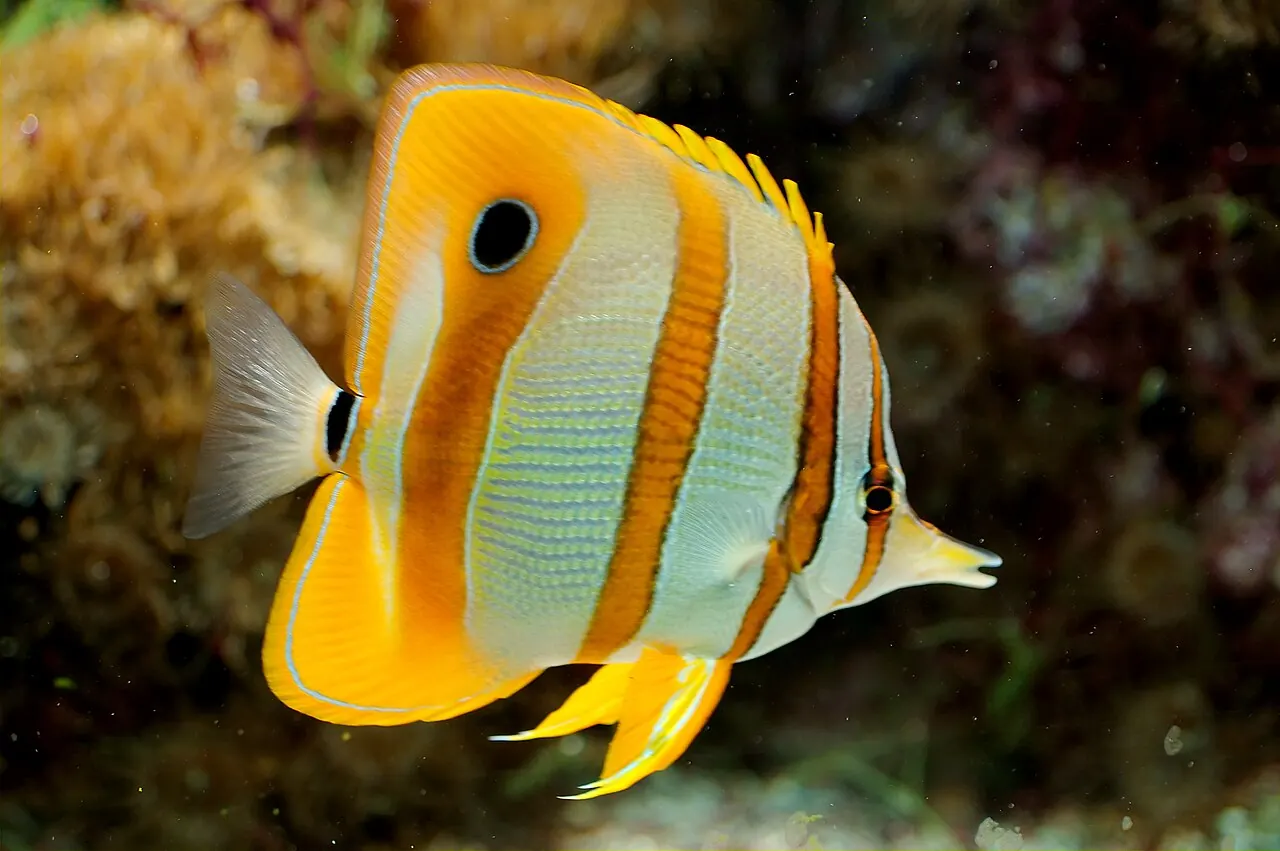
Copperband Butterflyfish
Chelmon rostratus
A butterflyfish with a long beak-like snout and a false eyespot, found in pairs on Indo-Pacific reefs and estuaries.
Photo: Luc Viatour / CC BY-SA 3.0
3 things to know
- Its species name, rostratus, is Latin for beaked.
- A false eyespot sits on its dorsal fin, near the tail end of the body.
- Pairs form for breeding, and the species is listed as monogamous.
- Scientific name
- Chelmon rostratus
- Depth
- 1 m – 25 m
3 – 82 ft - Size
- Up to about 20 cm (8 in) long
- Weight
- Not well known
- Lifespan
- Up to about 10 years (maximum reported age)
- Diet
- Small invertebrates picked from the reef and seafloor
- Where
- From the Andaman Sea east to Japan's Ryukyu Islands and south to Australia
- IUCN status
- Least Concern
- Depth zones
- Sunlight
A long, thin snout gives the copperband away. Its body is flattened, with narrow orange bars on the head and front of the body, a broad yellow-orange band toward the tail split by a crescent-shaped white bar, and a false eyespot on the dorsal fin. Fishes of Australia calls it the beaked coralfish, and the species name rostratus is Latin for beaked. Adults grow to about 20 centimeters (8 inches).
The species ranges from the Andaman Sea east to Japan's Ryukyu Islands and south to Australia, where Fishes of Australia records it from Exmouth Gulf in Western Australia, and from the far northern Great Barrier Reef south to Botany Bay in Sydney. It lives on coral reefs and rocky shores to about 25 meters (82 feet) deep, and also in estuaries and on silty inshore reefs.
Copperbands are usually seen alone or in pairs, and they hold territories. Pairs form for breeding, and FishBase lists the species as monogamous. They lay eggs, and the maximum reported age is 10 years. The diet is mainly small invertebrates that live on the bottom.
In a study published in 2001, Lara Ferry-Graham, Peter Wainwright and David Bellwood used high-speed video to film five butterflyfish species, the copperband among them, as they fed on live adult brine shrimp. All five combined suction with a forward lunge of the head and jaws. One species stood out: the longnose butterflyfish (Forcipiger longirostris), which feeds mostly on small, fast shrimps hiding in the reef, relied on lunging more than twice as much as any of the other four, thanks to jaws that push unusually far forward.
The copperband is a regular in the aquarium trade. The Georgia Aquarium notes that home aquarists sometimes use it to control Aiptasia, small anemones that are a common pest in reef tanks, and Wikipedia's account warns that it needs excellent tank conditions to do well in captivity. Wild fish are also taken in small fisheries. The IUCN lists it as Least Concern, from an assessment made in 2009.



