Cookiecutter Shark
Isistius brasiliensis
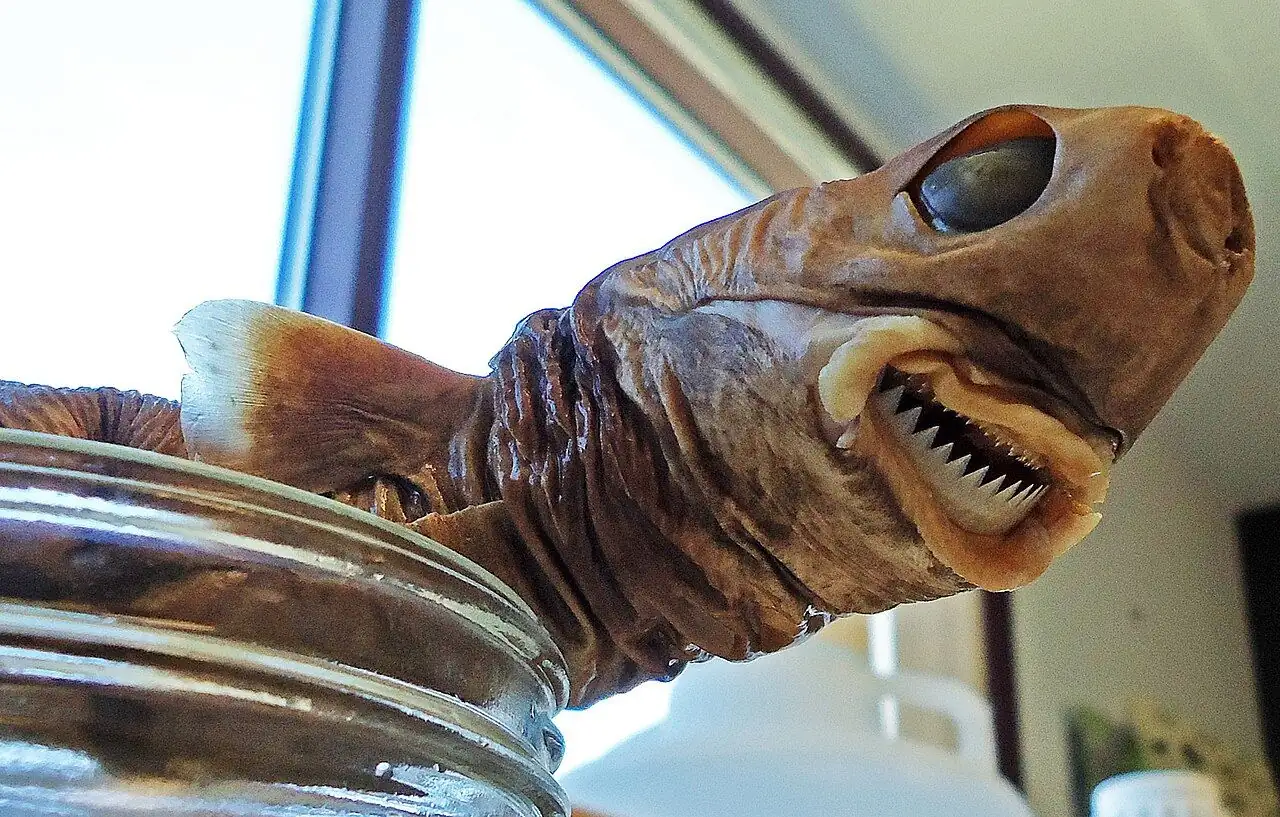
A small glowing shark that latches onto tuna, dolphins and whales, spins, and carves out a round plug of flesh.
Photo: Jennifer Strotman / Public domain
3 things to know
- It sheds a whole row of lower teeth at once and swallows them.
- Its belly glows green, except for a dark collar behind the head.
- Each night it can travel 2,000 meters or more between the deep and the surface.
- Scientific name
- Isistius brasiliensis
- Depth
- 0 m – 3,500 m
0 – 11,484 ft - Size
- Males up to 42 cm (16.5 in); females up to 56 cm (22 in)
- Weight
- Not well known
- Lifespan
- Unknown
- Diet
- Plugs of flesh bitten from large fish, whales and dolphins; also whole squid and crustaceans
- Where
- Warm open oceans worldwide, including around Hawaii and the Bahamas
- IUCN status
- Least Concern
- Depth zones
- Sunlight · Twilight · Midnight
Males of this small, cigar-shaped dogfish reach only 42 centimeters (16.5 inches) and females 56 centimeters (22 inches). Look for a short, bulbous snout, two small fins far back on the body, and a dark brown collar across the throat. The lips are fleshy and built for suction, and the lower jaw holds a row of large, triangular teeth.
Cookiecutter sharks live in warm open oceans around the world, from the Bahamas to southern Brazil, off West and southern Africa, across the Indo-Pacific to Japan and the Hawaiian Islands, and off Easter Island and the Galápagos. By day they stay deep, generally below 1,000 meters (3,280 feet). At night they rise to near the surface to feed, a daily round trip that can cover more than 2,000 to 3,000 meters of depth.
The shark's victims are usually far bigger than it is: tuna, billfish, wahoo, dolphins, whales and other sharks. It seals onto the skin with its lips and a strongly modified throat, drives in its saw-edged lower teeth, then twists its body to cut out a plug of flesh and pulls away, leaving a round crater. It also eats whole squid and crustaceans. The lower teeth are joined at their bases and fall out as a complete row, which the shark swallows, perhaps to recover calcium. George Burgess, who directed the International Shark Attack File, said it has the biggest teeth of any shark relative to the size of its jaws.
Tiny light organs give the belly a greenish glow, broken only by the dark collar, and the light organs reportedly keep glowing for up to three hours after the shark dies. In 1998, Edith Widder suggested that the glow hides the shark's outline from below while the unlit collar looks like a small fish, drawing predators close enough to bite.
Females bear 6 to 12 live young; size at birth is unknown. The IUCN lists the species as Least Concern. Bites on people are rare. A 2011 study in Pacific Science described the first documented attack on a living person, a swimmer crossing between the Big Island and Maui at night in 2009.
Sources
- floridamuseum.ufl.edu/discover-fish/species-profiles/cookiecutter-shark
- fishbase.se/summary/Isistius-brasiliensis.html
- australian.museum/learn/animals/fishes/smalltooth-cookiecutter-shark-isistius-brasiliensis
- floridamuseum.ufl.edu/science/first-cookiecutter-shark-attack-on-a-live-human
- Study: doi:10.2984/65.3.365



