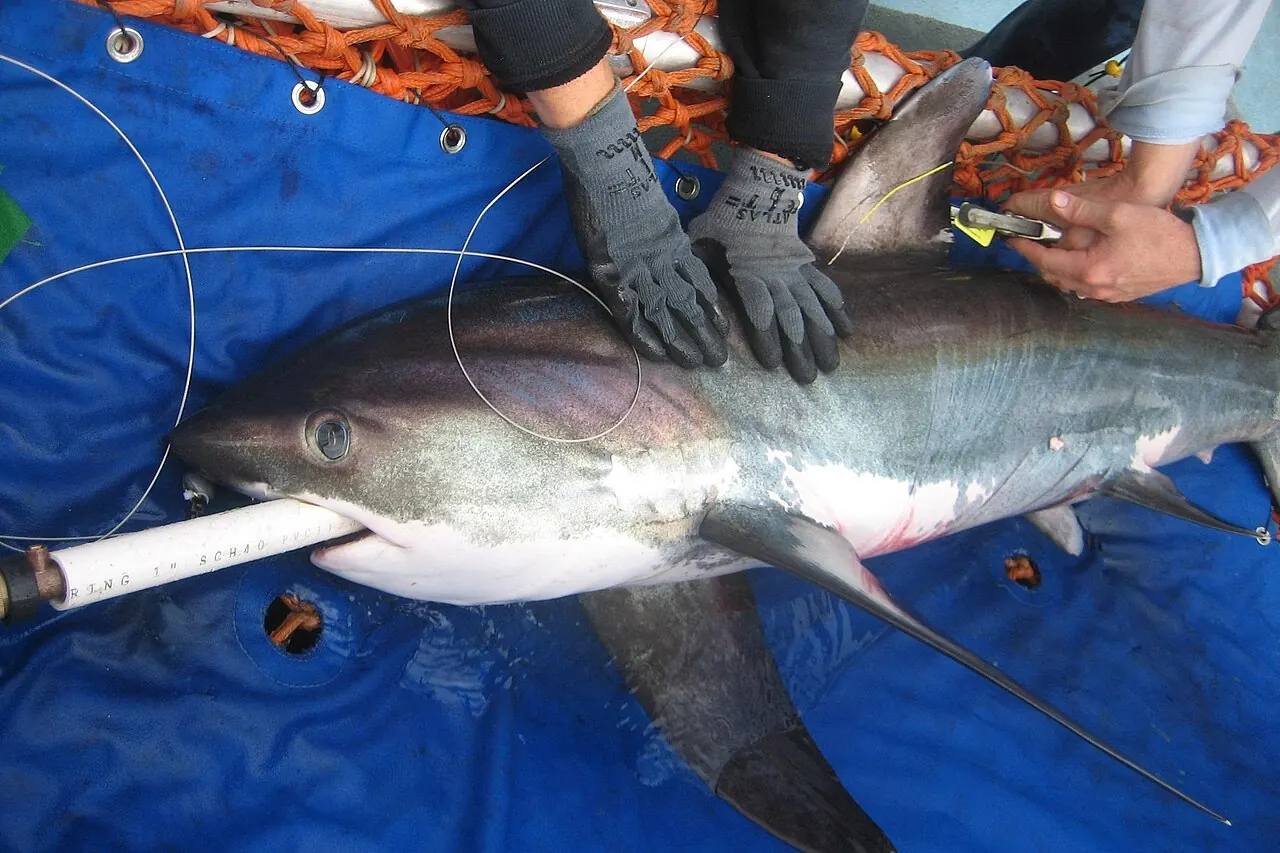
Common Thresher Shark
Alopias vulpinus
An open-ocean shark whose tail is as long as the rest of its body, used as a whip to slap and stun schools of small fish.
Photo: SWFSC Large Pelagics Program / Public domain
3 things to know
- The upper lobe of its tail can be as long as the rest of the shark.
- In 34 feeding attacks filmed off Southern California, every one began with a strike of the tail.
- Pups are born about 1.1 to 1.5 m (3.7 to 4.9 ft) long, usually two at a time.
- Scientific name
- Alopias vulpinus
- Depth
- 0 m – 650 m
0 – 2,133 ft - Size
- Commonly about 4.5 m (15 ft) including the tail; up to about 5.7 m (19 ft)
- Weight
- Up to about 348 kg (767 lb)
- Lifespan
- 19 to 50 years (NOAA Fisheries)
- Diet
- Small schooling fishes such as anchovies, sardines, herring and mackerel; also squid and occasionally seabirds
- Where
- Temperate and tropical seas worldwide, most common in temperate waters; in US waters along the Atlantic coast and from Washington to California
- IUCN status
- Vulnerable
- Depth zones
- Sunlight · Twilight
Half of a common thresher is tail. The upper lobe of its tail fin is long and strap-like, about as long as the rest of the shark, which gives it a sickle-shaped outline. The body is brown, gray, blue-gray or nearly black above and sharply white below, and the white reaches up over the bases of the pectoral fins. Adults commonly measure about 4.5 meters (15 feet) including the tail.
It is found in temperate and tropical seas worldwide, most often in temperate water, from near the coast to the open ocean and down to about 650 meters (2,130 feet). Young threshers often stay close inshore in shallow bays. Off the US West Coast, NOAA Fisheries says common threshers migrate seasonally between Oregon and Washington and Southern California and Baja California.
Threshers eat small schooling fish such as anchovies, sardines, herring and mackerel, along with squid, and the tail is the weapon. Scott Aalbers of the Pfleger Institute of Environmental Research in Oceanside, California, with Diego Bernal and Chugey Sepulveda, filmed threshers underwater off Southern California from 2007 to 2009. They recorded 34 feeding events, and every one began with a strike from the upper lobe of the tail. Anglers know the habit: threshers are often hooked in the tail after swatting at live bait. In an earlier study, published in 2005, Bernal and Sepulveda reported evidence that the thresher's aerobic swimming muscle runs warmer than the surrounding water.
Females give birth to 2 to 4 live pups, usually two, after a pregnancy of about 9 months. In the womb the embryos feed on eggs produced by the mother once their own yolk runs out. Pups are born 1.1 to 1.5 meters (3.7 to 4.9 feet) long, with tails already as long, relative to the body, as an adult's. NOAA estimates common threshers live 19 to 50 years.
The IUCN lists the common thresher as Vulnerable. In US waters it is a managed catch. NOAA reports that the Pacific stock was not overfished at its 2018 assessment, while the Atlantic stock has never been assessed.
Sources
- fisheries.noaa.gov/species/pacific-common-thresher-shark
- fisheries.noaa.gov/species/atlantic-common-thresher-shark
- fishbase.se/summary/Alopias-vulpinus.html
- floridamuseum.ufl.edu/discover-fish/species-profiles/alopias-vulpinus
- Study: doi:10.1111/j.1095-8649.2010.02616.x
- Study: doi:10.1643/cp-04-180r1
- api.gbif.org/v1/species/2420797/iucnRedListCategory
- iucnredlist.org/species/39339/212641186



