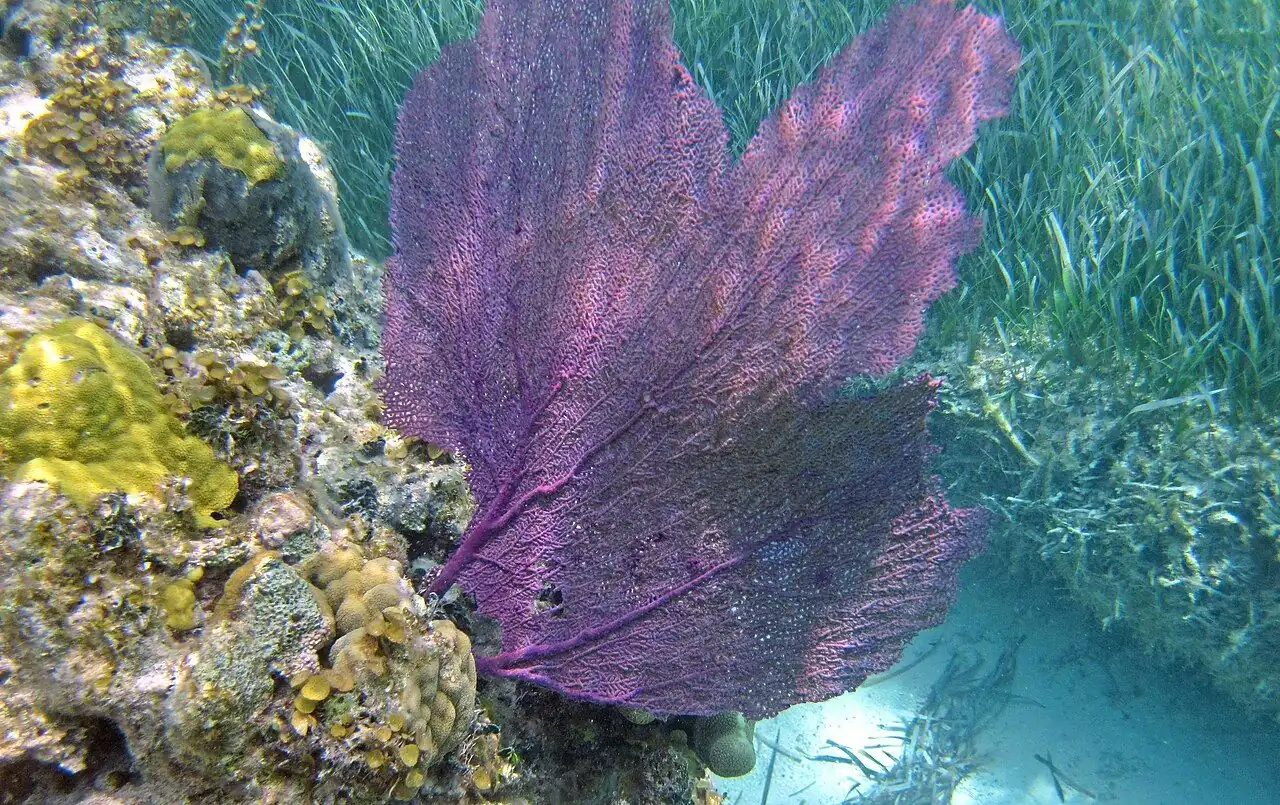
Common Sea Fan
Gorgonia ventalina
A purple, lace-like soft coral of Florida and the Caribbean that turns its fan across the current to catch plankton.
Photo: James St. John / CC BY 2.0
3 things to know
- Adult fans turn so that they face across the current or the surge.
- Researchers once counted as many as 1,700 small sea slugs feeding on a single fan.
- A fungal disease, aspergillosis, wiped out more than half of the sea fan tissue in the Florida Keys after 1997.
- Scientific name
- Gorgonia ventalina
- Depth
- 2 m – 10 m
7 – 33 ft - Size
- Up to about 1.8 m (6 ft) tall and 1.5 m (5 ft) wide
- Weight
- Unknown
- Lifespan
- Unknown
- Diet
- Zooplankton caught by its polyps, plus food from algae living in its tissues
- Where
- Bermuda, South Florida and the Florida Keys, the Bahamas and the Caribbean Sea
- IUCN status
- Not Evaluated
- Depth zones
- Sunlight
A common sea fan is a flat net of branches that join and rejoin, growing in a single plane. It is an octocoral, one of the gorgonians, and the whole fan is a colony of tiny white polyps. Most are purple, though yellow and brown fans turn up outside Florida. The color sits in tiny needle-like pieces of calcium carbonate, called spicules, in the fan's tissue. A large fan can stand 1.8 meters (6 feet) tall and spread 1.5 meters (5 feet) wide.
It grows on reefs from Bermuda and South Florida through the Bahamas and the Caribbean, mostly on reef crests and seaward slopes exposed to surge, chiefly at 2 to 10 meters (7 to 33 feet) and rarely below 15 meters. A young fan can grow in any direction, but as it matures it slowly turns until it faces across the current. Water then flows through the mesh, and the polyps catch zooplankton, especially at night. Algae living in the fan's tissue also supply food. Where the water moves in several directions, a fan may sprout smaller fans at right angles to the main one.
The fan defends itself with chemical compounds and its hard spicules, yet several snails still graze on its polyps, the flamingo tongue among them. A nudibranch, Tritonia hamnerorum, specializes in it, and researchers once counted as many as 1,700 of these sea slugs on a single fan.
Disease has hit it hard. By 1998, mass die-offs of sea fans had been reported across the West Indies for some 15 years. That year David Geiser and colleagues named the probable cause, a common fungus, Aspergillus sydowii: strains taken from diseased fans infected healthy ones in experiments, while strains from elsewhere did not. The infection, aspergillosis, kills the fan's tissue and can kill the whole colony. In the Florida Keys, Kiho Kim and Drew Harvell followed an outbreak from August 1997 for six years. It nearly wiped out the large fans at some sites, and across the Keys more than half of all sea fan tissue was lost. The number of fans held steady because small young ones replaced the big ones, and the disease slowly faded, which the researchers thought most likely came from the fans becoming more resistant.
The common sea fan has not been evaluated for the IUCN Red List.



