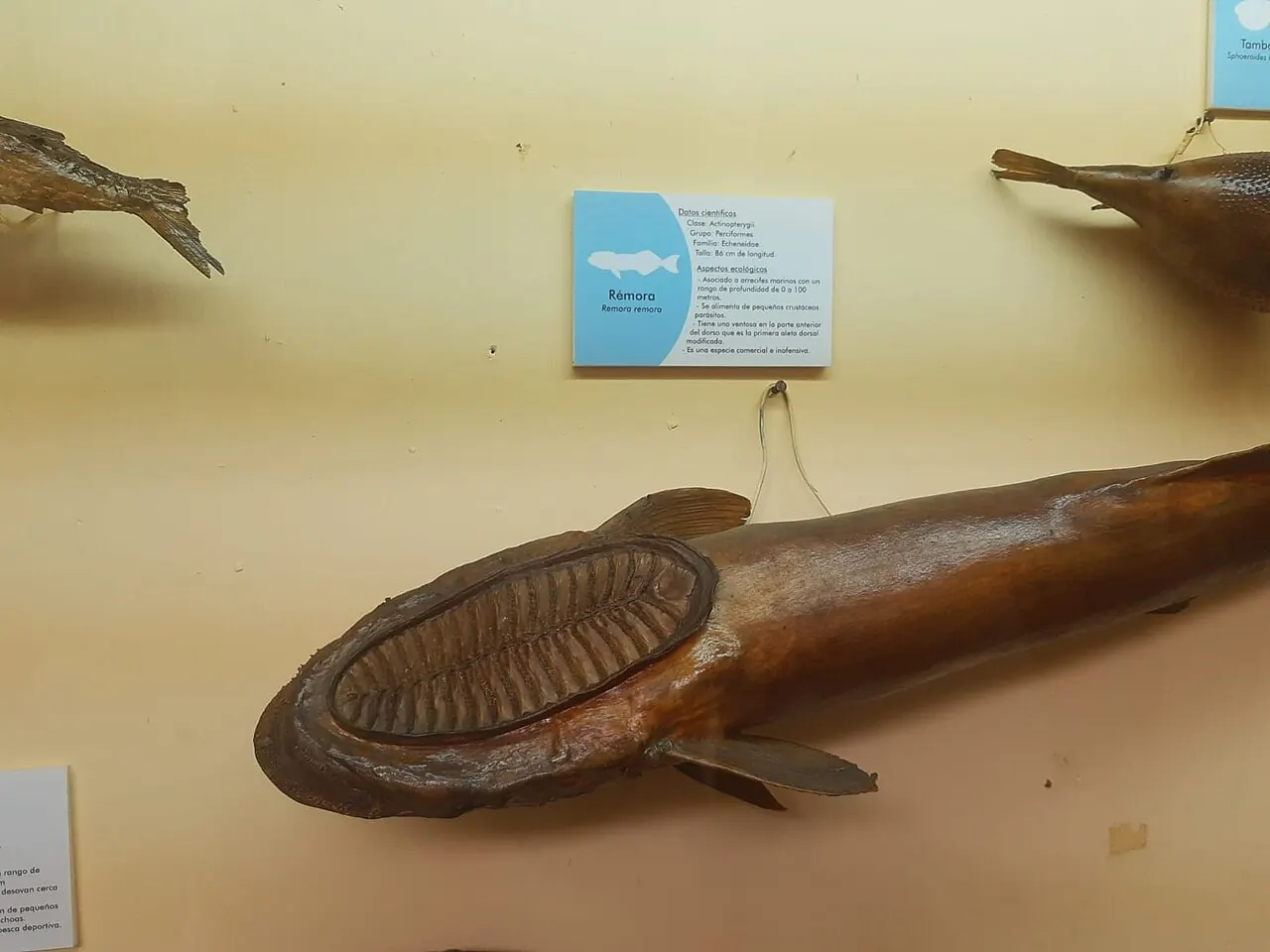
Common Remora
Remora remora
A hitchhiking fish that clings to sharks, rays and turtles with a suction disc that grew from a fin on its back.
Photo: Ayelen Rojas / CC BY-SA 4.0
3 things to know
- The sucker on a remora's head is a modified dorsal fin.
- Off the Azores, only about 1 percent of sicklefin devil rays had no remora attached.
- Its name comes from the Latin for delay, from an old belief that remoras slowed ships.
- Scientific name
- Remora remora
- Depth
- 0 m – 200 m
0 – 656 ft - Size
- Up to about 86 cm (34 in); usually about 40 cm (16 in)
- Weight
- Up to about 1.1 kg (2.4 lb) published
- Lifespan
- Unknown
- Diet
- Parasitic copepods picked off its hosts
- Where
- Warm waters worldwide
- IUCN status
- Least Concern
- Depth zones
- Sunlight
The ridged oval pad on top of a common remora's head is a fin that changed shape. As the young fish develops, its first dorsal fin turns into a suction disc made of crosswise plates, and the remora uses it to clamp onto a larger animal and ride. Adults are a dark brownish gray and deeper-bodied than their relative the sharksucker. FishBase gives a maximum length of about 86 centimeters (34 inches), but most are around 40 centimeters (16 inches). The name comes from the Latin for delay, because remoras were once thought to slow a ship by clinging to its hull.
The common remora lives in warm waters around the world and is listed from the surface down to 200 meters (660 feet). Its usual host is a shark, but it also attaches to other large fish, sea turtles and even ships, on the body, on the fins and inside the gill chambers. Sometimes it swims free. It feeds on parasitic copepods, the small crustaceans that live on its hosts, and young remoras are the most active parasite pickers. In March 1964, watching from a drifting raft in the central Pacific, John Magnuson and Reginald Gooding saw one to four common remoras traveling with each oceanic whitetip shark that came by.
Off the Azores, common remoras ride devil rays. Gloria Castellano-González, Bruno Macena, Jorge Fontes and colleagues at the University of the Azores combined dive surveys, cameras attached to the rays and 3D flow models, and reported in Marine Ecology Progress Series in January 2025 that the common remora was the main hitchhiker on adult sicklefin devil rays. Only about 1 percent of the rays had none. Most carried two or three, clustered near the head and tail, where the models showed drag was lowest. Each large remora on a ray's back added roughly 4 percent drag, a relatively small burden, the team concluded. Cameras on rays that dove below 400 meters (1,300 feet) showed remoras still holding on, including during one plunge at about 5 meters (16 feet) per second.
How remoras breed and how long they live is not well known; the Azores team notes that the early life of remoras in the wild is especially poorly understood. The IUCN lists the common remora as Least Concern, in an assessment from 2012.



