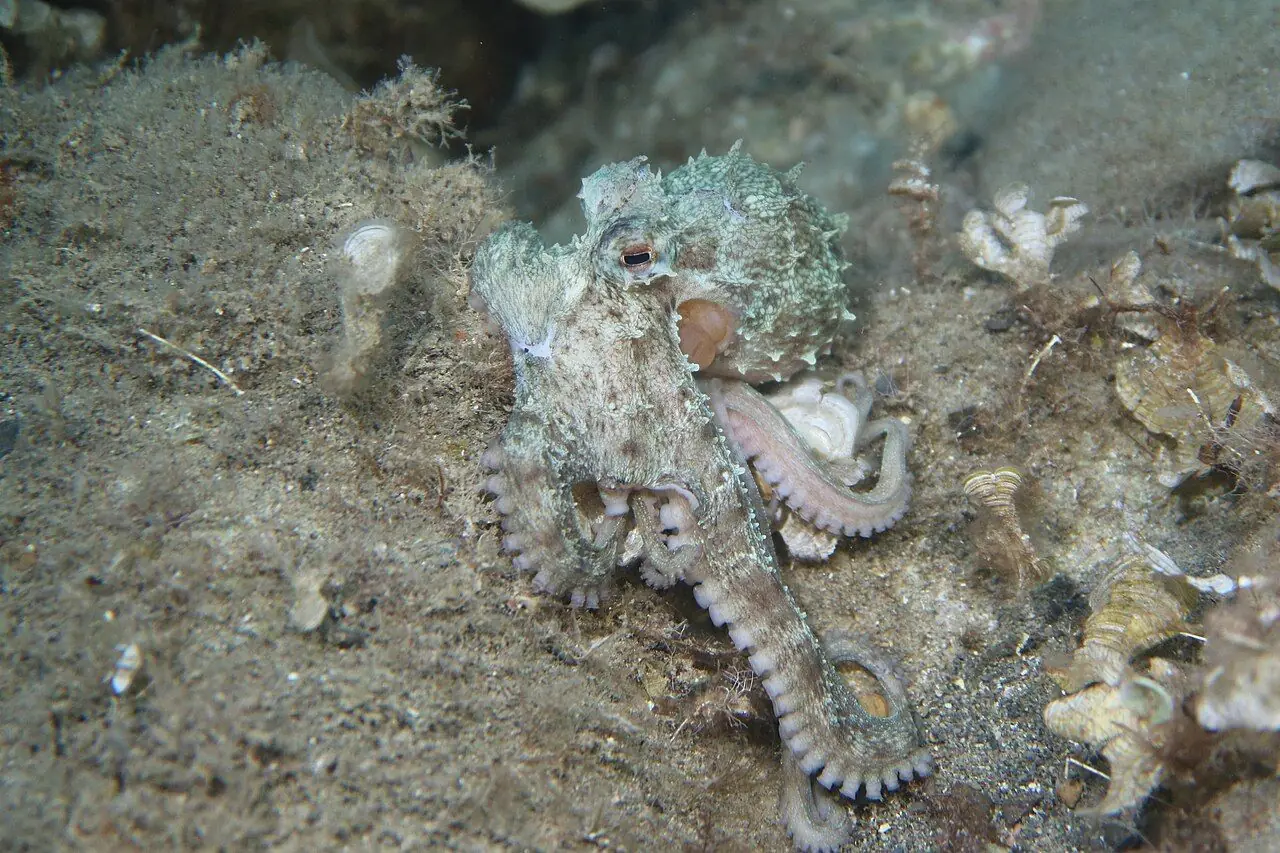
Common Octopus
Octopus vulgaris
The Mediterranean and northeast Atlantic octopus of fish markets and lab studies, now split from look-alikes in the Americas and East Asia.
Photo: Holger Krisp / CC BY 4.0
3 things to know
- Look-alike octopuses in the western Atlantic and East Asia are now counted as separate species.
- A female lays 100,000 to 500,000 eggs and usually dies soon after they hatch.
- Washington State banned octopus farming in March 2024.
- Scientific name
- Octopus vulgaris
- Depth
- 0 m – 100 m
0 – 328 ft - Size
- Mantle up to about 23 cm (9 in) long; commonly 10–20 cm (4–8 in)
- Weight
- Up to about 10 kg (22 lb); commonly 1–3 kg (2–7 lb)
- Lifespan
- About 1 year
- Diet
- Mainly snails and clams
- Where
- Mediterranean Sea and northeastern Atlantic, including the Azores, Madeira and Canary Islands (look-alikes in the western Atlantic and East Asia are now separate species)
- IUCN status
- Least Concern (2016 assessment, made before the species was split)
- Depth zones
- Sunlight
The name Octopus vulgaris once covered look-alike octopuses around the world, but studies of their genes and anatomy have split them apart. A 2023 paper in Molecular Biology Reports by Fee, Roura, Emami-Khoyi and Teske states that the common octopus in the strict sense is now considered restricted to the Mediterranean and the northeastern Atlantic. Western Atlantic animals have been split into Octopus americanus and Octopus insularis, and East Asian ones are Octopus sinensis; the World Register of Marine Species accepts all three. This profile covers those animals, including populations around the Azores, Madeira and the Canary Islands. The same paper found that the only published "common octopus" mitochondrial genome came from a specimen collected at Tokyo's Tsukiji fish market, and that it was really O. sinensis.
It is a muscular octopus with strong arms and often warty skin, colored gray, yellow or reddish-brown depending on its state. An FAO guide to Mediterranean species gives a maximum mantle length of 23 centimeters (9 inches) and a weight of 10 kilograms (22 pounds), though most weigh 1 to 3 kilograms (2 to 7 pounds), and males grow larger than females. It lives alone on rocky and sandy coastal bottoms down to about 100 meters (330 feet) and feeds mainly on snails and clams.
In the Mediterranean, females spawn from March to October, laying 100,000 to 500,000 eggs about 2 millimeters long in braided strings inside rocks, pots and even old tires. The mother cleans the eggs and jets water over them, usually does not feed while brooding, which can last 4 to 5 months in cold water, and as a rule dies soon after the last ones hatch. The young drift in the plankton for 1 to 3 months. A 2013 study that read the growth marks in the beaks of 20 spent octopuses from the Central East Atlantic confirmed a one-year life cycle.
It is a valuable catch, fished by small boats around the Mediterranean and by industrial fleets off northwest Africa. In 2023 the BBC reported plans by the Spanish company Nueva Pescanova to raise about a million a year on a farm in Gran Canaria. In March 2024, Washington's governor signed a law barring octopus aquaculture in the state. The IUCN rated it Least Concern in an assessment made in 2016, before the split, that still counts octopuses off Brazil, Chile, Japan and Taiwan as this species.
Sources
- marinespecies.org/aphia.php
- marinespecies.org/aphia.php
- marinespecies.org/aphia.php
- marinespecies.org/aphia.php
- link.springer.com/article/10.1007/s11033-023-08984-3
- Study: doi:10.1371/journal.pone.0230294
- fao.org/fishery/docs/CDrom/ARTFIMED/ArtFiWeb/descript/Species/OCTOCVUL.HTML
- animaldiversity.org/accounts/Octopus_vulgaris
- sealifebase.se/summary/Octopus-vulgaris.html
- link.springer.com/article/10.1007/s10750-013-1602-x
- bbc.com/news/science-environment-64814781
- lawfilesext.leg.wa.gov/biennium/2023-24/Htm/Bills/Session%20Laws/House/1153.SL.htm
- Study: doi:10.1242/jeb.78.1.87
- commons.wikimedia.org/wiki/File:Gew%C3%B6hnlicher_Krake_Octopus_vulgaris_1.jpg



