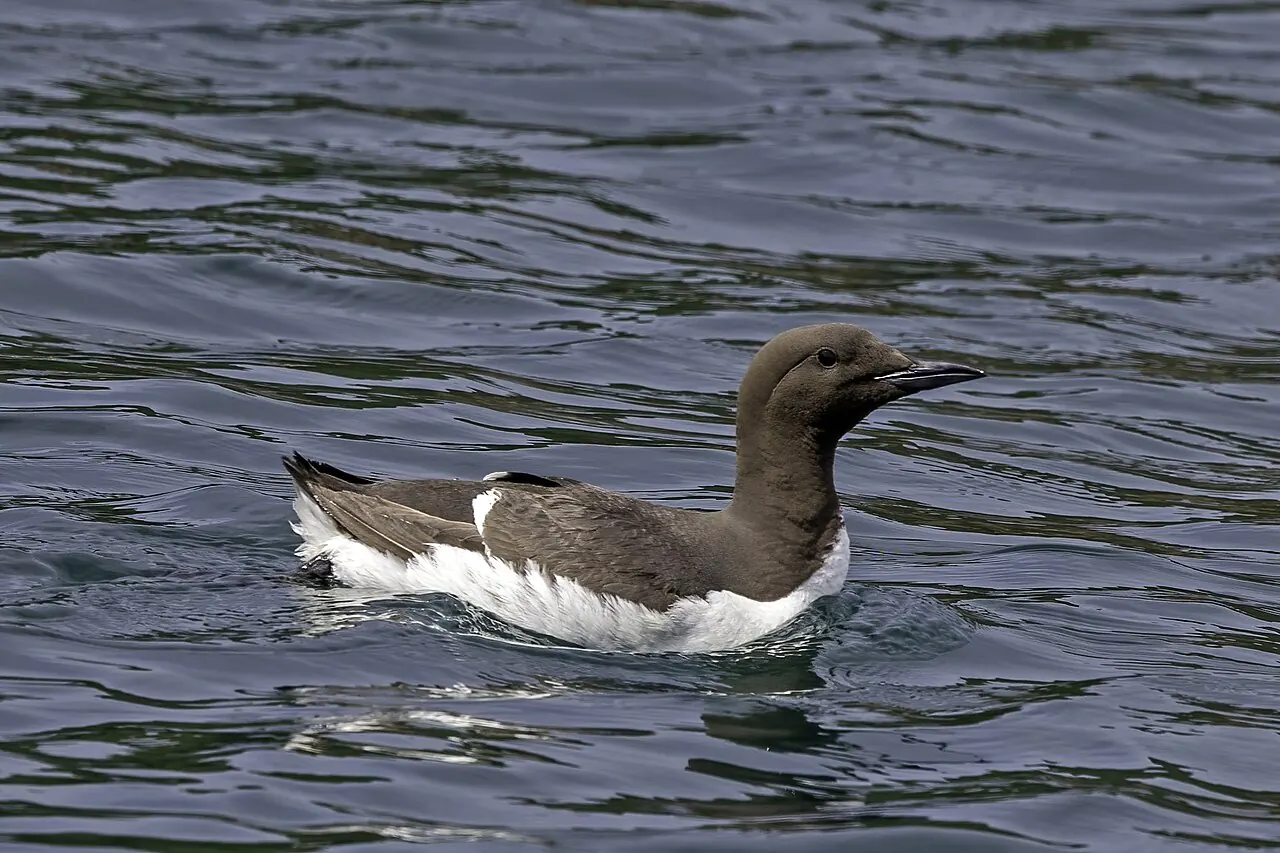
Common Murre
Uria aalge
A cliff-nesting auk that flies underwater on its wings; about 4 million died in Alaska after the 2014–2016 Pacific marine heatwave.
Photo: Charles J. Sharp / CC BY-SA 4.0
3 things to know
- It lays its single egg on bare rock, with no nest at all.
- Chicks leave the cliff before they can fly, gliding and fluttering down to the sea.
- Murres caught in fishing nets set on the seafloor show it can dive to at least 180 m (590 ft).
- Scientific name
- Uria aalge
- Depth
- 0 m – 46 m
0 – 151 ft - Size
- 40–45 cm (16–18 in) long, with a wingspan of 74–84 cm (29–33 in)
- Weight
- 800–1,000 g (1.8–2.2 lb)
- Lifespan
- Typically about 23 years once breeding; the British ringing record is almost 41 years
- Diet
- Fish such as capelin, herring, cod and sand lance, plus crustaceans, marine worms and squid
- Where
- North Atlantic and North Pacific; in the US, along the Pacific coast from Alaska to California
- IUCN status
- Least Concern
- Depth zones
- Sunlight
Common murres, called guillemots in Britain, are large auks, dark brown to charcoal above and white below, sharply two-toned in summer. They are 40 to 45 centimeters (16 to 18 inches) long and weigh 800 to 1,000 grams (1.8 to 2.2 pounds). Underwater they swim with their wings.
They hunt capelin, herring, cod, sand lance and many other fish, along with crustaceans, marine worms and squid. Murres tracked from a colony in southwest Greenland dived on average to about 27 to 36 meters (90 to 120 feet), and Audubon notes dives of more than 46 meters (150 feet). Murres caught in nets set on the seafloor off Newfoundland show they can reach at least 180 meters (590 feet). In the US they are widespread on the Pacific coast from Alaska to California.
They nest in dense colonies on cliff ledges, packed within touching distance of one another, and build no nest. Each female lays one large egg on bare rock, and both parents take turns incubating it for about a month. About three weeks after hatching, the chick leaves the ledge before it can fly, gliding down to the water and slowing its fall by fluttering. Its father stays close and feeds it at sea for weeks afterward. Murres that reach breeding age typically live about 23 years; the British ringing record is almost 41 years. In the early 1850s, egg collectors working the murre cliffs of California's Farallon Islands gathered about half a million eggs a year for Gold Rush San Francisco.
During the 2014 to 2016 marine heatwave in the northeast Pacific, about 62,000 dead or dying murres were documented along the coast from California to Alaska, most of them badly emaciated. The real toll was far larger. Heather Renner and colleagues compared counts at 13 Alaskan colonies in the seven years before the heatwave and the seven years after, and found that numbers fell 52 to 78 percent. They calculated a loss of 4 million birds, about half of Alaska's common murres, and called it the largest documented wildlife mortality event of the modern era. Through 2022 they saw no sign of recovery.
Across its whole range the species is still abundant, and the IUCN lists it as Least Concern, in an assessment from 2018, years before the Alaska losses were measured.
Sources
- audubon.org/field-guide/bird/common-murre
- bto.org/understanding-birds/birdfacts/guillemot
- Study: doi:10.1371/journal.pone.0072987
- Study: doi:10.2307/4086771
- nps.gov/chis/learn/nature/common-murre.htm
- npr.org/sections/thesalt/2016/08/15/487644637/the-gold-hungry-forty-niners-also-plunder…
- Study: doi:10.1371/journal.pone.0226087
- Study: doi:10.1126/science.adq4330
- Study: doi:10.2305/IUCN.UK.2018-2.RLTS.T22694841A132577296.en
- rspb.org.uk/birds-and-wildlife/guillemot
- Study: doi:10.1242/jeb.02128



