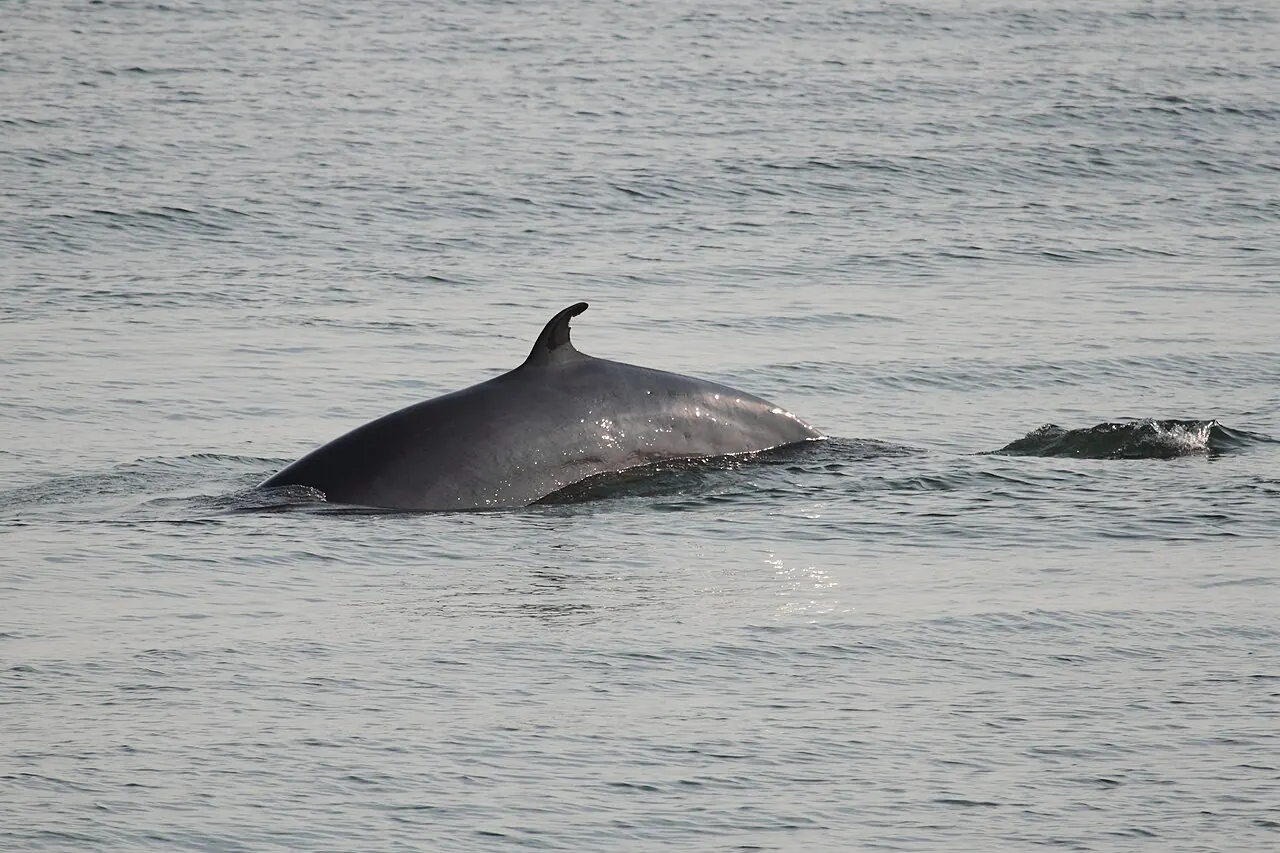
Common Minke Whale
Balaenoptera acutorostrata
The smallest of the rorqual whales, a curious, fast surfacer identified as the probable source of the North Pacific's mystery boing.
Photo: Cephas / CC BY-SA 3.0
3 things to know
- It is the smallest baleen whale in North American waters.
- Northern minke whales have a white band across each dark flipper.
- A minke whale was identified as the probable source of the North Pacific boing sound during a 2002 survey off Hawaii.
- Scientific name
- Balaenoptera acutorostrata
- Depth
- 0 m – 250 m
0 – 820 ft - Size
- Up to about 10.7 m (35 ft) long
- Weight
- Up to about 9 metric tons (20,000 lb)
- Lifespan
- Up to about 50 years
- Diet
- Small schooling fish such as herring, capelin, sand lance and anchovies, plus crustaceans and plankton
- Where
- Polar, temperate and tropical waters worldwide, mostly feeding in cooler waters at high latitudes
- IUCN status
- Least Concern
- Depth zones
- Sunlight · Twilight
Minke whales are the smallest of the rorquals, the group of baleen whales that includes blue and humpback whales, and the smallest baleen whale in North American waters. Adults grow to about 10.7 meters (35 feet) and 9 metric tons (20,000 pounds). The body is black to dark gray-brown above and white below, with a tall, curved fin two-thirds of the way back. In the Northern Hemisphere each dark flipper carries a clear white band. The name supposedly comes from a Norwegian whale spotter called Meincke who mistook one for a blue whale.
You can find minke whales in polar, temperate and tropical seas, near shore and far offshore, though they feed mostly in cooler water at high latitudes. They side-lunge into schools of herring, capelin, sand lance, anchovies and other small fish, and also take crustaceans and plankton, sometimes with seabirds gathering overhead. They usually travel alone or in twos and threes. At the surface they come up snout-first with a small, bushy blow and do not lift their tails when they dive. Two minke whales tagged off northern Norway and reported on in 2025 made dives of 2 to 12 minutes, reaching 20 to 250 meters (65 to 820 feet). They are curious and will approach boats, especially ones sitting still.
Minke whales mature at 3 to 8 years, and females give birth to a single calf after 10 to 11 months. The species is one of the most abundant rorquals, and the IUCN lists it as Least Concern. Greenland, Japan and Norway still hunt common minke whales, and in US waters they get tangled in fishing gear and struck by ships.
Their sounds include clicks, grunts, thumps and the boing. Submarine sonar picked up that strange call off San Diego and Hawaii in the 1950s, and for decades no one knew what made it. On November 7, 2002, during a survey of whales and dolphins in US waters around Hawaii, Shannon Rankin and Jay Barlow's team recorded a series of boings, tracked the sound, and saw a whale breach near their boat that they confirmed was a minke. Their 2005 paper names the minke as the probable source and describes two versions of the call: an eastern boing heard only east of 138° west, and a central boing heard only west of 135° west.
Sources
- fisheries.noaa.gov/species/minke-whale
- sealifebase.se/summary/Balaenoptera-acutorostrata.html
- Study: doi:10.1186/s40317-025-00432-2
- Study: doi:10.1121/1.2046747
- oceanbites.org/minke-boings-a-50-year-mystery-and-the-science-of-listening-in-the-ocean
- en.wikipedia.org/wiki/Common_minke_whale
- iucnredlist.org/species/2474/50348265



