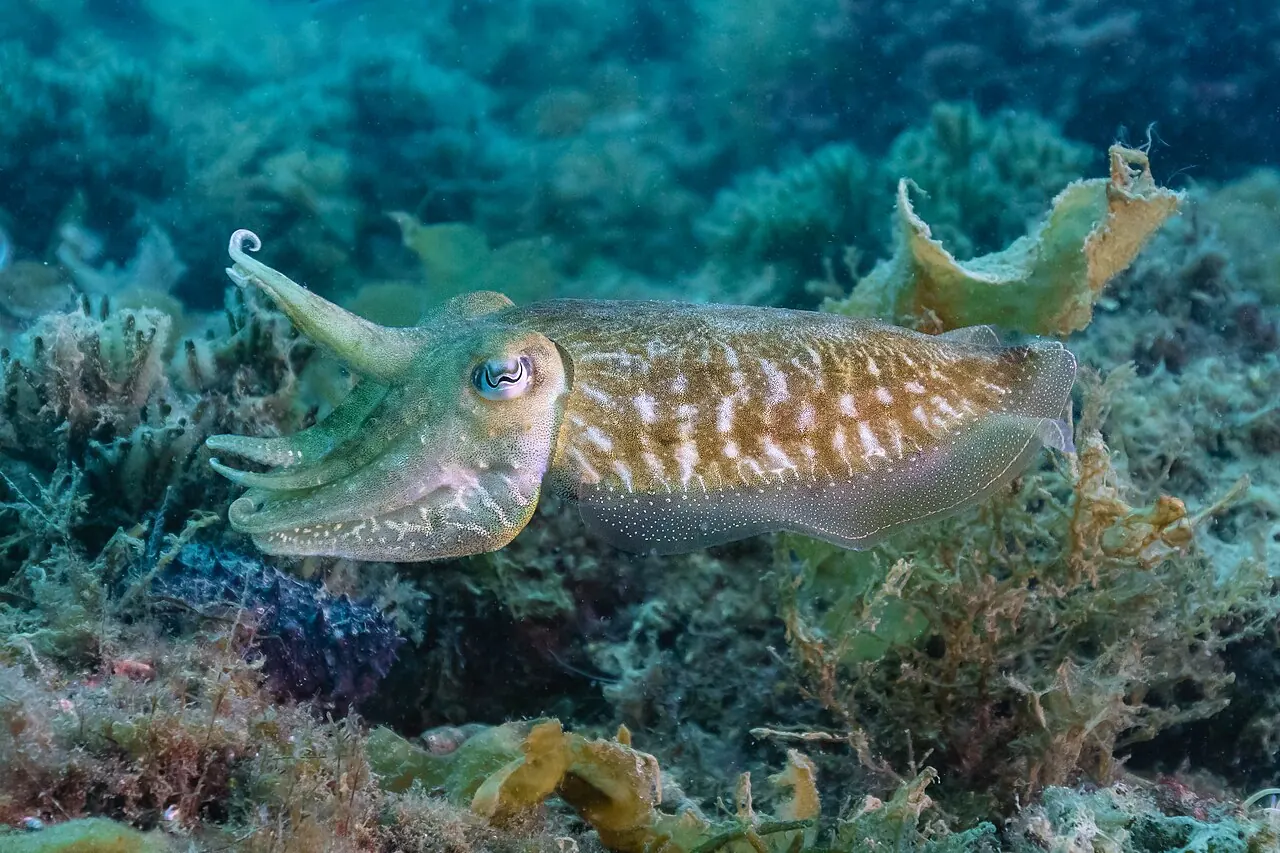
Common Cuttlefish
Sepia officinalis
A camouflage expert of the eastern Atlantic and Mediterranean that lives about two years and passed a version of the marshmallow test.
Photo: Diego Delso / CC BY-SA 4.0
3 things to know
- It usually lives about one to two years.
- Its eggs are blackened with ink and laid in grape-like clusters on seaweed and shells.
- In tests at Woods Hole, cuttlefish waited more than two minutes for a preferred shrimp instead of eating a prawn right away.
- Scientific name
- Sepia officinalis
- Depth
- 0 m – 200 m
0 – 656 ft - Size
- Mantle up to 49 cm (19 in) in temperate waters; commonly 15–25 cm (6–10 in)
- Weight
- Up to about 4 kg (8.8 lb)
- Lifespan
- About 1–2 years
- Diet
- Small mollusks, crabs, shrimp, young fish and other cuttlefish
- Where
- Eastern Atlantic from the Shetland Islands and southern Norway to northwest Africa, and the Mediterranean
- IUCN status
- Least Concern
- Depth zones
- Sunlight
A cousin of octopuses and squid, Sepia officinalis lives over sandy and muddy bottoms in the eastern Atlantic, from the Shetland Islands and southern Norway south to northwest Africa, and across the Mediterranean. It is found from the shallows to about 200 meters (660 feet), most often in the top 50 meters (160 feet). Many move inshore in spring and summer and out to around 100 meters (330 feet) in autumn and winter.
Size depends on the water. In temperate seas the body, or mantle, can reach 49 centimeters (19 inches) and the animal 4 kilograms (8.8 pounds); in the subtropics the maximum is about 30 centimeters (12 inches) and 2 kilograms (4.4 pounds). Cuttlefish eat small mollusks, crabs, shrimp, young fish and other cuttlefish, and cannibalism is common. From hatching onward, most bury themselves in the sand during the day and ambush prey from hiding.
Breeding happens in shallow water. Courtship is elaborate and ritualized, with visual displays and males guarding their mates. Females attach eggs 8 to 10 millimeters across, blackened with ink, to seaweed, shells and debris in clusters that look like bunches of grapes. Depending on temperature, the eggs hatch after 30 to 90 days, and the whole life cycle in the wild takes 12 to 24 months. Adults usually die soon after spawning. This is one of the most important cephalopods for fisheries in many countries and is heavily fished in places such as the Mediterranean, but the IUCN lists it as Least Concern.
Camouflage is what cuttlefish are known for, and it may explain a finding from the Marine Biological Laboratory in Woods Hole, Massachusetts. In a 2021 study led by Alexandra Schnell, then at the University of Cambridge, six cuttlefish passed up a piece of king prawn to wait for a live grass shrimp they liked better, the best of them holding out for more than two minutes. The researchers suggest that self-control helps an animal that spends long stretches sitting still and hidden on the seabed, then forages in short bursts in the open.



