Sunlight Zone · 0–200 m
Dolphins Whistle Back at Their 'Names' and Remember Friends for Decades
Each bottlenose dolphin invents a signature whistle. Nearly 50 years of recordings in Sarasota Bay, Florida, show how they use it.
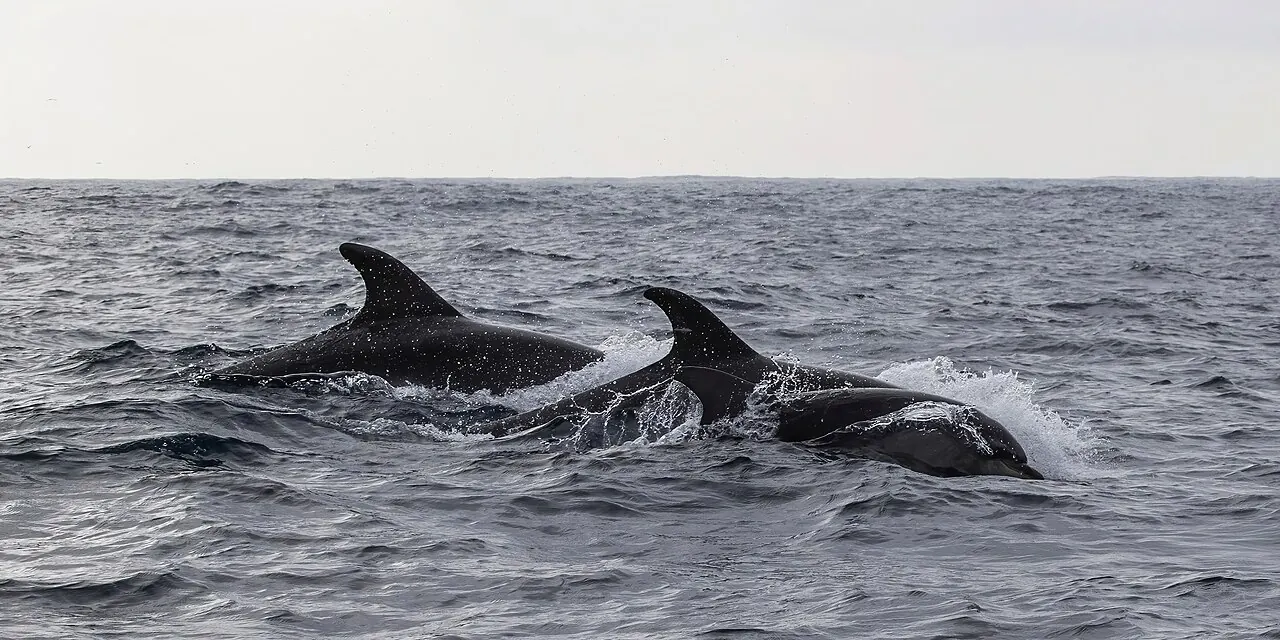
Tursiops truncatus
The familiar gray dolphin of coasts and open sea, which develops its own signature whistle and answers when it hears a copy.
Photo: Charles J. Sharp / CC BY-SA 4.0
Common bottlenose dolphins are generally gray, 1.8 to 4 meters (6 to 13 feet) long and 136 to 635 kilograms (300 to 1,400 pounds). They live in both coastal and offshore waters around the world, and the two kinds differ. Dolphins in nearshore water are often smaller and lighter in color than those living offshore, according to NOAA Fisheries.
They eat fish, squid and crustaceans, gripping prey with their teeth and swallowing it whole without chewing. Coastal dolphins generally make short, shallow dives of less than 10 meters (33 feet). Offshore dolphins go much deeper. Near Bermuda, tagged offshore dolphins made 96 percent of their daytime dives within 50 meters (164 feet) of the surface but regularly dived below 450 meters (1,476 feet) at night, and a 2023 study led by Andreas Fahlman found them commonly diving deeper than 199 meters (653 feet), with the deepest dive reaching 1,000 meters (3,281 feet).
Bottlenose dolphins may travel alone or in groups that often break apart and re-form. They usually begin to breed between 5 and 15 years old. A female is pregnant for about 12 months and gives birth every 3 to 6 years on average. They can live at least 40 years, and some females live past 60. The IUCN lists the species as Least Concern, and it is not endangered or threatened under the US Endangered Species Act, though five stocks along the Atlantic coast are considered depleted under the Marine Mammal Protection Act. Getting caught in fishing gear is one of the main threats.
Each dolphin develops its own signature whistle, a learned pattern of changing pitch that helps others recognize it and keep in touch. In Sarasota, Florida, researchers have recorded these whistles during health checks since the mid-1970s, and by 2022 their database held 926 recording sessions from 293 dolphins, one of them recorded across 43 years. Wild bottlenose dolphins call back when they hear a copy of their own whistle, Stephanie King and Vincent Janik reported in 2013. That same year, Jason Bruck showed that dolphins still recognized the whistles of former tank mates they had not lived with for at least 20 years.



