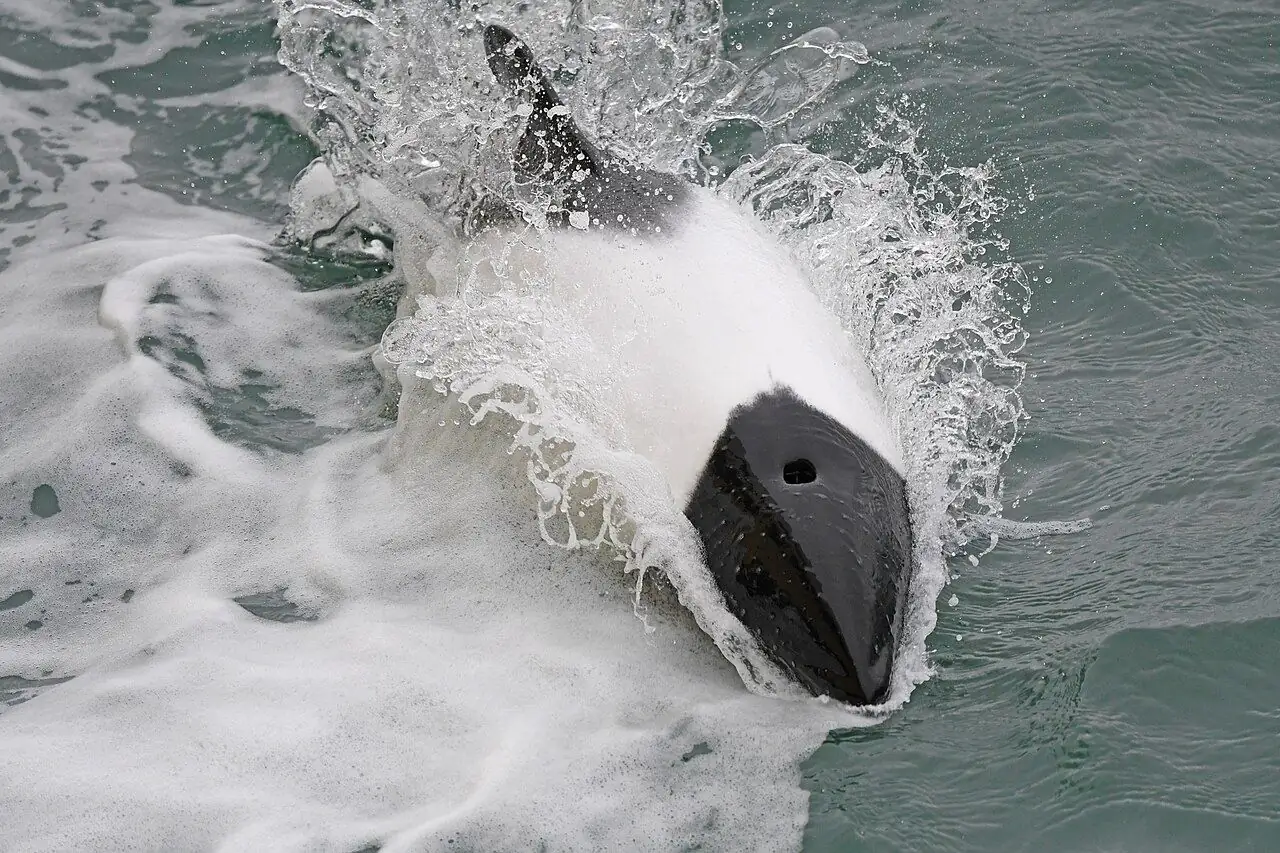
Commerson's Dolphin
Cephalorhynchus commersonii
A small black-and-white dolphin of Patagonia's cold coasts, with a second, gray population 8,500 km away at the Kerguelen Islands.
Photo: Christoph Moning / CC BY 4.0
3 things to know
- Its sharp black-and-white pattern has earned it nicknames such as panda dolphin and skunk dolphin.
- A separate population lives around the Kerguelen Islands, about 8,500 km (5,300 miles) from South America.
- It echolocates with narrow-band, high-frequency clicks centered around 133 kilohertz.
- Scientific name
- Cephalorhynchus commersonii
- Depth
- 0 m – 200 m
0 – 656 ft - Size
- Up to about 1.75 m (5.7 ft) long
- Weight
- Up to about 86 kg (190 lb)
- Lifespan
- Not well known
- Diet
- Fish, squid, crustaceans and other bottom-dwelling invertebrates
- Where
- Coasts of southern South America and the Falkland Islands, and the Kerguelen Islands in the southern Indian Ocean
- IUCN status
- Least Concern
- Depth zones
- Sunlight
In South America, Commerson's dolphins are sharply black and white: a black head, dorsal fin and tail, and a white throat and body, which explains nicknames such as panda dolphin and skunk dolphin. They are small and stocky, built more like a porpoise than most dolphins, and SeaLifeBase lists a maximum length of 1.75 meters (5.7 feet) and weight of 86 kilograms (190 pounds). The name honors the French naturalist Philibert Commerson, who saw them in the Strait of Magellan in 1767.
The main subspecies lives along the coasts of Argentina and Chile and around the Falkland Islands, in cold inshore water: open coasts, fjords, bays, harbors and river mouths, often at the edge of kelp beds and sometimes inside the breakers. Off mainland South America they have been seen only over the continental shelf, in water less than 200 meters (656 feet) deep. In the Strait of Magellan they favor the narrows, where currents can run at 15 kilometers per hour (9 miles per hour) or more, and one was recorded 24 kilometers (15 miles) up the Deseado River in Argentina. They eat fish, squid, crustaceans and other bottom animals.
A second subspecies lives in shallow water around the Kerguelen Islands in the southern Indian Ocean, roughly 8,500 kilometers (5,300 miles) away, and none have been reported from the islands in between. Formally described in 2007, these dolphins are larger and dark and light gray rather than black and white. The IUCN says their population was apparently founded by a few individuals as recently as 10,000 years ago, and the regional IUCN Red List for the French Southern Territories rates it Endangered.
Commerson's dolphins are among the small toothed whales that echolocate with narrow-band, high-frequency clicks. Recording wild dolphins off the Falklands, L. A. Kyhn and colleagues found their clicks centered around 133 kilohertz, slightly higher than those of Peale's dolphins in the same waters, a difference the authors suggest may reflect character displacement between the two species.
The IUCN's 2017 assessment lists the species as Least Concern. Aerial surveys off Argentina in the 1990s and 2000s estimated about 40,000 between the shore and the 100-meter depth line. It is the whale or dolphin most often caught in fishing nets off southern South America, and from the 1970s until at least the early 1990s, fishermen in the Beagle Channel and Tierra del Fuego harpooned them for crab bait.



