Twilight Zone · 200–1,000 m
The First Video of a Living Colossal Squid Shows a See-Through Baby
A century after the species was named, a robot sub filmed a 30-centimeter juvenile in the South Atlantic in March 2025.
Mesonychoteuthis hamiltoni
The heaviest invertebrate known, a Southern Ocean squid armed with swiveling hooks and first filmed alive in its habitat in 2025.
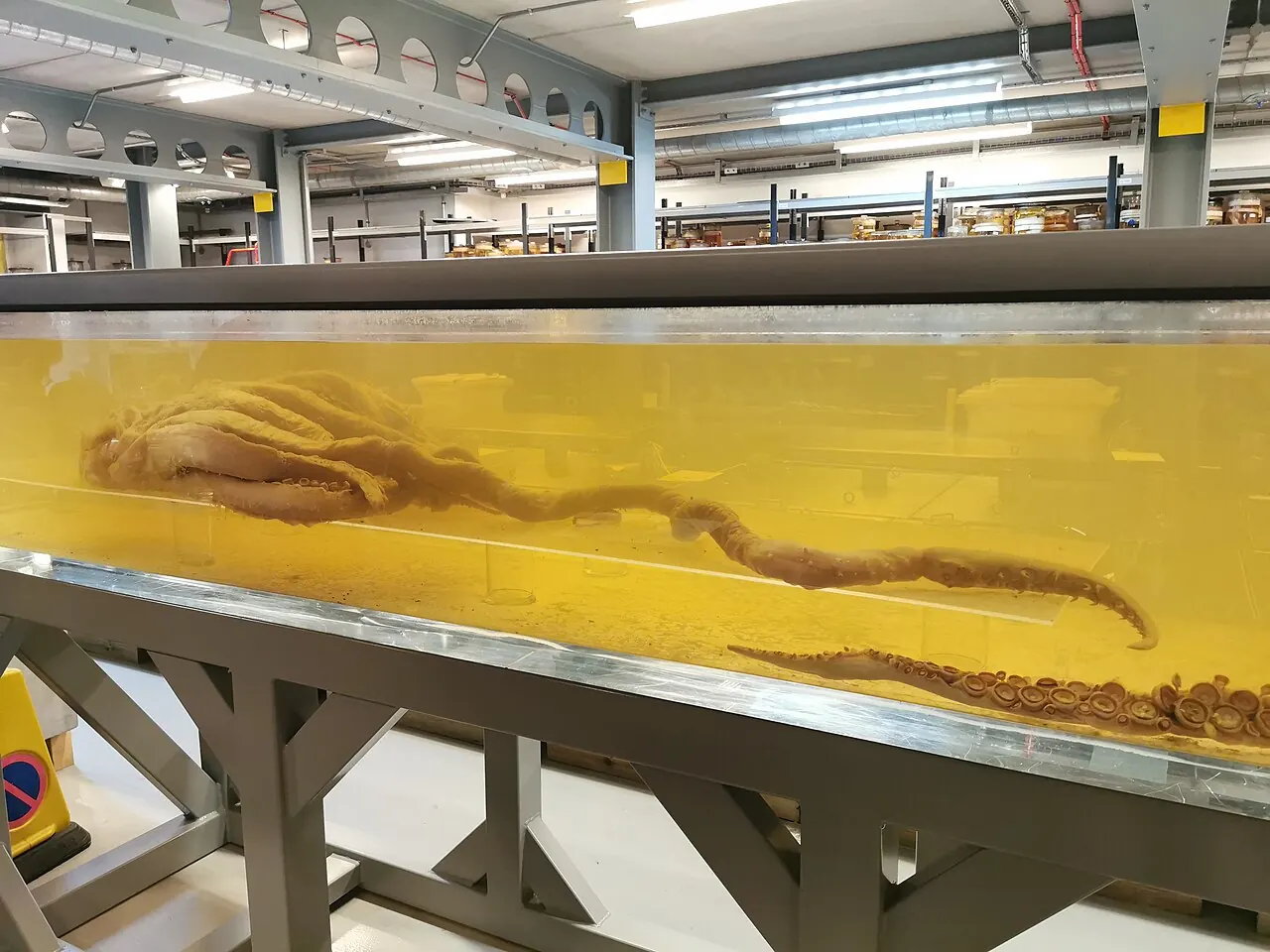
Photo: Mgiganteus1 / CC BY-SA 4.0
Mesonychoteuthis hamiltoni is the heaviest invertebrate on the planet, according to Schmidt Ocean Institute, which estimates adults reach about 7 meters (23 feet) long and as much as 500 kilograms (1,100 pounds). Its relatively short arms carry both hooks and suckers, and the clubs at the ends of its two long tentacles carry two rows of swiveling hooks. Its beaks are the largest known of any squid, bigger and sturdier than a giant squid's.
It lives in the cold Southern Ocean around Antarctica, mainly south of the Antarctic Convergence. Te Papa, New Zealand's national museum, says adults live deeper than 1,000 meters (3,300 feet) in water near freezing, while juveniles are not uncommon from the surface down to about 1,000 meters. The young are transparent and lose that look as they grow. On March 9, 2025, a Schmidt Ocean Institute robot filmed a 30-centimeter (12-inch) juvenile at 600 meters near the South Sandwich Islands, the first confirmed footage of a living colossal squid in its natural habitat.
Adults have never been seen alive at depth; fishermen have filmed only dying ones. Te Papa counts eight adult specimens reported, all but two recovered from sperm whale stomachs, and sperm whales eat a great many. In the Antarctic, colossal squid beaks make up 14 percent of the beaks counted in sperm whale stomachs and, because the squid are so big, an estimated 77 percent of the biomass eaten. Te Papa's own specimen, caught on a toothfish longline in the Ross Sea in 2007, weighed 495 kilograms (1,091 pounds) and measured 4.2 meters (14 feet), though its tentacles may have shrunk after death. Its beak measured 42.5 millimeters, while beaks up to 49 millimeters have come from sperm whale stomachs, so larger colossal squid are out there.
Its life history is mostly unknown. Te Papa says no comprehensive description of a mature adult has been prepared and that no mature male is known. SeaLifeBase lists deep-sea fish and squid as prey, and the Te Papa animal was holding a toothfish when it was hauled up. How long it lives is not known. The IUCN Red List rates the species as Least Concern.



