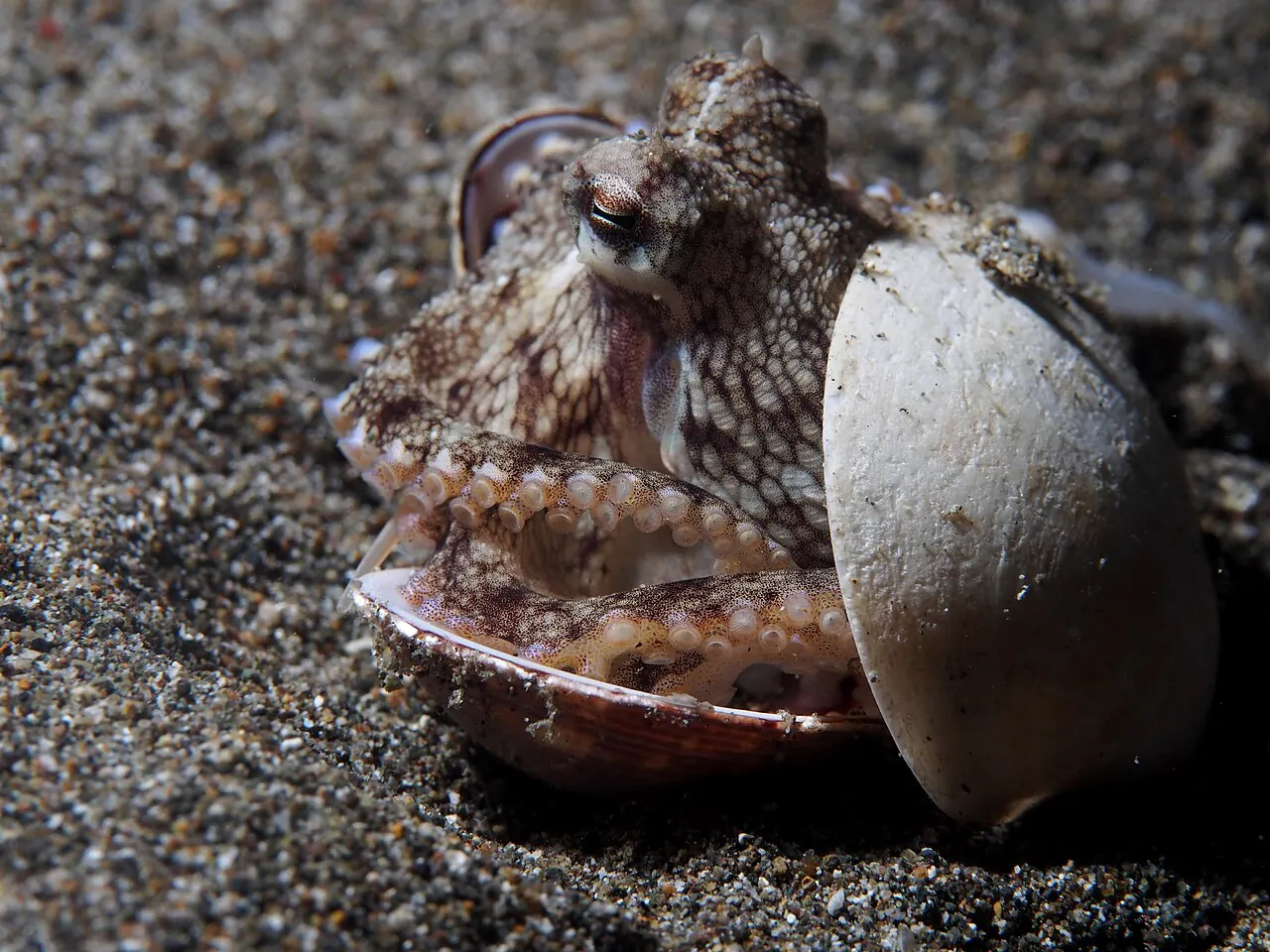
Coconut Octopus
Amphioctopus marginatus
An Indo-Pacific octopus that carries coconut shells around as a portable shelter and can walk on two arms.
Photo: Rickard Zerpe / CC BY-SA 2.0
3 things to know
- It carries stacked coconut shell halves under its body and later hides inside them.
- Divers watched one carry its shells as far as 20 m (66 ft).
- It can walk on two arms while the other six help keep its disguise.
- Scientific name
- Amphioctopus marginatus
- Depth
- 0 m – 190 m
0 – 623 ft - Size
- Up to about 30 cm (12 in) long including arms; mantle about 10 cm (4 in)
- Weight
- Up to about 400 g (14 oz)
- Lifespan
- Unknown
- Diet
- Crabs and clams
- Where
- Indo-West Pacific, on muddy and sandy bottoms
- IUCN status
- Least Concern
- Depth zones
- Sunlight
Also called the veined octopus, the coconut octopus is a small Indo-West Pacific species with a dark brown to purple stripe along the top of its arms, a net of dark purple lines around the arm bases and pale pink to white suckers. SeaLifeBase gives a maximum length of about 30 centimeters (12 inches) including the arms and a weight of about 400 grams (14 ounces). It lives on mud and sand from the shallows to at least 190 meters (620 feet) and eats crabs and clams.
It also makes portable homes. It dens in clam shells, coconut shells, bottles and other human trash, and it will carry one shell or half a coconut shell while it searches for another to close itself inside.
Julian Finn and Mark Norman of Museum Victoria in Melbourne and Tom Tregenza of the University of Exeter watched this off Indonesia. Over 500 hours of diving they observed 20 veined octopuses, and on four occasions an octopus traveled up to 20 meters (66 feet) carrying stacked coconut shell halves beneath its body. It spread itself over the stacked shells, made its eight arms rigid and ambled across the seafloor on them, a gait the team called stilt walking. Because the shells gave no benefit until later, when the octopus used them as a shelter, the researchers argued in Current Biology in 2009 that this counts as tool use, unlike a hermit crab simply living in a discarded snail shell.
The species has a second unusual gait. In 2005, Christine Huffard of the University of California, Berkeley, and colleagues reported in Science that it can walk on two alternating arms with a rolling gait, while appearing to use the other six for camouflage, so that it resembles a coconut. Each arm stayed on the sand for more than half of every stride, which qualifies as walking. A second octopus, Abdopus aculeatus, does the same while looking like a clump of floating algae.
As in other octopuses, adults usually die soon after spawning and brooding. How long this species lives is unknown. The IUCN lists it as Least Concern.
Sources
- sealifebase.se/summary/Amphioctopus-marginatus.html
- Study: doi:10.1016/j.cub.2009.10.052
- eurekalert.org/news-releases/538714
- nationalgeographic.com/animals/article/octopus-behavior-shelter-animals
- Study: doi:10.1126/science.1109616
- marinespecies.org/aphia.php
- commons.wikimedia.org/wiki/File:Coconut_octopus_(Amphioctopus_marginatus)_(14217840897)…



