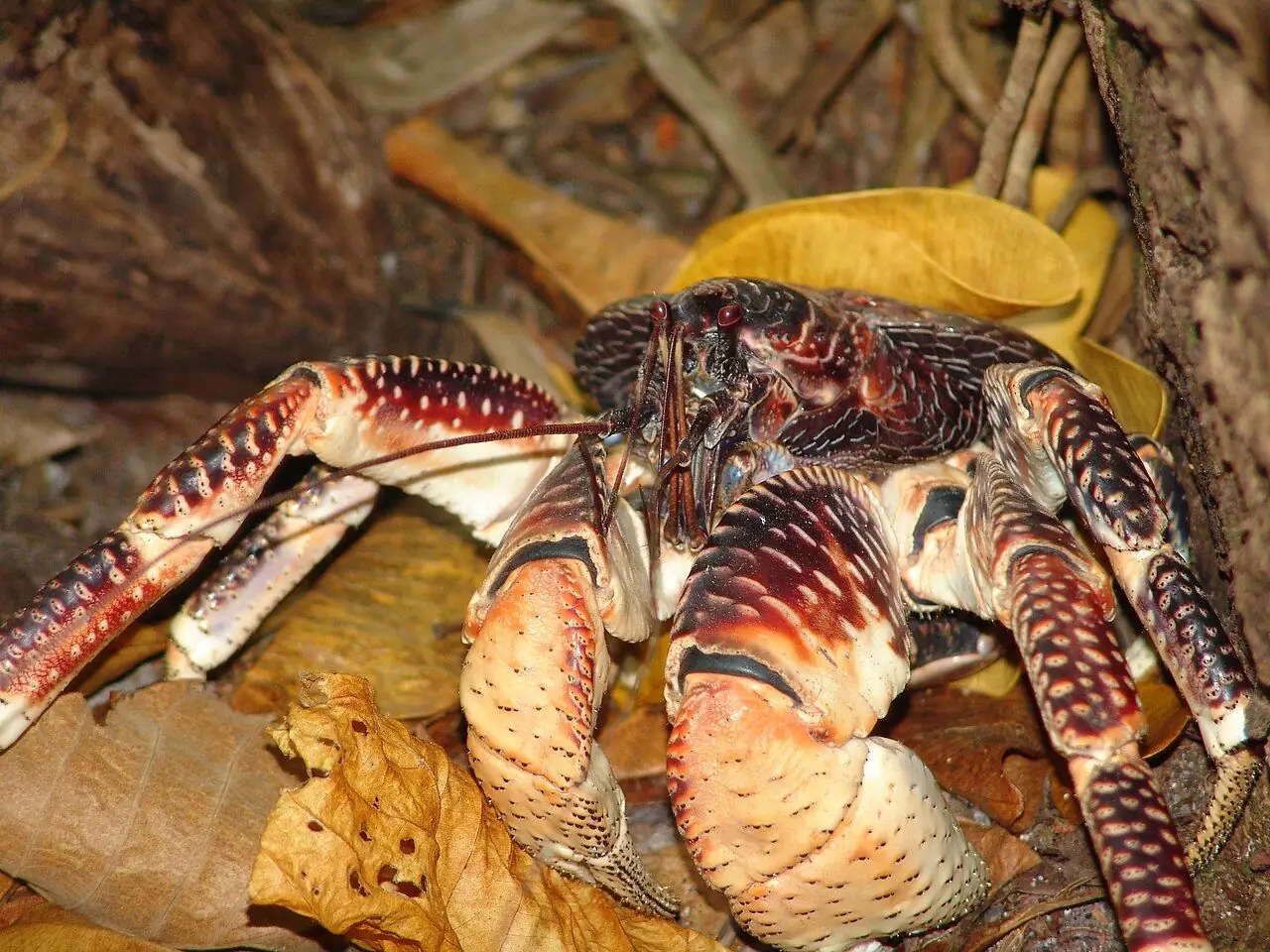
Coconut Crab
Birgus latro
The biggest land crustacean, a hermit crab relative that starts life drifting at sea, then lives on islands for 50 years or more.
Photo: Drew Avery / CC BY 2.0
3 things to know
- Young coconut crabs carry empty seashells like other hermit crabs, but adults grow a hard abdomen instead.
- Its larvae drift at sea for weeks before the young crabs move onto land, where they breathe air.
- A 4 kg (8.8 lb) coconut crab is estimated to pinch with about 3,300 newtons of force.
- Scientific name
- Birgus latro
- Depth
- At the surface
- Size
- Up to about 1 m (3.3 ft) from leg tip to leg tip; shell up to about 20 cm (8 in)
- Weight
- Up to about 4 kg (8.8 lb)
- Lifespan
- More than 50 years; a 2013 growth study suggests large crabs are probably over 100
- Diet
- Mainly fruit, seeds, nuts and the pith of fallen trees; also carrion, other crabs, rats and sometimes seabirds
- Where
- Islands of the Indian and Pacific oceans, from Tanzania and Mozambique east to the Pitcairn Islands
- IUCN status
- Vulnerable
- Depth zones
- Sunlight
Christmas Island National Park calls the coconut crab the world's biggest land crustacean, an animal that can weigh more than 4 kilograms (8.8 pounds) and measure up to a meter (3.3 feet) across. Most are deep blue, though some are red or purplish red. It is a giant relative of the hermit crabs: young ones carry empty seashells for protection, and adults grow a hard abdomen instead.
It is a sea creature mainly at the start of its life. Mating happens on land, and a female carries 50,000 to 138,000 eggs under her body, then wades into shallow water at high tide and shakes them loose. The larvae hatch as they touch the seawater and drift through four or five stages lasting about 17 to 28 days. Then they move into empty snail shells and head for land, where they develop lungs from the lining of the gill chamber. Adults live in burrows on islands from Tanzania and Mozambique east to Pitcairn, sometimes 6 kilometers (4 miles) from the shore.
They feed mainly on fruit, seeds and the pith of fallen trees, and they scavenge dead animals, including other crabs. Their claws are formidable. In 2016, Shin-ichiro Oka and colleagues at the Okinawa Churashima Foundation measured the pinch of 29 wild crabs from northern Okinawa, Japan. The strongest reached 1,765 newtons, and the team calculated that a 4-kilogram crab could reach about 3,300 newtons, far more than any other crustacean measured.
They take bigger prey too. In March 2016, Dartmouth biologist Mark Laidre was studying the crabs in the Chagos Archipelago when he saw one attack a red-footed booby sleeping in a tree at night; later, five crabs tore the bird apart. On a 15-kilometer (9-mile) survey on Diego Garcia he counted 1,000 crabs and no nesting birds.
Coconut crabs also grow very slowly. After tagging more than 1,440 crabs on Christmas Island, a team led by M. M. Drew reported in 2013 that large crabs are probably over 100 years old, which, the authors wrote, may have serious implications for a species that is still being exploited. The IUCN assessed the coconut crab as Vulnerable in 2018.
Sources
- christmasislandnationalpark.gov.au/discover/nature/animals/crabs/robber-crab
- animaldiversity.org/accounts/Birgus_latro
- sealifebase.se/summary/Birgus-latro.html
- Study: doi:10.1371/journal.pone.0166108
- sciencenews.org/blog/wild-things/coconut-crab-bird-attack
- Study: doi:10.1002/fee.1730
- Study: doi:10.3354/ab00523
- int-res.com/abstracts/ab/v19/n2/p129-141
- en.wikipedia.org/wiki/Coconut_crab



