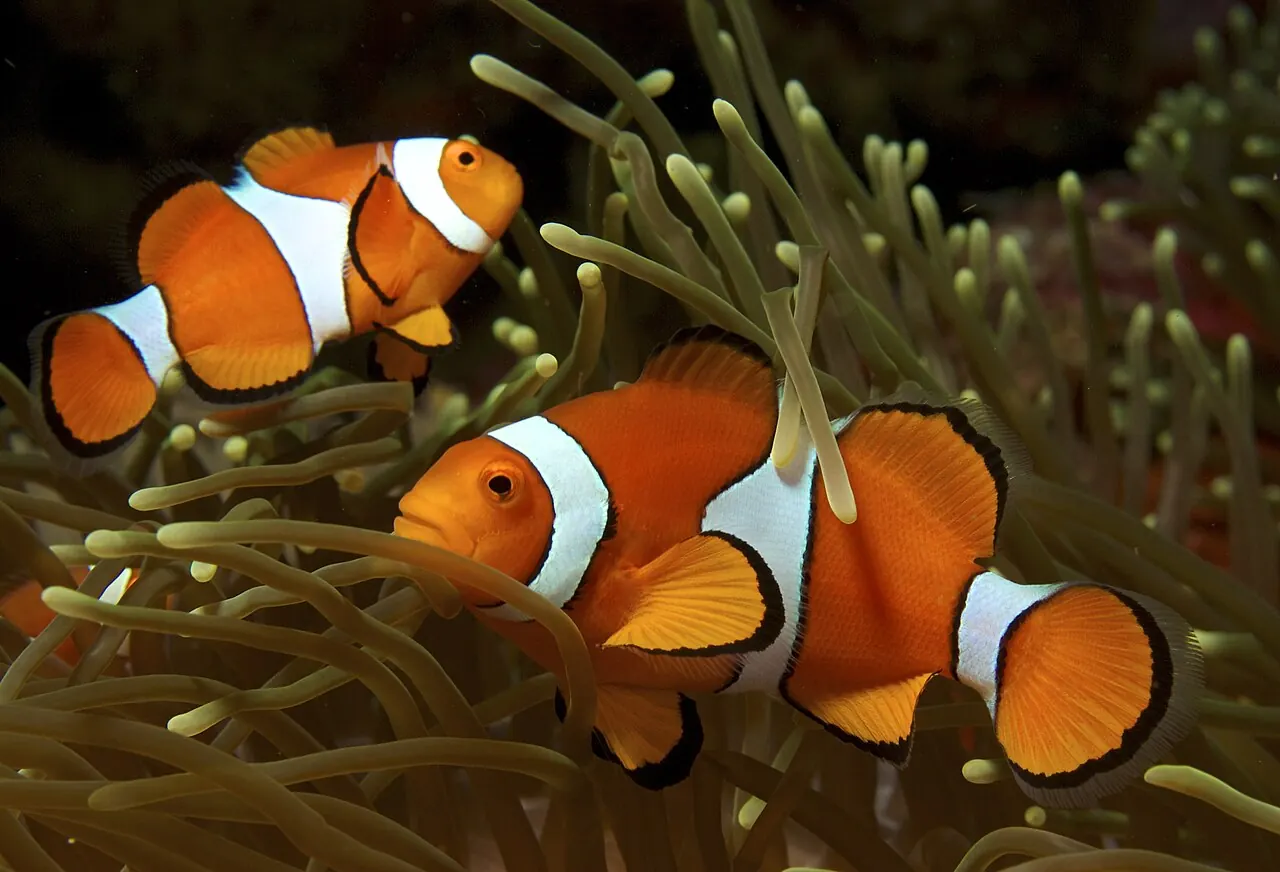
Clownfish
Amphiprion spp.
Small orange reef fish that live in stinging sea anemones, start breeding life as males, and turn female when the group's top fish dies.
Photo: Nick Hobgood / CC BY-SA 3.0
3 things to know
- Every clownfish develops into a male first and can become female later.
- A coat of mucus protects it from its anemone's stinging tentacles.
- In each anemone the female is the biggest fish and her mate the second biggest.
- Scientific name
- Amphiprion spp.
- Depth
- 1 m – 15 m
3 – 49 ft - Size
- Up to about 11 cm (4.3 in) in the clown anemonefish and orange clownfish
- Weight
- Not well known
- Lifespan
- Disputed; the Florida Museum gives 6–10 years in the wild, while a 2007 population model put the life expectancy of female orange clownfish at about 30 years
- Diet
- Algae and plankton, plus scraps from the host anemone
- Where
- Coral reefs of the tropical Indian and Pacific oceans
- IUCN status
- Least Concern (clown anemonefish and orange clownfish)
- Depth zones
- Sunlight
Most people picture one of two near-identical fish: the clown anemonefish, Amphiprion ocellaris, or the orange clownfish, A. percula. Both are bright orange with three white bands across the head, middle and tail, and both reach about 11 centimeters (4.3 inches). The tell is the black edging on the white bands, thick in the orange clownfish and thin or nearly absent in the clown anemonefish.
Clownfish live on coral reefs in the warm Indian and Pacific oceans, usually 1 to 15 meters (3 to 50 feet) down. The clown anemonefish ranges from Japan's Ryukyu Islands through Southeast Asia to northwest Australia, and the orange clownfish lives farther east, from Queensland to Melanesia. Neither strays far from its host sea anemone. A mucus coat protects them from the stinging tentacles, and a newcomer first gets used to its host by rubbing against them. They eat algae and plankton, and they pick up dead tentacles and scraps of the anemone's prey.
Rank depends on size. An orange clownfish anemone holds one breeding pair and up to four non-breeders. The female is the largest, her mate next, and the rest line up below. Every clownfish develops into a male first. When the female dies, her mate changes sex and takes her place, and the largest non-breeder becomes the new breeding male. In the clown anemonefish, lab work at the University of Illinois found that the brain of a male turning female changes first, while the gonads follow on their own schedule, sometimes years later. The male builds a nest on bare rock beside the anemone and guards the eggs, fanning them with his fins.
How long they live is unsettled. The Florida Museum gives 6 to 10 years in the wild. A 2007 study led by Peter Buston used one year of field data and a population model to estimate that female orange clownfish in Papua New Guinea have a life expectancy of about 30 years, twice the longevity estimated for any other reef damselfish.
Both species are listed as Least Concern. Collecting for the aquarium trade has hit some local populations of the clown anemonefish, which is also bred in captivity, including in Florida.
Sources
- fishbase.se/summary/Amphiprion-ocellaris.html
- fishbase.se/summary/Amphiprion-percula.html
- floridamuseum.ufl.edu/discover-fish/species-profiles/clown-anemonefish
- floridamuseum.ufl.edu/discover-fish/species-profiles/orange-clownfish
- Study: doi:10.1111/j.1095-8649.2007.01445.x
- Study: doi:10.1016/j.yhbeh.2019.04.002
- Study: doi:10.1098/rspb.2018.1295



