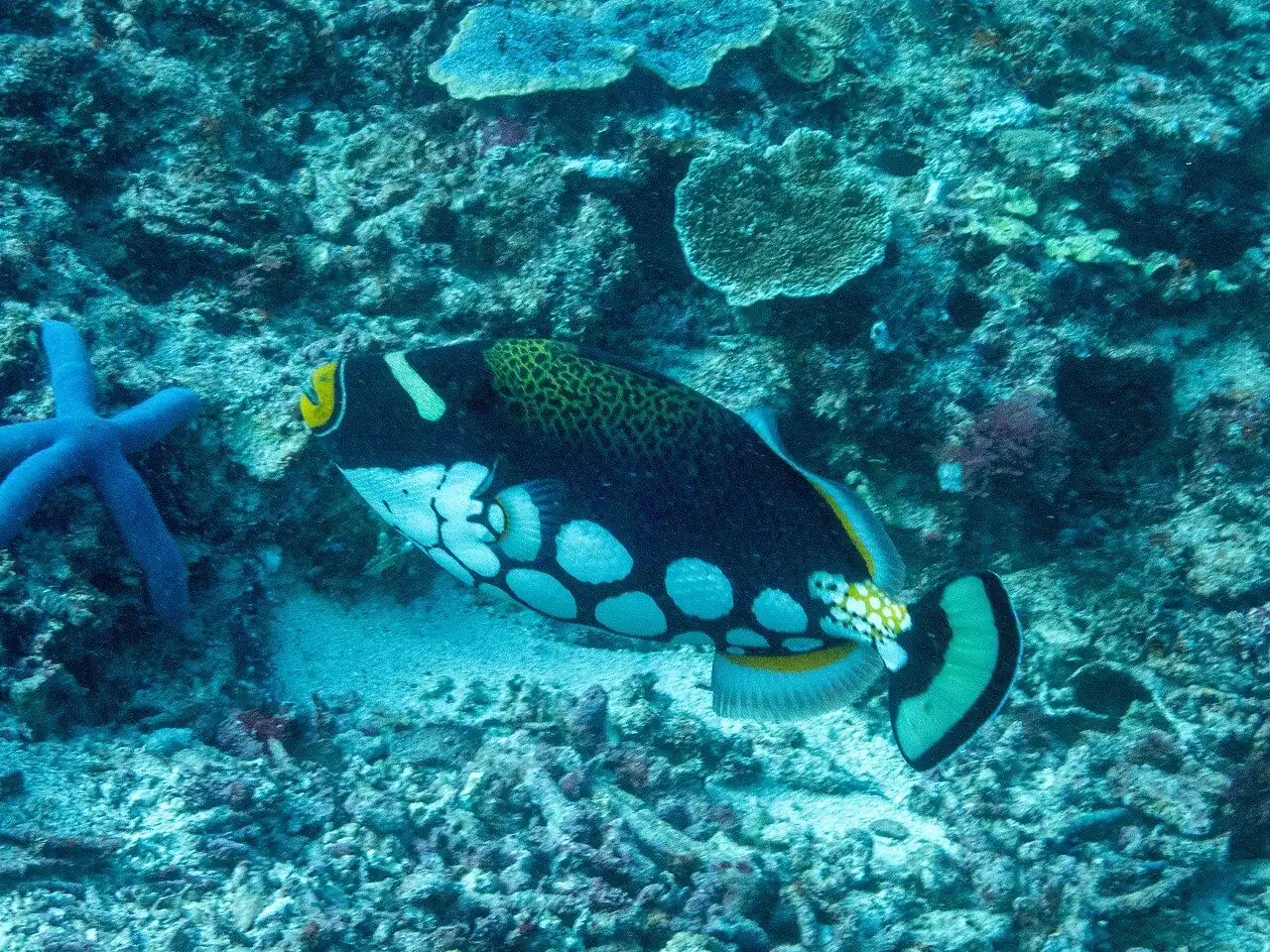
Clown Triggerfish
Balistoides conspicillum
A polka-dotted Indo-Pacific triggerfish of steep reef drop-offs that crunches sea urchins and crabs and can lock itself into a crevice.
Photo: Justin Philbois / CC0
3 things to know
- Its belly is covered in large white spots on a black background.
- Its species name, conspicillum, means spectacles, probably for the pale band in front of its eyes.
- A locking dorsal spine lets it wedge itself into holes in the reef.
- Scientific name
- Balistoides conspicillum
- Depth
- 1 m – 75 m
3 – 246 ft - Size
- Up to about 50 cm (20 in) long
- Weight
- Not well known
- Lifespan
- Unknown
- Diet
- Sea urchins, crabs and other crustaceans, mollusks and tunicates
- Where
- Indo-Pacific from East Africa east through northern Australia to Samoa, north to southern Japan
- IUCN status
- Least Concern
- Depth zones
- Sunlight
Large white spots cover the lower half of the clown triggerfish, set against black, while its back carries a yellowish, net-like pattern of dark spots. Its lips are orange-yellow, a pale band crosses the snout in front of the eyes, and another broad pale band crosses the tail. The species name, conspicillum, is Latin for spectacles, probably a nod to that band in front of the eyes. Adults reach about 50 centimeters (20 inches).
It lives in the tropical Indo-Pacific, from East Africa east through northern Australia to Samoa and north to southern Japan, at depths of 1 to 75 meters (3 to 250 feet). Its home is clear water on coastal and outer reefs, usually beside steep drop-offs with rich coral growth. Adults are solitary and swim in the open along the drop-offs, retreating into caves when approached. Juveniles are secretive, sheltering in small caves with rich invertebrate growth. FishBase describes the species as uncommon to rare across most of its range.
Like other triggerfishes, it is named for its dorsal spines. National Geographic explains that triggerfishes use a set of spines to deter predators or to lock themselves into holes in the reef. Pressing down a smaller trigger spine releases the lock. The clown triggerfish also has enlarged scales just behind the gill opening and above the pectoral fin that form a flexible patch FishBase calls a tympanum.
It feeds on bottom-living animals, including sea urchins, crabs and other crustaceans, mollusks and tunicates. It forms distinct pairs to breed, and spawning takes place in patches of mixed coral rubble and sand on clear seaward reefs.
It is among the most highly prized fish in the aquarium trade, and it is also sold fresh as food in some places, although FishBase notes reports of ciguatera poisoning from it. The IUCN lists the clown triggerfish as Least Concern, from a 2022 assessment.



