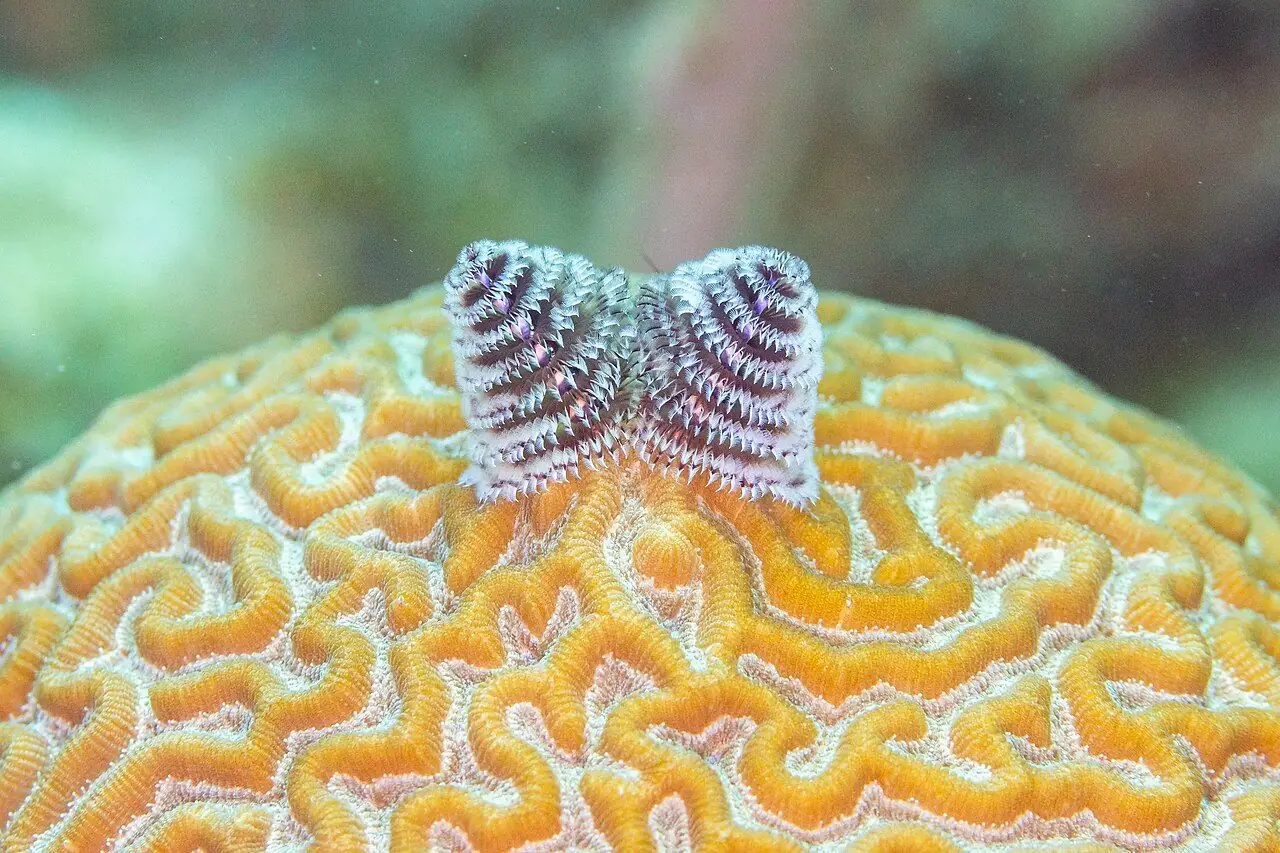
Christmas Tree Worm
Spirobranchus giganteus (Caribbean); Indo-Pacific Christmas tree worms belong to other Spirobranchus species, such as S. corniculatus
A coral-dwelling worm with two spiral crowns. Some live for decades, and on the Great Barrier Reef they appeared to help corals survive starfish attacks.
Photo: Diego Delso / CC BY-SA 4.0
3 things to know
- Its two spiral crowns are used for breathing and for catching food.
- Some worms are estimated to have lived more than 40 years in the same coral.
- At the Flower Garden Banks they have been seen spawning the same evening as the corals.
- Scientific name
- Spirobranchus giganteus (Caribbean); Indo-Pacific Christmas tree worms belong to other Spirobranchus species, such as S. corniculatus
- Depth
- 3 m – 30 m
10 – 98 ft - Size
- About 3.8 cm (1.5 in) on average; the hidden tube can reach 20 cm (8 in)
- Weight
- Not well known
- Lifespan
- More than 10 years for some; a few estimated at more than 40 years
- Diet
- Phytoplankton and other tiny particles filtered from the water
- Where
- Caribbean, the Bahamas, Florida and the Gulf of Mexico; similar worms on Indo-Pacific reefs belong to other Spirobranchus species
- IUCN status
- Not Evaluated
- Depth zones
- Sunlight
Two spiral crowns, each shaped like a tiny fir tree, are usually all anyone sees of a Christmas tree worm. They are made of feathery radioles that the worm uses both to breathe and to catch phytoplankton drifting past. The rest of the animal, a segmented worm about 3.8 centimeters (1.5 inches) long on average, stays inside a chalky tube buried in living coral. When something startles it, the worm snaps back into the tube and seals the entrance with a trapdoor called an operculum.
The name Spirobranchus giganteus was long used for Christmas tree worms on reefs around the world, but the World Polychaeta Database now says it should be restricted to worms from the Caribbean. Those live around Florida, the Bahamas and the Caribbean, about 3 to 30 meters (10 to 100 feet) down, according to Caribbean field guides. At the Flower Garden Banks National Marine Sanctuary in the Gulf of Mexico they are abundant, and they have been seen spawning on the same evening as the sanctuary's mass-spawning corals. Worms elsewhere belong to other species, such as Spirobranchus corniculatus in the Indo-Pacific.
Males and females release eggs and sperm into the water. The larvae drift for 9 to 12 days, then settle on coral and build a tube, which the growing coral surrounds. A worm stays in the same coral for the rest of its life. In 1996 Eijiroh Nishi and Moritaka Nishihira estimated the ages of Christmas tree worms, then identified as S. giganteus, by counting the yearly growth bands of their host coral in X-ray images. Some had lived more than 10 years, and a few more than 40.
The worms may also repay their hosts. After crown-of-thorns starfish swarmed reefs of the central Great Barrier Reef in 1983 and 1984, L. M. DeVantier and colleagues at the Australian Institute of Marine Science surveyed Porites corals at Potter Reef. All 15 colonies with worms survived with some living tissue, while 11 of the 16 colonies without worms had been eaten completely. Living coral persisted around the worms' tubes and was regrowing more than two years later. In preliminary field tests, some worms pushed their crowns and operculum against a starfish touching them, and the starfish quickly moved away.
Christmas tree worms have not been assessed by the IUCN.
Sources
- oceanservice.noaa.gov/facts/xmas-tree.html
- marinespecies.org/aphia.php
- reefguide.org/keys/spirobranchusgiganteus.html
- caribbean-diving.linnaeus.naturalis.nl/linnaeus_ng/app/views/species/nsr_taxon.php
- sealifebase.se/summary/Spirobranchus-giganteus.html
- sanctuaries.noaa.gov/pgallery/pgflower/living/living_26.html
- aquarium.org/animals/christmas-tree-worm
- Study: doi:10.2331/fishsci.62.400
- Study: doi:10.3354/meps032307
- oceana.org/marine-life/christmas-tree-worm
- commons.wikimedia.org/wiki/File:Gusano_%C3%A1rbol_de_Navidad_(Spirobranchus_giganteus),…



