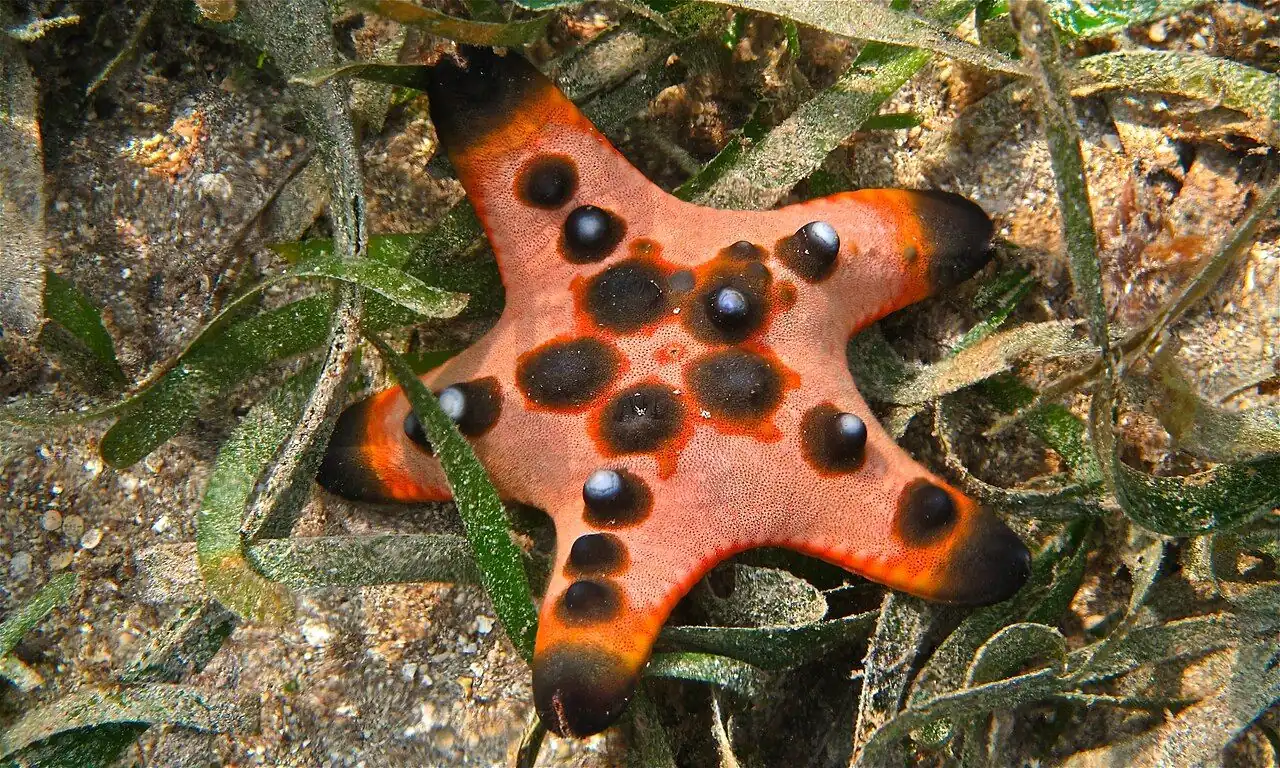
Chocolate Chip Sea Star
Protoreaster nodosus
A knobbly five-armed sea star of western Pacific seagrass beds, collected for aquariums, whose skeleton is built like a single-crystal lattice.
Photo: Bernard Dupont / CC BY-SA 2.0
3 things to know
- It is identified by a single row of dark knobs along the top of each arm.
- Juveniles live in seagrass 2 m (6.6 ft) deep or less; adults range down to 37 m (121 ft).
- Its skeleton is a microscopic lattice formed from a single calcite crystal.
- Scientific name
- Protoreaster nodosus
- Depth
- 0 m – 37 m
0 – 121 ft - Size
- Up to about 30 cm (12 in) across
- Weight
- Not well known
- Lifespan
- Estimated at up to about 17 years
- Diet
- Films of microbes and algae on sand and seagrass, plus living and decaying seagrass; some accounts add sponges and small invertebrates
- Where
- Western Pacific, from Thailand to Samoa and from Japan to New Caledonia (older sources extend it across the Indian Ocean)
- IUCN status
- Not Evaluated
- Depth zones
- Sunlight
A single row of knobs along the top of each of its five thick arms identifies this sea star, also known as the horned or knobbly sea star. Adults reach about 30 centimeters (12 inches) across, with a hard, heavy, calcified body. Most are red, orange or brown, but white, pink, blue and green ones turn up too. Despite the spiky look, it is not venomous.
It lives on sand, seagrass and shallow reef flats. In Davao Gulf in the Philippines, Arthur Bos and colleagues found adults from the surface to 37 meters (121 feet) deep, averaging 29 animals per 100 square meters in sandy and seagrass areas, while juveniles stayed in seagrass beds 2 meters (6.6 feet) deep or less. Most references give its range as the whole Indo-Pacific, from East Africa to the Pacific islands. In 2023, Frédéric Ducarme reviewed the literature, citizen-science photos and field surveys and concluded that it probably lives only in the western Pacific, from Thailand to Samoa and from Japan to New Caledonia, with no reliable record from the Indian Ocean.
It feeds by pushing its stomach out of its body onto the bottom, digesting films of microbes and algae along with living and decaying seagrass. Some observers report it scavenging or eating sponges and small invertebrates. Bos's team estimated that it matures at 2 to 3 years old and that the biggest animals, with arms 14 centimeters (5.5 inches) from the center, were about 17 years old. In Davao Gulf, spawning peaks from March to May, and on May 14, 2022, a group was recorded spawning together off Samal Island, two days before the full moon.
Its skeleton has drawn engineers. In 2022, Ling Li's team at Virginia Tech reported in Science that the star's skeletal plates are built as a microscopic lattice, repeating about every 30 micrometers, whose whole framework is a single calcite crystal. The structure substantially boosts the skeleton's tolerance to damage, and the team suggests it could guide the design of new synthetic materials.
People take these sea stars for the aquarium and ornament trade. They were once among the most common large sea stars of Malaya, and in Singapore they are now listed as Endangered on the national Red List of threatened animals. The IUCN has not assessed the species.
Sources
- sealifebase.se/summary/Protoreaster-nodosus.html
- wildsingapore.com/wildfacts/echinodermata/asteroidea/protoreaster.htm
- Study: doi:10.1007/s00227-008-1064-2
- Study: doi:10.21425/f5fbg56187
- Study: doi:10.3755/galaxea.g26-4
- Study: doi:10.1126/science.abj9472
- api.gbif.org/v1/species/5187269/iucnRedListCategory



