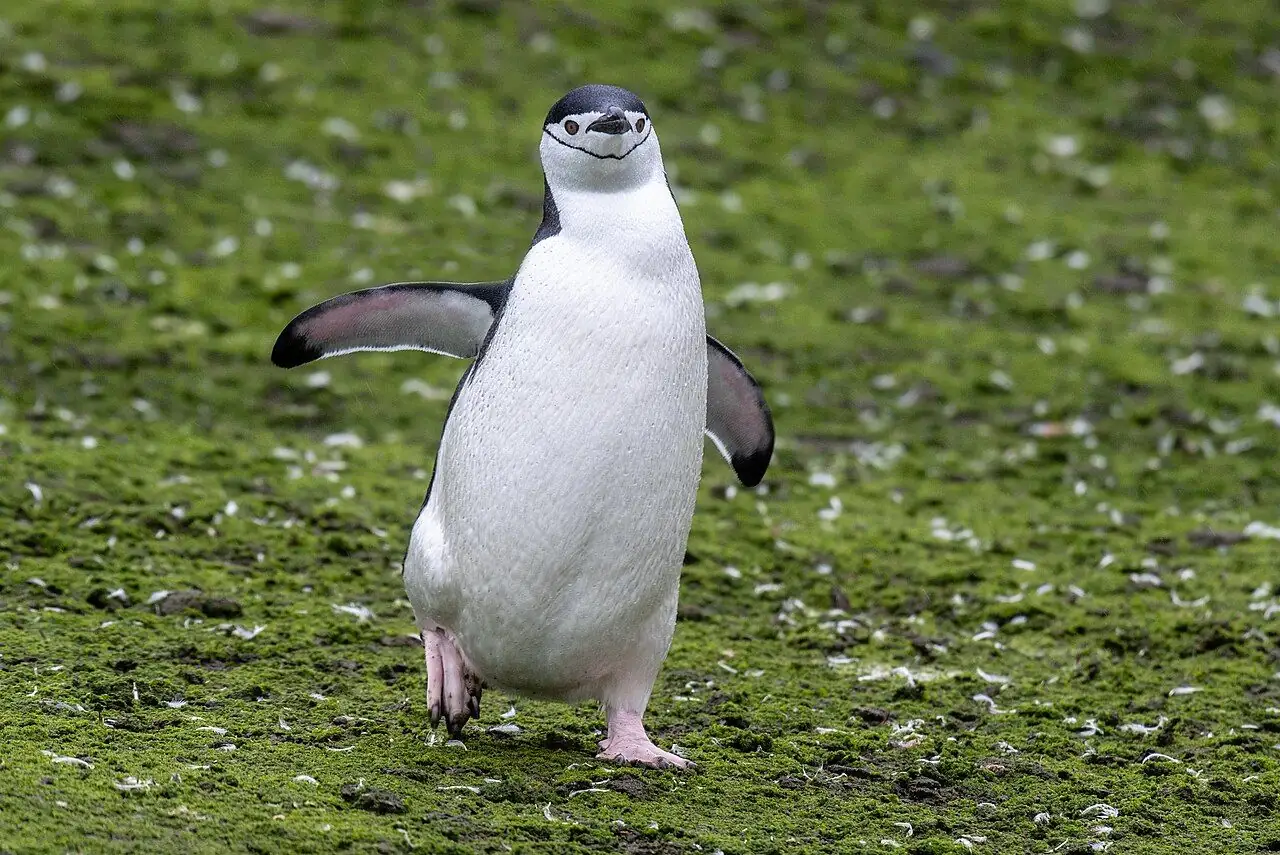
Chinstrap Penguin
Pygoscelis antarcticus
A krill-eating Antarctic penguin named for the black band under its chin, which sleeps in thousands of four-second naps a day.
Photo: Gordon Leggett / CC BY-SA 4.0
3 things to know
- A narrow black band runs under its chin from ear to ear.
- Nesting birds nod off more than 10,000 times a day, for about 4 seconds at a time.
- It generally feeds in water less than 40 m (130 ft) deep.
- Scientific name
- Pygoscelis antarcticus
- Depth
- 0 m – 40 m
0 – 131 ft - Size
- Stands about 72 cm (28 in) tall
- Weight
- About 3.5–5.5 kg (7.7–12 lb)
- Lifespan
- Up to about 16–20 years
- Diet
- Mainly krill, plus fish
- Where
- Antarctic Peninsula and islands of the South Atlantic, mainly the South Shetland, South Orkney and South Sandwich islands
- IUCN status
- Least Concern
- Depth zones
- Sunlight
A narrow band of black feathers running under the chin from ear to ear gives the chinstrap penguin its name. It is about the size of an Adélie, standing about 72 centimeters (28 inches) tall and weighing 3.5 to 5.5 kilograms (7.7 to 12 pounds).
Chinstraps breed mainly on the Antarctic Peninsula and on islands in the South Atlantic, chiefly the South Shetland, South Orkney and South Sandwich islands. Nests are built of stones. Each pair lays two eggs in late November, and both parents take turns incubating them for 33 to 35 days. The birds feed mainly on krill and fish, generally in water less than 40 meters (130 feet) deep. They can live 16 to 20 years.
A breeding colony is a hard place to rest. Brown skuas hang around the edges looking for eggs, and neighboring penguins are aggressive. Researchers from the Lyon Neuroscience Research Center, the Korean Polar Research Institute and Germany's Max Planck Institute for Biological Intelligence, with Paul-Antoine Libourel as first author, used data loggers to record the brain activity of wild chinstraps nesting on King George Island. Their results, published in Science in late 2023, showed the penguins nodding off more than 10,000 times a day. Each microsleep lasted only about 4 seconds on average, sometimes in both halves of the brain and sometimes in just one. Added together, the naps came to more than 11 hours of sleep for each hemisphere. Because these birds were breeding successfully, the authors suggest that the benefits of sleep can build up a few seconds at a time.
Chinstraps are still an abundant penguin in the Antarctic and sub-Antarctic, and the IUCN lists them as Least Concern in a 2020 assessment. The Australian Antarctic Division notes, though, that their numbers are declining significantly.
Sources
- antarctica.gov.au/about-antarctica/animals/penguins/chinstrap-penguin
- animaldiversity.org/accounts/Pygoscelis_antarcticus
- Study: doi:10.1126/science.adh0771
- mpg.de/21169426/penguins-nesting-in-a-dangerous-environment-obtain-large-quantities-of-…
- Study: doi:10.2305/IUCN.UK.2020-3.RLTS.T22697761A184807209.en



